Sunday, August 28, 2011

Kitten Teachings


A few weeks ago my neighbor here on the shores of Willapa Bay knocked on my front door. She was planning to leave the next day for a week-long trip. When I answered the door, she looked a little wild-eyed. "Florence," she said, "I'm sorry to bother you, but there are two kittens trapped under an abandoned house down the street. What should we do?" We walked down the street together, and soon we could hear desperate, high-pitched, piercing mews emanating from a dilapidated house.

Two impossibly tiny, nearly identical tabby kittens were in the crawl-space beneath the house, clinging to a small screened-in entryway and crying piteously. If kittens can scream, they were screaming. There are sounds that young mammals make in distress that are nearly impossible to ignore: the crying of a baby, the whimpering of a pup, the sound of hungry, frightened kittens. Wherever their feral mother had gone, she had been gone too long for them, or wasn't coming back at all. The sounds were unmistakably the sounds of little animals in extremis. I thought of my priest vows to be of benefit to all beings. It was too late to walk away. We looked at each other. "OK," we said, "let's do something."

We got a cat carrier, then went back to the kittens and tried to figure out how to extricate them from their crawl-space prison. With the help of another neighbor, we pried the screen off the small opening, and he crawled in. The kittens retreated, but were too small to go far. All we could see of the rescuer were his lower legs, but then his arm reached back to us, holding a trembling tiny bit of fur, blue eyes wide, striped legs spread wide. A minute later, another one appeared.

We popped them into the carrier and carried them back to my neighbor's house. They were very young, much younger than we had thought when we first saw them. Their blue eyes didn't focus, their ears were just unfurling and they wobbled more than they walked. We tried giving them milk (not a good idea, we later learned) but it was clear that they were too young to drink. They were trembling violently, clearly chilled, and mewing incessantly. Neither of us had any idea what to do. A call to the local rural animal shelter yielded only a recorded message.


We did what we all do these days, when faced with a dilemma: we went online. We learned that the kittens were perhaps just a bit over three weeks old, were almost certainly not weaned, and would need to be bottle-fed every few hours. They would not be able to maintain their own body temperatures and would need to be kept warm. They didn't even know how to urinate or defecate on their own. They were too young to go to a shelter, and might be euthanized if we tried. We should not have attempted to feed them - a chilled kitten should never be fed, and shouldn't be given cow's milk - our first big mistakes, blessedly irrelevant because they couldn't figure out what to do with the milk anyway.

My neighbor looked at me. We both knew she was leaving early the next morning. I had already promised to take care of her five-month-old Akita puppy while she was gone. "Of course," I said, wondering what my week was going to be like, wondering what I'd just promised to do.

So for the next week, with the help of my neighbor's kids and their father, I became a kitten mom. I coaxed them to eat, first unsuccessfully trying to feed them from a miniature kitten bottle filled with warm formula,  then from a mixture of warm formula and canned kitten food that they waded into and emerged from covered from paws to tail in what they were supposed to be eating. They would come straight to me afterward, to get warm, and then I'd be covered with formula and kitten food too. I washed them, I massaged their bellies to encourage them to defecate, I found them a surrogate mother to cuddle up to at night (a stuffed camel toy, just about the right size), I checked their heating pad every two hours. Mostly, I worried about them.


The first few days were the hardest. Although they'd had enough life force to get themselves into our hands and out from under the crawl space, I wasn't sure their life force would be enough to keep them going, especially in the hands of someone who had no idea what she was doing. The first night they spent at my house in their little cat carrier I barely slept. I kept wondering if I would wake to a dead kitten, or two dead kittens, and the thought seared me into wakefulness over and over again, listening for their small sounds. They were so fragile, so incapable of taking care of themselves. They had moved from the category of "other" and anonymous to the category of "beloved" in just a few hours.

That was the most extraordinary thing to me, to watch my own attachment develop so quickly, to care for them as if they had been in my life for years rather than hours. This seems to be one of the most basic of human capacities: the imperative to protect and care - for one another, for children, for wounded strangers, for the vulnerable and frightened. I could no more have chosen not to care for those kittens than I could have chosen not to breathe.


I was also shocked by how much I suffered over them, how completely neurotic I became, overnight. I worried about them nearly all the time. I felt responsible for their lives, moment after moment. A simple mistake on my part, a little carelessness, and they would be dead. I wondered how the parents of a newborn, or the parents of a sick child, stand that suffering. And here I must express my thanks to Cherie Kearney, who connected me to her friend Barb Hoover, a long-time foster kitten mom who gave me much-needed advice over the phone. Otherwise I might have gone right over the edge, not sure whether I was doing anything right at all. It turns out that it's hard to learn to take care of kittens via the internet (I'm sure the same could be said for babies) - I needed an old hand, and thanks to Cherie and Barb, I got one.

Then there were the moments when these tiny scraps of life curled together peacefully on my lap, small enough that I could hold both of them in my cupped hands, or when they clumsily climbed up on to the gigantic mountain of me, or when they looked into my face with their barely focused blue eyes. Then it was worth all the kitten food smeared on my clothing, and all the neurotic agitation. I could almost see the heart-strings that ran from my heart to their small faces.


And the miracles! They didn't know how to purr on Day 1. By Day 2 they were emitting tiny crackling noises. By Day 3 they were purring on my chest. They didn't know how to wash themselves on Day 1. By Day 4 they were swiping themselves with their paws, not very effectively. By the end of the week they'd learned how to wash everywhere but under their chins (that took quite a bit longer - weeks, actually!). I got them a miniature litter box and scratched in it with my fingers. One of them came stumbling over and started scratching too. Within a day they knew what to do in the litter box, and squatted there like real cats, looking a little puzzled but also pleased. I saw them wrestle together the first time, on about Day 3.  Their development was so rapid, it was like stop-motion photography, like a flower blooming, like the sun rising.

What had started out as bewildering and frightening became joyful and astonishing.


They - and I - survived the week. My neighbor came back and took them into her care with her kids' help. It was hard to let them go. They are now about six weeks old, and running around like little hellions. One's eyes are almost green, the other's still blue. We think they are both males, or maybe one is male and the other female (it's surprisingly hard to tell, graphic internet photos notwithstanding). My neighbor is still considering whether it's right to keep them - there are a lot of coyotes and raccoons around here, and kitties tend to be short-lived. If just the right home came along, someone who would take the two together, they might let them go. Otherwise, long-lived or short-lived, they do appear to have wormed themselves quite well into my neighbor's heart.

And I just donated to my local animal rescue group - HAVA - the Harbor Association of Volunteers for Animals- because the plight of kittens and puppies and dogs and cats and all the other creatures we take into our care, neglect, abuse, forget, abandon, has become vivid to me. I don't want kittens, any kittens, to starve under an abandoned house. All animals are these two kittens I cared for, deserving a good life, a chance to grow up and grow old.

I learned a lot from those kittens. I saw my ferocious protectiveness, my fear, my care, my capacity to love. I saw how life - any life - has a way of insisting, against the odds, on staying alive, on growing, on becoming. And beyond any words, our lives touched, intimately.

I will always be part of them, and they of me, however long they pounce and purr and climb in this precarious world.

May their lives be long, and bright, and lovely.


And a postscript, nearly a year later. I drove up to the house today, after being gone for several months, and was greeted by both kittens, now grown up and full of piss and vinegar. Here's a picture of one them.


Tuesday, August 2, 2011

Running the Edge of the World

Tokeland, Willapa Bay Southern Washington Coast ---


For the last sunny week or so I've been running barefoot on the big beaches to the north of here. Running's new - it's been a long time since I've been well enough to run - and running barefoot along the wet shiny salt-spray-and-wind edge of the continent is wholly new. The sand is packed hard from the breakers, almost as hard as pavement, and the shorebirds dash wildly into and out of the waves, just as I veer inland when a big wave comes in. Otherwise I like to run where the waves spread out into a fine mirror for the sky, my feet splashing in the shallow sheet of water.

Everything is reduced down to just a few "things", almost not things at all - sand    ocean    line of dunes   shorebirds   terns    sun   sky. There's a sense of edge, but not a hard edge - a constantly shifting, literally fluid edge.  Running the edge of the world.


James Swan, in his record from 1851 of the earliest white settlement of this part of the coast, writes about traveling along this very beach from Grays Harbor to "Shoalwater Bay" (now Willapa Bay). Inland were huge dark cedar and spruce forests, deep bogs, steep hills - but a person could drive a coach and four horses down the hard-packed open sand. Washington beaches are still classified as "public highways" - a legacy of the time, not so long ago, when they were the only way up and down the wet and wild Pacific coast.

I say "this very beach" but the beach I've been running on is called Washaway Beach. It's the fastest eroding shoreline in North America. What is beach now was once land, just a few years ago. Hundreds of feet of coastline a year disappear into the ocean, houses that were once well inland now stand tipped nearly over the edge of the sandy bank, the entire town of North Cove (church, coast guard station, cemetery) occupied a sandy peninsula now entirely underwater, where Pacific waves break at low tide, the graves moved inland, bones and headstones and all. Where I run this year will be ocean next year, the edge moving inexorably inland.

So what beach do I run on? Do I run on James Swan's beach? Where is the edge?


This time of year the shorebirds are just beginning to return from their far northern nesting grounds, some to stay here for the winter, others to go south south south, unimaginably far south. They're tired. Today I saw a whole group resting beside the waves, little white balls of feathers, heads tucked in, a gull presiding over them. I run a long way around the shorebirds. The last thing they need is to have to fly unnecessarily, after what they've been through. I cringe when I see a dog on the beach, joyously chasing them.


Right now it's all semipalmated plovers and sanderlings, the plovers gazing meditatively off into the middle distance, the sandlerings running like wind-up toys back and forth from one good feeding area to another, flying up together like a school of silvery fish flickering in the air. It took me about a half an hour to move slowly slowly up to a group of sanderlings today, to get close enough to see what they were with my small binoculars, but slow enough not to spook them.


This is why I don't want to spook them - the plovers have just arrived from their nesting grounds in the Arctic and subarctic, and they're headed south for the winter. Some of them are headed to....hang on to your hat here....Patagonia. More of the sanderlings stay around for the winter, but they nest even farther north, only in the High Arctic above the Arctic Circle, and some of them migrate 5,000 miles or more to South America. This is serious flying for birds smaller than a robin. I don't even travel that far, wanderer that I am.

So the shorebirds and I share the beach, all of us travelers, here for a little while before we head south, and the beautiful Caspian terns fly overhead staring into the water and croaking "like a crow being strangled" (as a friend of mine described them). When it's windy the dry sand moves in a fine sheet across the hard-packed wet sand, and the effect is mesmerizing, like running in a shallow desert river.

There is a joy that can seize a person in a place like that, running in the wind in all that space and light. I'm not sure where it comes from, or why it arrives. The spirit grows wide, spreading itself out. There's nothing outside that brightness, for a while.


Saturday, March 12, 2011

All At Once


Isn't it strange, the way so many things are happening at the same moment? At this moment,as I write this or you read this, an inconceivable number of events are occurring: someone is experiencing the greatest happiness, another the greatest grief; there is an avalanche cascading down a mountain slope and somewhere else a light rain has begun to fall; a small creature is being born and another creature is dying; a new star is forming, and somewhere another star is winking out, its light and heat fading away into darkness. All at once.

Yesterday and the day before I experienced this mystery with particular vividness. Thursday night I was reading from Wildbranch at a local bookstore with two of the book's contributors. It was a lovely night, and local friends came out to hear us. I shared a story from a reader of the book, who had told me that she had given up reading environmental literature because it was too depressing, but she had realized that Wildbranch was about love, love and intimacy with our world, and love is a more potent force for action than despair. I felt so happy about the book and what it offers, so happy to be sharing it and reading from many contributors.

I came home from the reading to the news of the earthquake and tsunami in Japan, which had happened as we read. 

I was up much of the night, knowing that there could be a tsunami on the west coast of North America, and concerned for my little retreat cabin a few feet above high water on the Washington coast, my neighbor and her children, and my sweet friends who were staying in the cabin that night. I knew enough about tsunamis to know that they can cross whole oceans in a matter of hours without much diminution of their force. I knew that the county had called for an evacuation of all houses at sea level, including mine and those of my neighbors.


Several of us at the reading had arranged to go hiking the next day. The next morning I left for the hike before the time that the first major waves would come ashore. I had reached my friends who were staying at the cabin, and they had left and driven back to their own home, safely above sea level, but I didn't know what would happen to the cabin and the small community around it, all of which sits just a few feet above sea level on a narrow peninsula on Willapa Bay, a stone's throw from the open ocean and the roaring surf. I've always known that it is vulnerable to an event just like this one. Would this be the time?

Then, for the next few hours, I was hiking and looking at spring wildflowers, and I don't know what happened, except that the four of us on the hike fell into a kind of grace, one of those times of magical ease and beauty, unlooked-for, unrepeatable, perfect.


It was a clear, sunny spring day after rain, the air soft and subtly misty, the ground exhaling its moisture. Our trail started high up on Mount Tamalpais, then descended the open west-facing slopes of the mountain, views far out over the ocean, north to Bolinas and south to the very tops of the towers of the Golden Gate Bridge. The grass - not just the grass, but everything, every tree, shrub, herb and moss - was deeply, brilliantly green, the hallucinatory green of March in the coastal hills. After a while the the trail entered the redwoods and turned upward again, following waterfall after waterfall back up the mountain, up mossy stone stairways.


Some of us in our little group of four knew each other well, over many years; others were just acquaintances. Two Zen practitioners, three writing teachers, one botanist. What we shared was our love of literature and the natural world, and this moment together. We talked and walked and admired flowers and mushrooms and the light through the redwoods. We took photographs and shared gingerbread and homemade coffee cake by the side of the creek. We told stories. We wandered on and off the trail. I left my walking stick by a flower and then it reappeared, leaning against a railing on an entirely different trail. The day unfolded with a kind of ease that only happens now and again, in dreams or, if we're lucky, for a few hours in waking life.

The whole time I didn't know what had become of the only place I can call home, whether the sturdy little white cottage underneath the Sitka spruce was filled with muddy water as I walked the hills, or still sitting quietly in the rain, unharmed and whole. Or what might be happening in Japan or elsewhere all along the edge of the Pacific. There was nothing I could do, but I didn't forget, and it gave a subtly different feeling to the day for me, a kind of strangeness that made the light more brilliant and the grace more poignant.

When I got back to town, many hours later, I heard from my neighbor that everything was fine. She talked about how the day had been for her, also not knowing, waiting, and the gratitude she felt for the simple gift of being fine, of having a house and safe children, of making a pot of soup and starting a fire in the woodstove. How often do any of us remember to be grateful for our lives as they are, in all their ordinary details?


Meanwhile, across the ocean, thousands of people are still missing. Tonight, as I write this, people are huddled in makeshift shelters, mourning their homes, their friends and relatives, their pets, the lives they once had - lives that can be rebuilt but which will never be the same. And I sit here, still bathed in a sense of well-being from my day in the hills, feeling happiness for what was not destroyed in my life. These things exist side by side, utterly connected and yet also independent of one another.

I read tonight that the Dalai Lama has asked people in Dharamsala, the home of the Tibetan government in exile for more than fifty years, to chant the Heart Sutra 100,000 times for the people of Japan and all who are suffering disaster.

The Heart Sutra says "form does not differ from emptiness, and emptiness does not differ from form." Another way of saying it is that I am, at the same time, both an individual with a history and an experience that is uniquely my own, and completely connected. I am affected by an earthquake across an ocean from me, and yet walked the hills as others suffered and died. We breathe air that has been in the lungs of a lion, the stomata of 300-year-old coast live oak, the nose of Buddha, but when we breathe, only we can breathe our breath, this one irreplaceable, unrepeatable breath

And on the day I die, there will almost certainly be someone walking those hills I walked yesterday, bending to look at a wildflower, smiling at a friend, breathing in the clean ocean air. We will share that moment, not knowing each other, linked inextricably.


Friday, January 21, 2011

Ode to a Favorite Place


It's been a long time since I've written here: I've been preoccupied with promoting the Wildbranch anthology (several great book readings, in San Francisco and Portland), working on a new book of Buddhist koans and stories about women, and organizing and helping to lead a women't retreat up in Washington. It's been a project-full time!

But today is a fabulously beautiful spring day in Marin County. I walked downtown from my aerie amongst the oaks and the hawks, down through the dark, cool redwoods and the creek in Blithedale Canyon, then into the quiet village of Mill Valley. I saw a friend for green tea and apple pie, then walked back through the canyon and up the hill again. Although it's not yet the end of January, we're having true spring weather. The grassy hills are ludicrously green, daffodils are in bloom, and everywhere the spring annuals are sending up leafy shoots.


I'm often astonished that I am able to live here, even if I can only afford to be here for a few months out of every year. The beauty of this area has never grown commonplace to me. Every time I see the Golden Gate Bridge from the hills behind my place, miles away, fog drifting between the towers, I'm amazed all over again. Every time I look out my window to the peak of Mount Tamalpais, or get out of my car in the evening to quiet moonlight, I'm grateful.

And the people! Marin is still a place for eccentrics and artists and meditation junkies, surviving like relic trees amidst the Lexus SUV's, and I seem to have the luck to meet them every time I turn around.

What inspired me to write today is a quote in a book by Gary Thorpe, a sort of neighbor in Marin, fellow Zen practitioner, writer, and naturalist. I don't know Gary, but I feel like I should - we've probably passed each other on the trail and sat in the dark together at Green Gulch, never knowing it. The book is a collection of short essays about Gary's quest to see a mountain lion, Caught in Fading Light. Here's the quote that caught my eye:

"Marin County, where we live, is a wonderful place to look for something. It's a land of wilderness, parks, marine sanctuaries, farmlands, small villages, and manageably sized cities. Here one can find an abundance of wildflowers and mushrooms, along with meditation centers and ethnic restaurants. There are elephant seals, car dealerships, redwood trees, high-tech industries, rare falcons, and imprisoned felons, all sharing one of the loveliest landscapes and coastlines anywhere."

This quote reminded me of another paean to Marin Countyin Alan Watt's delightful autobiography (remember Alan Watts, the first popularizer of Eastern religions?), In My Own Way. Alan spend the last decades of his life in Marin County, some of that time on a houseboat in Sausalito, and here's what he wrote about it in 1972. Now, admittedly, Marin was a little bit wilder then (in every possible way) but I detect the same spirit even now, and many of the people who were here in 1972 are still here, tucked away up the canyons. Some of them are my neighbors!

"Here in San Francisco and Southern Marin we have succeeded, more than anywhere else in the United State, in curbing the White Anglo Saxon Protestant subculture of the nation, though our slight margin of victory requires incessant vigilance...By virtue of its hilly landscape, its redwood forests and eucalyptus groves, its wayward coastline, its liberally bohemianized population, the peninsula of southern Marin has attracted imaginative people from all over the world...it has also become a powerful spiritual center of the nation, as befits the fact that its geographical center is a mountain holy to the Indians...Though not much more than twenty-five hundred feet high, Mount Tamalpais rises almost directly from sea level...Seen in the first light of dawn...the whole mass of hills, valleys, and canyons with their forests. groves, meadows and giant rocks confers an atmosphere of strange benificence.

Extraordinary people live upon it... There are mountain lions, bobcats,and deer galore, and wild goats and eagles and vultures and racoons and rattlesnakes and gophers... All these and many more wizards, yogis, artists, poets, musicians, gardeners and madmen cluster about this mountain."

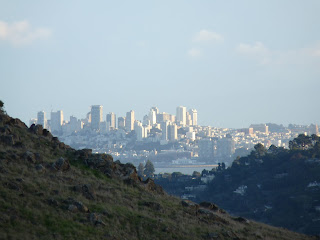
So there you have it. My friends might wonder why I keep being drawn back to this place, so far from my home ground of the rainy Northwest coast. It's the light of the January sun, my 95-year-old neighbor who traveled the world as an adventuresome entomologist, the joy of walking beneath old coast live oaks draped in lichen, the library beneath the redwoods, the shorebirds by the tens of thousands, the Buddhist meditation groups in every nook and cranny (including my own household!), the beautiful white city shimmering to the south. And I do have a soft spot for mountain lions and vultures and wizards and poets and gardeners and madmen... (might even be more than a little bit one of the latter myself).


I've been thinking about gratitude, and its power to transform our habitually whiney minds into happy minds. Gratitude for place seems like a important kind of gratitude, at least for me. To bow down and kiss the ground, whatever that ground might be - granite or concrete, dirt or sand or duff or garden bed. Beauty everywhere.

And although it's true that I don't exactly live anywhere, I feel grateful for the many beautiful places that are part of my life, from the soft shoals and light of Willapa Bay, to the tawny slopes of Mt. Tamalpais, to the tremendous spaciousness and wilderness of the Mojave Desert. Even my hometown in the Midwest, with its gracious old houses and tropical summer heat, deep green - where in the world is there NOT something to celebrate of the place where you stand?

If you feel like writing a response in the comments, something about the place or places you love, please share.

Friday, December 17, 2010

Poetic Interlude: Winter on Mount Tamalpais


Mist covers the mountain today
houses nestled in the folds of the hills,
half hidden by trees,
a Chinese landscape scroll outside the window.
All day they're cutting a huge fir across the valley
first, branches, till the tree stands bare
then, piece by piece from the top.
I miss the moment
when it no longer stands at all
clouds hide the sight.


Monday, October 25, 2010

Abundance and Diminishment, Diminishment and Abundance


This afternoon I shopped at Whole Foods, the aisles just brimming over with the beauties of the world: rare and tasty cheeses, the finest carefully-chosen organic vegetables glowing in artfully arranged piles, forty different artisan breads made by hand from stone-ground flour, Fair Trade chocolates from around the world (chocolate and lavender, chocolate and chile, chocolate and espresso beans). The food of gods and goddesses, and I'm one of them, grateful and amazed, even as I know that this abundance can only be temporary, in a world of such disparities, where so few have so much and so many have so little.


When I was a kid growing up in Terre Haute, Indiana, we shopped at the A&P grocery on 9th St - Wonder Bread, Hostess Twinkies, old wilted broccoli (who wanted fresh vegetables when canned and frozen lasted so much longer?), Folger's instant coffee.

"Organic" didn't exist.

The Wabash River flowed through town and an abandoned park on the river was my favorite haunt, but the river was so polluted that in all my years there I never dreamed of touching the water. Now my hometown has a restaurant where all the food has been grown or raised within one hundred miles, people catch and eat fish from the river, and The Nature Conservancy is working to protect the riparian forests of the Wabash which is - to my astonishment - the longest free-flowing river east of the Mississippi, an ecological treasure, a jewel.


Meanwhile, every day there is another story about the disappearing fish stocks in the world's oceans. Meanwhile the song birds are coming back from migration in fewer and fewer numbers. Meanwhile...well, you know the stories, you read them too. When I'm with a group of like-minded friends, sometimes we trade these stories, a badge of our shared despair. I've begun to wonder if this is helpful, for the song birds or for us.

When I was working in Southeast Alaska this summer, I saw abundance that seemed far beyond anything I'd ever known. The inlets and waterways were filled with diving murrelets (endangered south of Alaska), auklets and puffins; the streams were full of silver salmon; humpback whale spouts could be seen in all directions; every kelp bed was filled with flipper-waving sea otters. On land the deer barely bothered to lift their heads when we entered their rich sedge meadows; bear sign was everywhere (I would have been happy with a little less bear sign); and sandhill crane pairs trumpeted from their nests in secret muskegs.


It was wonderful and encouraging, and it would be easy to stop here, to write a few elegiac words about how the whole world must have once been like this - but it's not so simple. Here are a few examples of the not-simplicity of the abundance I saw....

Until a few years ago, there had been no sea otters in Sea Otter Sound for a hundred years or more - they had all been hunted out by the Russians and the English and anyone else who appreciated the warmth and value of otter-skin coats. Thanks to the Marine Mammal Protection Act and tireless work by biologists and others, they're back, more every year, but the local people say that they're eating all the shellfish, and the shellfish beds are barren and empty now.


The bears and deer move through a landscape that has been decimated by some of the most rapacious clear-cutting ever seen on this planet. The Tongass National Forest was, between the late 1960's and the late 1990's, nothing short of a national sacrifice area, its vast dark forests of old growth hemlock and Sitka spruce merely fodder for two huge pulp mills on the mainland, its landscape scarred by thousands of miles of roads. Our national heritage was sold for a pittance, a tiny fraction of its worth, to keep those two mills turning out toilet paper and newspaper - toilet paper no doubt sold at the A&P in Terre Haute, Indiana - and to keep the owners of those mills providing large donations to Alaskan politicians.

A small group of activists. local subsistence-based people, biologists and foresters fought to stop, or at least mitigate, the damage, and they won. The cutting on Prince of Wales Island has largely stopped (except, ironically, on native-owned lands.....that's a whole other story).


One biologist I know, who has been working on Prince of Wales for eighteen years, said he had never seen so many bears before. The bears are coming back, the forests are coming back, with each storm the land reclaims another road.

Some of the salmon I saw in such abundance are hatchery stock, moving upstream to where they were born, where they will be milked of their eggs before being hit over the head and their carcasses dumped nearby. The bears like this a lot.

Our fingerprints are everywhere, doing good, doing harm, one step forward, one step back. Sometimes we don't even know if it's good or harm, or both. Even as I write this on this rainy night, I look out on to the dark slopes of Mount Tamalpais. I am spending the winter here again because I love being in a place where open space is a stone's throw from where I sleep, where mountain lions and red-shouldered hawks are my neighbors.


Mt. Tam from outside my window

But Mount Tamalpais was - and continues to be - saved from urban sprawl by generations of wealthy or influential (or both) peope who fought and fought to protect it, some of whom are probably shopping at Whole Foods right now, debating with themselves about which fish is most "sustainably harvested" for their Saturday dinner.

The world of owls and whales and otters may be in big trouble. I suspect it is. We, goofy troublesome primates that we are, may be in very big trouble, and I'm almost certain we are. But some of us have the will and energy to fight for the world, and the world has immense powers of recuperation, of renewal, even as we mess with it in our various ways. I don't even pretend to understand what's going on, but I suspect that abundance and diminishment, kindness and rapaciousness, damage and renewal walk together.

I do know this: the rain and wind that soaks the hills tonight and that brings such misery to those without homes in the streets of San Francisco will also bring the salmon up the streams to dance their old dance above their redds again. And the willow saplings planted along those streams by a hundred volunteers will take root in the wet, take hold, begin to grow.


P.S. Let's continue the conversation...if you post an online comment, I promise to respond.


Thursday, September 9, 2010

Southeast Alaska - Second Glimpse: The XtraTuf State


A few weeks before I left for for my field work in Southeast Alaska, I was on a conference call with the four other biologists on the crew, all of whom had logged serious field time in Alaska, from seabird surveys in the remote Pribilof Islands to laying out huge timber sales on the Tongass National Forest. I was the newbie, the innocent, the lower-48-only idiot. I had no pride to lose, so I asked, “Hey, what is the best footwear for working in Southeast Alaska?”

The response was unhesitating and simultaneous: “XtraTufs, preferably with corks.”

I was not quite willing to admit at that moment that I had no idea what XtraTufs were, but I jotted the name down (Extra-Toughs? Extra-Tuffs?) in my little notebook with all the other tips (full working-man’s raingear – none of that Gore-Tex crap – boot dryers, fleece gloves with neoprene palms for the devil’s-club, Rite-In-The-Rain field paper….)

I was going to be PREPARED, by gum. I did know what corks were, though I’d never worked in them: they’re a set of wicked spikes that fit into the bottom of the sole of the boot, designed to grab on to slick logs so that you don’t go head over tea-kettle into the aforementioned devil’s-club.

(A digression here: devil’s-club, Oplopanax horridus, is a well-named Dr. Seuss-like being with enormous spiny leaves atop a long, bare spine-studded stem. I knew it well from the West Cascades of Washington, but only when I got to Alaska did I see devil’s-club growing in thickets tall enough to hide a basketball star. It seems to prefer steep slopes where an unwary sliding biologist will be likely to grab the spine-festooned stem as a last resort.)


An innocent-looking patch of devil's-club

I wasn’t so sure I wanted corks, especially after I heard stories of neophytes putting the spikes through their own raingear and shins, but I was determined to get XtraTufs, whatever they were. I went online and read this: “XTRATUFs are American-made neoprene boots that provide 100% waterproof protection with all-day comfort for the MOST SEVERE fishing, farming, and work conditions.” Sounded like the conditions I was heading toward. They looked like an expensive version of a basic rubber boot, but if my experienced Alaskan co-workers said I needed them, then clearly I needed them, and no questions asked.

Finding them – and extra-tough raingear to go with them -turned out to be another story altogether. I don’t want to go into the embarrassing details here, but I’m on the small side. I have been called (in a friendly manner) “height-challenged”, and I often save money by shopping in the children’s section of REI.

I quickly discovered that the iconic tan and brown XtraTufs are found primarily in marine supply stores, the kinds of places that cater to commercial fisherman and aspiring stars of “The Deadliest Catch”. Ditto for heavy-duty raingear. Now I KNOW there are women and children on boats all the time, but tell that to the makers of these things. In their world, all human beings are at least six feet tall and weigh over two hundred pounds. I could have fit at least two of me in the men’s extra-small rain bibs, and for a while it looked like my search for the essential XtraTufs might fail altogether.

Eventually I found a store that carried the smallest possible size of XtraTufs – men’s size 5 – and by some miracle, and with heavy socks and a pair of insoles – it seemed that they more or less fit me. I walked out the proud owner of the indispensable Alaska boots, and in retrospect, I shudder to think of how I would have felt if I had been unable to procure XtraTufs. I had no idea of their role in coastal Alaskan culture. Those of you who have been there are surely nodding knowingly now.

I will say that the raingear search was harder. Five marine stores in three different towns later, I was about to surrender and buy bright pink little girl’s raingear. I knew it was silly to care, I knew a Buddhist practitioner should be beyond “praise and gain”, but it was really hard on my dignity as a field biologist to imagine showing up in bright pink raingear. On the other hand, showing up without any raingear at all seemed like a truly bad idea.

In desperation, I spent two hours combing through a vast supply of raingear seemingly designed for Mr. Universe, until I found bright blue bibs and a jacket that I thought I could wear without tripping over my own hems or losing my hands inside the sleeves. I was quite pleased with myself, since I had avoided the deadly pink raingear, but I must admit that just the other day I put on the bibs for a walk in the rain with friends, and my friends burst out laughing. I have the sneaking suspicion that I looked like a large, overly ripe blueberry up there in the Alaskan rainforest. Maybe the only reason that the bears left me alone was that they were doubled up with laughter at the sight of me.

Photo by Emily Drew

Thus armed with a ridiculous quantity of brand new outdoor gear, I journeyed north, by Alaska airlines to Ketchikan, then by ancient float plane to Prince of Wales Island. I brought hiking boots along with my XtraTufs, because I’ve always worked in hiking boots and I couldn’t imagine that they wouldn’t be appropriate somewhere, sometime. But they weren’t.

Nothing made it clearer just how wet this part of the world really is than discovering the astonishing, absolute necessity of high waterproof boots at all times. Years ago I did wetland delineations, using plants and soil to identify boundaries of wetlands. I’m pretty sure that a wetland delineator could draw a great big circle around Southeast Alaska and call it good. There are dryer forests there, but even dry forests are covered with a dense, deep layer of sopping wet moss – moss everywhere, on the ground, on fallen logs, on upright logs, on rocks….like an emerald green blanket thrown over anything remotely horizontal. In fact, not only did I wear my boots all the time, I wore raingear nearly all the time too, rain or no rain. The first time I crawled over a big moss-covered log with no raingear on was my last.


XtraTufs doing their stuff in a mudflat

Within days I discovered - and I’m really not exaggerating much here at all - that no one wears anything on his or her feet, at any time, other than XtraTufs. Not just my seasoned field crew, but everyone. Not that we saw many people, but those we saw had XtraTufs on. Outside fading, dilapidated cabins, you could see a line of XtraTufs on the porch, matching the sizes of the men and women inside. In fact, I remember, on our last day, checking in with the floatplane company, and seeing a young, very pretty, very chic, well-dressed woman, waiting for the plane too. What was she wearing on her elegantly crossed feet? ExtraTufs, turned fetchingly down at the ankle. She made XtraTufs look like the sexiest thing north of the Canadian border.

I’ve even had a fantasy that babies have been conceived in Southeast Alaska by parents wearing nothing but XtraTufs (giving “rubbers” a whole new twist).

Here’s the funny thing, after all: XtraTufs are not all that great in the woods. Their soft and flexible neoprene provide little ankle or arch support, which are real issues when a person is on his or her feet for many hours a day, covering miles of uneven, very slippery, sometimes steep terrain. Sometimes I’d be going downhill through the endless little muddy streams and sphagnum, wincing as I twisted one ankle or the other about every five minutes. They’re probably great on a fishing boat, but a fishing boat is a far cry from the woods. A good pair of ordinary rubber boots would have probably been better. Nonetheless, I cringe to think of myself pulling out my cute little bright blue rubber boots (and oh, wouldn’t they have been fetching with my bright blue raingear?)

I have a suspicion that part of the reason terrestrial biologists wear XtraTufs in Southeast Alaska is the same reason that I might wear XtraTufs again if I went back, even if it meant sprained ankles after a day in the woods: they are a true symbol of Southeast Alaska, recognized by everyone there. They express your knowledge of the conditions and your readiness for anything – a day in the rain, a day fishing for salmon along the river, a day stalking your winter deer in the muskeg, a day out crabbing on the high seas, even a day hunting rare plants in the woods. The way they say, “This is one hell of a wet, difficult place, but I’m up for it, I’m prepared, I’m tough.”


Spencer Richter, with his pit bull Bristol and his XtraTufs

And Southeast Alaska demands a lot of her people. Her people are not just tough, but extra tough. And they have the boots to prove it.