Saturday, March 12, 2016

Entering Another World


Japan! Three days ago I crossed the international dateline for the third time in my life, flying back to Japan three years after my first trip here. Last time I was part of a group of Canadian Zen students, the token American; this time I am traveling alone as this year's recipient of the Tsubaki Grand Shrine Scholarship, an award from the Unitarian Universalist Association and Tsubaki Grand Shrine, given to one UU seminarian each year: a chance to be a guest of one of the oldest and most important Shinto shrines in Japan. Shinto is the indigenous religion and way of life of Japan, predating Buddhism in Japan by many centuries.


early morning at Tsubaki
Two days ago I was met at the airport by Ochiai-san, an English-speaking Shinto priest at Tsubaki (which means "camellia" - and a few of the camellias are still blooming here) Grand Shrine (or jinja in Japanese). I will be here at Tsubaki, staying at the guesthouse of the shrine, until the 23rd of March. From the 23rd to the 30th I will be visiting Kyoto and Kamakura, also on my own. 

Tsubaki Grand Shrine is an extraordinary place, and their generosity to me is also extraordinary, truly welcoming me into all aspects of life inside the shrine. I am aware that very few people, Japanese or foreign, have such an opportunity, and I will try to share it with you, as best I can, as I write here over the next two weeks.

Stone lantern and ancient tree, Tsubaki 
Tsubaki celebrated its 2,000th anniversary a few years ago - yes, that is the correct number of zeroes! - and more than a million people visit this shrine, nestled at the foot of steep, forested mountains, each year. They come to honor the kami, to pray, to ask for blessings, to get married. Four couples were married just today, a sort of river of bridal parties, gorgeous kimonos and western suits intermingled. A small army of shrine employees take care of everyone: nearly thirty priests and miko (shrine maidens), and cooks and guesthouse workers, presided over by Guji-san, the 97th chief priest of the shrine, and his wife, also a priest and the daughter of the 96th chief priest. 

A wedding party, led by a miko, walking to the shrine from the guest house

The kami are central to Shinto, sometimes mistranslated as "gods" in English. I think I should just quote from the Historical Dictionary of Shinto, since understanding kami stretches the bounds of the English language. I am quite sure we do not have an equivalent understanding. Here is some of what the dictionary says: "...a unique force or power in nature, animals, or people that engendered attitudes of reverence, fear, or gratitude in those who perceived it...anything that filled a human being with wonder and awe." Japan is sometimes called "the land of the kami". 

Kami can be forces of nature (fire, water, wind), old trees, mountains, divine beings (Ameterasu omi-kami, the kami of the sun and the principal kami of Japan), and even great human beings, after their death. Until the end of World War II, the emperor of Japan was considered a kami. Kami are enshrined in particular places. Tsubaki, for instance, is important because it is the main place where Sarutahiko-no-okami, the guardian of the Japanese land and safe travel, and his wife Ame no Uzume no mikoto, the kami of dance, are both enshrined. It is also believed to the place where the grandchild of Ameterasu descended to the earth, welcomed by Sarutahiko-no-okami, and so it is deeply resonant for Japanese people as a place of origin.

Sarutahiko-no-okami and his wife Ame no Uzume

Kami often have an animal messenger, and for Sarutahiko-no-okami, the messenger is the frog, so there are whimsical frog statues all over Tsubaki.

Stone frogs 
Kami can help human beings, and so people come to places like Tsubaki for blessings and to ask for help from the kami. The kami can also bless weddings and children, so there are many weddings here. There is also a deeper sense that the human being can come into greater harmony with the kami and with life itself through purification practices. Here at Tsubaki, the practice of purification by water, misogi, is central, a ceremony where people stand beneath a sacred waterfall. People come from all over Japan to participate. People also come to have their new cars blessed and purified, which makes sense to me! I watched the ceremony yesterday - on the weekends about a hundred cars a day are brought to the shrine for blessing.

Tsubaki priest blessing a very small car

You might wonder why in the world there is a connection between Unitarian Universalists in the US and a very traditional Shinto shrine in Japan, and why Tsubaki would support and host a UU seminarian each year. 

I'm still learning about all the reasons, but there is a spirit of interfaith commitment here that goes back decades. Tsubaki is the only Shinto shrine in Japan with foreign branch shrines (one in Granite Falls, Washington, that I visited last summer) and Tsubaki priests have a long history with the International Association for Religious Freedom and with a beloved Japanese Unitarian minister who died at the age of 106 several decades ago, Shin Ichiro Imaoka - most UUs in the US are not aware that there is a long history of Unitarianism in Japan. 

Tsubaki also had a connection with Ueshiba Sensei, the founder of the peaceful martial art of aikido, which is now practiced around the world, and with the practices of a form of esoteric Buddhism/Shinto called Shugendo. In fact, the former head priest rebuilt a Buddhist temple on the Tsubaki shrine grounds in honor of the founder of Shugendo, En no Gyoja, very unusual for a Shinto shrine. Buddhism and Shinto have always been intertwined to some degree, since Buddhism arrived in Japan in the 5th century, but during the Meiji period and the advent of "State Shinto" in the late 19th and early 20th century, there was an effort by the government to clearly separate them. But I see, being here, how much overlap there really is, even in some of the forms of Zen that I know so well.  

Buddhist temple on the grounds of Tsubaki Grand Shrine

For my part, as a Zen Buddhist practitioner and biologist, when I was considering applying for the scholarship, the chance to learn about the other major spiritual tradition in Japan, one that influenced Zen in many ways, and that also has a deep relationship with the natural world - well, it was irresistible.

My very first day in the country started at 8 am with Ochia-san ushering me in to meet with Guji-san, the head priest of Tsubaki, attending the morning service with the shrine staff, then Ochiai-san taking me to Ise Shrine, about an hour away, the most important, holiest Shinto shrine in Japan, where Amaterasu omikami is enshrined, the kami of the sun, the principal kami of Japan, and the female ancestor of the Japanese imperial family, Ise is enormous, its lands encompassing an area about the size of Paris, much of it wilderness. Shrine forests are one of the few places in Japan where ecologists can see what the original forests may have been like.

Ise trees
Pine garden, Ise

The buildings of Ise, all 125 shrines, are rebuilt and recreated every twenty years, exactly as they were before, along with all the ritual treasures - swords and fans and drums - everything. This rebuilding has been going on for centuries, and it keeps alive many traditional arts and artisans. 

You might expect that the most important Shinto shrine in Japan, where the emperor comes to preside over ceremonies, would be grand and gilt-covered, but instead the buildings feel timeless and simple, with massive thatched roofs and smooth polished beams of light-colored wood, surrounded by courtyards of white and black gravel stones. I really felt the affinity with Pacific NW native architecture there, and I feel this a lot, in Shinto. I think it would be extraordinary to bring native elders here. If you would like to see some photos of the buildings at Ise, click here.

Sacred sakaki branch at Ise
But the best part of Ise for me was visiting the area of traditional shops on the way to the main shrine, crossing the Ise River on a beautiful bridge and then sitting on a veranda overlooking the river eating a kind of sweet made only in Ise, red bean paste - though it looked purple - on the outside and mochi (rice) on the inside, the tea water heated in enormous kettles over a wood fired oven. 


I haven't been in many places in Japan where all the buildings are traditional, tile roofs (many of them bright blue here - I have a bit of a tile roof fetish, so the roofs made me very happy) and the streets just wide enough to walk, filled with cheerful-seeming Japanese Ise visitors, like being somewhere on a festival day - no sign of foreign tourists, except me. It was magical.


I had a feeling that the little place where we stopped for sweets and tea (they served nothing else) had been serving customers for hundreds of years, pilgrims and visitors to the shrine. I often find that there is a moment when I "arrive" in a place, and I arrived in Japan on that veranda overlooking the river, eating Ise sweets and drinking Hojicha tea with a Shinto priest! 

So here I am, in a country that unexpectedly captured my heart last time I was here, with its grace. Nonetheless, it does feel like another world, and right now I am swimming in near-total cultural immersion. I haven't spoken to another native English speaker since I left San Francisco, and despite my best intentions to study Japanese this winter....well, I didn't. And oh, I am regretting it! 

I am surrounded by kind and friendly people, but I can't communicate with most of them, other than a few basic greetings and smiles and bows. I am in a fascinating religious environment but am often only guessing at what is going on. I know this is the experience of many Americans traveling abroad, monolingual as we tend to be, but it's hard on me. I want to connect, and to communicate, but I am so limited. 

Finding one's feet in another culture always feels like a spiritual exercise to me - a practice of surrender, letting go, being willing to be foolish and lost - hard practices for someone with pride and a sense of competence when in her own culture. So I am immersed not only in a deeply traditional part of Japan, but in my own struggle to be here. So much to learn! More later. 

Florence at Ise
   

Thursday, December 31, 2015

Snow Idyll


From Thomas Merton: There is a pervasive form of contemporary violence to which the idealist most easily succumbs: activism and overwork. The rush and pressure of modern life are a form, perhaps the most common form, of its innate violence. To allow oneself to be carried away by a multitude of conflicting concerns, to surrender to too many demands, to commit oneself to too many projects, to want to help everyone in everything, is to succumb to violence. The frenzy of our activism neutralizes our work for peace. It destroys our own inner capacity for peace. It destroys the fruitfulness of our own work, because it kills the root of inner wisdom which makes work fruitful.”
Years ago my friend Ruth Ozeki told me about a famous Japanese book from the 14th century, Essays in Idleness (or The Harvest of Leisure), written by a  Japanese Buddhist monk. I suppose she thought I would appreciate the book because of my own forays into the country of idleness, or, as I said for a few years, “gainful unemployment.” Now I am gainfully and happily employed in the work of ministry, which is a 24/7 sort of job (maybe I’m making up for my years of idleness!), but I find that times of idleness are even more important, not less, in this life I have now.

And so I found myself here in a stone hermitage at St.Benedict’s monastery, otherwise known as Snowmass Monastery, for five solo days in the heart of winter, starting Christmas Eve, because, luckily for me, my current Colorado congregation celebrates Winter Solstice rather than Christmas, and so my winter holiday obligations were officially over. This Trappist monastery on nearly 4,000 acres of land, up above Snowmass in the Colorado Rockies, home of Father Thomas Keating, maintains a few small hermitages, offered freely, in the Benedictine spirit of hospitality.


I’ve been in seminary and trying to learn the art of ministry for years now, so this kind of open time has just not been possible for a long time. As I drove the snowy roads on Christmas Eve from my house in the valley up into the wild open mountains, I wondered, “Will I remember how to just be? Will I be frantically trying to study something, just out of habit? Will I feel guilty that I am not answering emails?”

I did remember how to be idle! I suppose it’s not surprising, given how much of my life I’ve spent in silent retreat. I turned into the mile-long road to the monastery, sitting at 8,000 feet in a snowy bowl surrounded by high ridges, and felt the deep familiarity of entering sacred space; drove up the hill to the hermitages and felt something in my heart ease. 


I parked and walked up the snowy path to my little octagonal hut, rabbits (more on rabbits later) scattering this way and that under the trees, and I felt home in the silence. And so for five days I  drifted, dreamed, sat in zazen, slept, watched sky, watched snow fall, read poetry, wondered, wandered, opened, breathed.


I found a phrase from a dream about process theology, dreamt more than a year ago, in my journal – the journal I have barely written in this past year - “Everything brimming over with divinity.” That’s what it was like. On Christmas Day is began to snow, and it snowed and snowed, all day, all night, the light crystalline snow of western Colorado, like feathers and sugar combined, glittering in the light, everything covered up with snow, mountains hidden, and I remembered Norman Fischer’s story of being a young Zen student and wandering in the snow reciting the Heart Sutra, around and around in a sort of joyful delirium. A rabbit came and peered in at me, its paws on the glass door,  then hopped away into the storm.


In the afternoon of Christmas Day I put on my big warm winter boots and my warm down jacket and headed out in the snow, my car already buried. It seemed like I was the only one here. I found the path down to the main retreat house, through the Gambel oak, and kicked my way down through the deep powdery snow. Half way there I could just make out the outlines of a bench, completely covered. I unburied an edge of it and sat down, warm, the only sound the delicate sound of snowflakes landing on me – my hat, my eyelashes, my jacket, my boots. I was so still for so long that a rabbit (I told you would be hearing more about rabbits) came right up alongside me, looked at me, and hopped way.


The next day was clear, a blindingly blue sky and snow sort of day. I shoveled out my path and around the car (greeting the rabbits, of course), helped a monk dig out his plow, which had nearly been swallowed up by snow, and then sat and read and thought and drank tea.  

I thought my heart might burst with happiness and gratitude. And that night I walked the mile or so down the road through the open fields to the main monastery for vespers, the air so cold it was nearly frightening, despite my layers and the thermos of tea in my pack. 

In the dark the monks sang songs to the Holy Family and to Mary, and afterwards I walked back, only now the full moon had risen over the hills, and miles of snowy mountains were illuminated with its brilliance.

And so it went. Ordinary moments -- making meals and eating, brushing teeth, shoveling snow. Sleepy moments. Waking to moonlight. Moments of tears, of gratitude, of laughter. Taking off the armor, re-acquainting myself with my life and my practice, remembering why I am doing the work I am doing, and what matters. 

It is such a privilege, to be able to take time out from work and ordinary life for this plunge into beauty and solitude. If I had fewer resources, if I had a family to care for, if the great generosity of the donors to this place had not manifested in a way that makes being there affordable.....so many causes and conditions had to come together to make this possible. I never take for granted how much silence and depth have been part of my life, and what a blessing they have been. 

May all who need idleness find a way to it.   


Sunday, February 23, 2014

Japanese Pilgrimage: "No matter where you go, you can’t lose yourself."


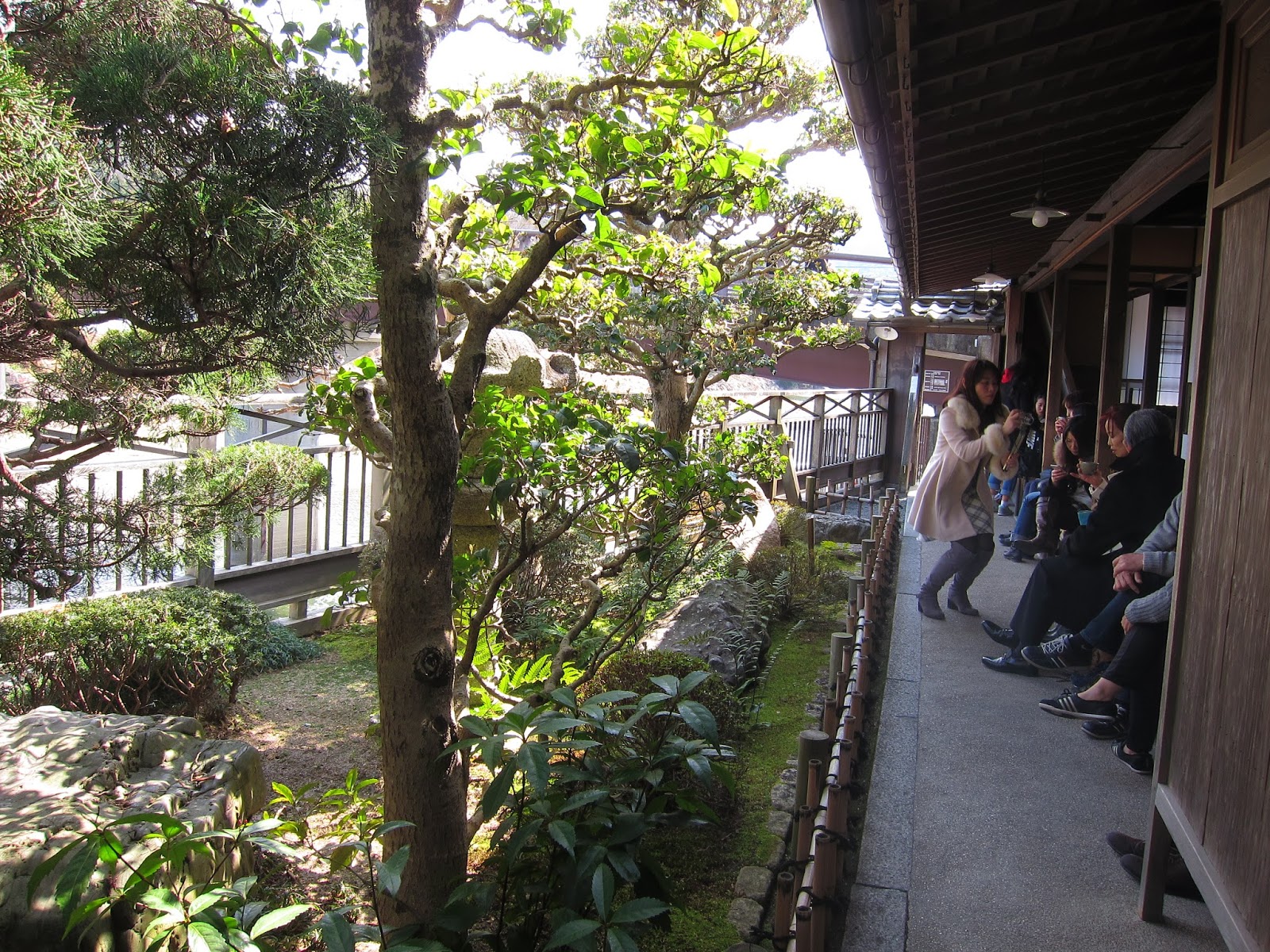
Rinso-in from the garden
Road approaching Rinso-in
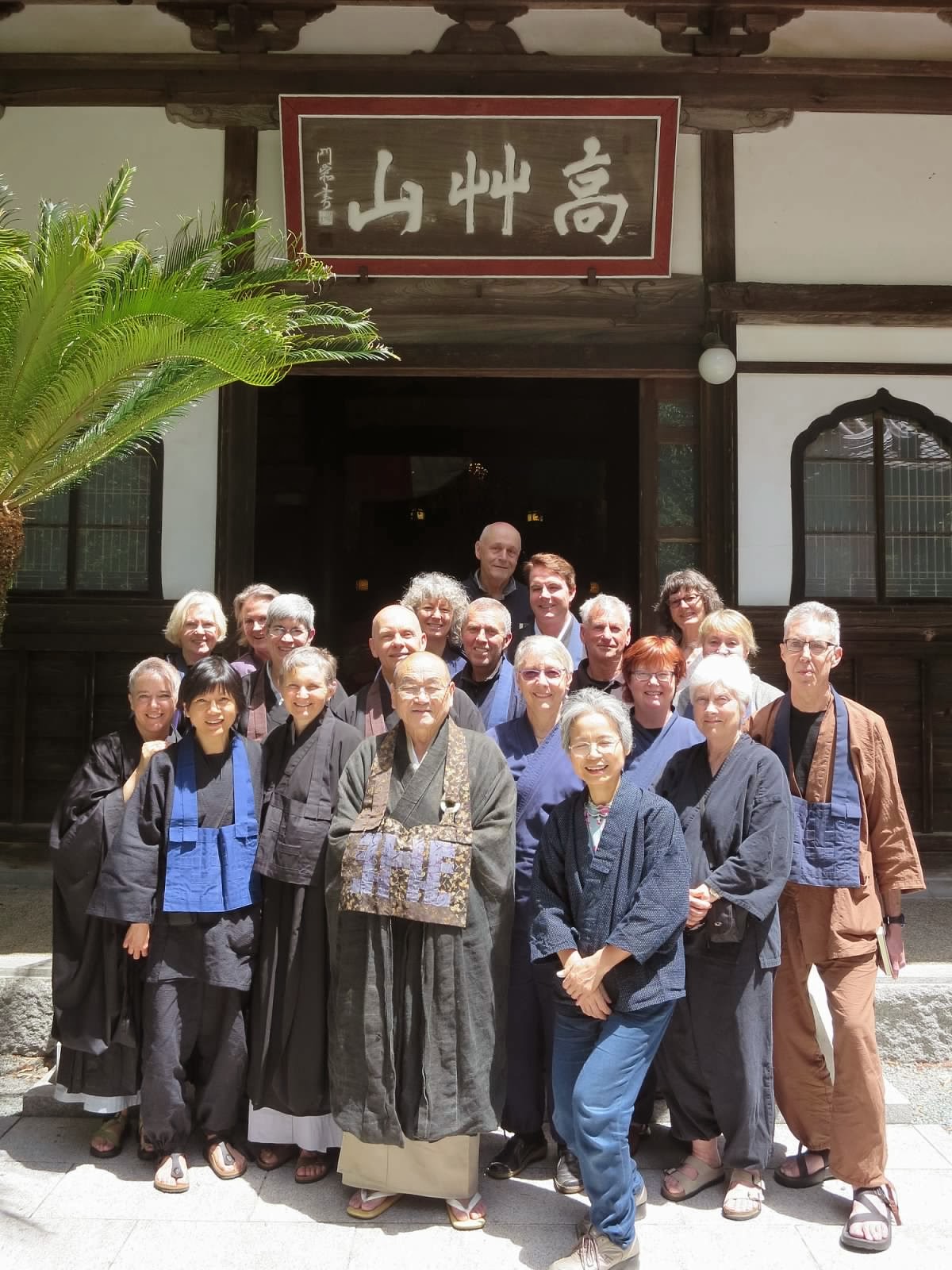
Our little group of Mountain Rain pilgrims (seventeen Canadians and me) spent five days at Rinso-in, a 500-year-old family temple in Shizuoka province. Rinso-in, though not a place where tourists generally visit, is very important to those of us who practice Zen within the lineage started by Shunyru Suzuki Roshi, who founded San Francisco Zen Center in the 1960's.

In Japan, temples are passed down from father to son, generally. Suzuki Roshi inherited Rinso-in from another Zen priest, and when he left for America, he left the temple in the care of his son, Hoitsu-san. Now, many, many years later, Hoitsu Suzuki (respectfully called Hojo-sama - "revered abbot"), now in his seventies, his wife Oka-san, his son Shungo-san (also a priest), his daughter-in-law, and his two grandchildren all live at Rinso-in.

For me, our days at Rinso-in were the heart of the pilgrimage, and I mean "heart" in every sense of the word. There was a tremendous sense of heart there, expressed by the whole family. In Zen sometimes we talk about a "family flavor" or "family way" of a particular lineage, and it's always felt to me like the family way of Suzuki Roshi's lineage, at its best, is generous, kind, and humble. Now I found myself in a place where Suzuki Roshi's own family, his actual biological descendants, live and work, and the feeling of that kindness was everywhere there.

Suzuki Roshi's family
I was also amazed by how beautiful and, in a way, how grand, Rinso-in is. All these years, when people said that Suzuki Roshi came from a small rural temple, I had imagined a run-down little place. Instead, everywhere I looked there was a graceful, dignified beauty, from the lines of the tile roofs to the exquisite pond and gardens. Rinso-in is tucked up at the head of a narrow valley, surrounded by steep slopes, and I could see why Suzuki Roshi fell in love with Tassajara when he first saw it. It must have reminded him of home.

Buddha Hall 
Every morning we sat in the old zendo, 300 years old and built to be a training place for monks. The rest of the days we cooked, worked around the temple, went for walks in the surrounding mountains, and spent time with the family. One evening Hojo-sama gave a dharma talk and question and answer for us. I took notes, as Kate McCandless and Michael Newton translated.

Old zendo and abbots chair, Photo by Kwee Downie
The talk filled me with delight and happiness. Afterward I had such a sense of pride - although pride is a funny word to use - in this particular way of Buddhism that somehow I'd been lucky enough to fall into, nearly a quarter century ago. I can't imagine another path that would be more perfect. Of course, every path is perfect, in its own way, but this one, this "family way" is deeply and thoroughly perfect for me. And of course, it has shaped me over these many years, and so perhaps I am thoroughly perfect for it too. I remember my mother used to tell me I was such a good traveler, and I would say, "That's because you've trained me!" Maybe it's like that.

Here is Hoitsu Suzuki's lovely talk, given May 19, 2013. What you can't see is his humor, sweetness, and tremendous gift for mimicry. You'll just have to imagine his impersonation of the big frogs.

Hoitsu Suzuki looking at tiny frogs in the garden. Photo By Kwee Downie
The reason human beings have so much suffering is because we’re so smart. Sometimes we think good things, but often our thoughts confuse us. We have a lot of desires: “I want this, I want that, I want to go here, I want to go there, I want to be this, I want to be that.” Shakyamuni sat down and quieted his whole being, his whole heart. When we do zazen, our heart and our whole life becomes quiet and still. If we continue the way we are we just keep running and running. Buddha asks us to stop and take a look at our lives, how they truly are.

Having desires is not a bad thing in itself; it’s how we relate to those desires. Zazen allows us to harmonize our lives with what is. It’s not a bad thing that we want things; that’s just what’s given to us. We can’t throw it away – it’s part of who we are. Or maybe we can get rid of them – desires – perhaps! [laughing]

It’s the body that does zazen. Sometimes we think, “Oh, I’m not doing zazen,” but it’s the mind that’s not doing zazen. Don’t worry about it. The body is doing zazen. Even when you think of something else, that is also doing zazen. If your body is doing zazen, that’s enough. Even if your mind is thinking things, there is also the “you” who is watching the thoughts. No matter where you go, you can’t lose yourself.

Kate McCandless and Oka-san's ikebana
There was an old teacher, two generations before Tendo Nyojo, Dogen’s teacher in China. Huanxi Zenji. He wrote the poem called “Zazen-shin”, “the acupuncture needle of zazen”. Zazen is the point of the needle. He said, “Your mind is like a pool of water. You can see the bottom and you can see a fish slowly swimming. It is like an endless sky where a bird slowly flies. And that is zazen.”

Koi in a pond at a nunnery in Ohara
Dogen changed the poem a little bit: “The mind is like a clear pool, and is the fish; a fish swims like a fish. The sky is limitless and a bird flies in the sky. A bird flies like a bird.”

Dogen Zenji says, “ If you are doing zazen, you are doing zazen, no matter what you think, just as a fish swims like a fish. You’re doing it like you.”

Just as Huanxi and Dogen said, “ The world before our eyes is vast and clear.” Around us everything is as vast and wide as the whole universe. It’s right here.

Sometimes when I breathe in, it’s not so much that I’m taking air into my body, but the air is passing through me. And bird song passing through me, light passing through me. Sometimes. We have many different experiences during zazen. Just because someone has written down or said in the past that you should feel a certain thing, don’t believe it. Really the only thing to do is sit quietly and settle your posture and breath. When you stabilize your posture, you make your mudra round, your arms round, your face and your breath round – but this is just something I feel, not something you have to do.

Old arhat statue
This is the teaching that came down from Dogen Zenji’s teacher to him, and from him to us. If you look for where your mind is, you notice, “it’s not here, it’s not here,” or, “it’s here, it’s here, it’s here.” You could look at it either way. You have a certain feeling when you do zazen, but it’s not a feeling exactly. No one is special in their accomplishment; we are all the same. If you tried to put your own experience of zazen into words, it would be impossible. Just words.

We really worry about things more than we need to. The trees, the stars, the rivers, the rocks, they don’t worry nearly as much as we do. The Buddha is inviting us, in zazen, to be like the many beings of the world – the trees, the rocks, the waters, the stones – to be in their family. To do zazen is not to be concerned with our desires to become this or become that. If you think you’ll get something out of zazen, some great idea, you’re just being sucked into the world of confusion. Good or bad in zazen is irrelevant.

Tiny frog. Photo by Susan Elbe
I was watching the pond today, and tiny little frogs were coming out and climbing up the mountain. My father loved frogs. There’s a very big kind of frog here in Japan, or maybe a toad, that almost never croaks, and doesn’t move much either. But when a little bug comes flying, it moves fast! (pantomimes a frog catching a bug)

My father was like that big frog. He was put in charge of the monastery when he was about twenty, but he had studied English and he wanted to go study zazen in a place where English was spoken. When the opportunity came, he jumped, just like that frog. “Within the stillness there is sudden movement. In movement there is stillness. Don’t forget your heart-mind.”

It took my father ten hours to prepare an hour talk in English. He must have been very busy, but when you read Zen Mind, Beginner’s Mind, it seems that he was very calm. He must have had a very calm steady heart, even though he was busy.

Shungo-san at Suzuki Roshi's ashes site, surrounded by the memorial stones of the many abbots of Rinso-in, We did a ceremony for Suzuki Roshi here. Photo by Kwee Downey.
Zazen is a good thing. It’s not a matter of being good or bad. There is no one who is good at it and no one who is bad at it.

My father went to Poland with Bill Kwong. Someone asked, “Is it OK if I do zazen as a Christian?” He answered, “So you’re Christian, but when you do zazen you are a zazen person.” Kobo Daishi, who brought Shingon Buddhism from China, didn’t tell people, “Forget about indigenous religion.” He said, “Indigenous religion is very important, and let’s practice Buddhism.” And because of that, Buddhism was able to penetrate and sink into Japanese culture.

Just do zazen. That’s it!

Question: When I’m doing something and thinking about something else, am I having a direct experience?

You can really only do one thing at once; you can really only think one thing at once. It’s really always like that. It might seem like you can think or do more than one thing at once, but you really can’t. It’s OK.

Question: What is the relationship between ceremonies and zazen?

[Quite a bit around the translation of “ceremonies”...perhaps no good Japanese word for it, but he understood when Shungo-san pantomimed hitting a mokugyo]

There is no relationship. Zazen is zazen. Ceremony is ceremony. But there is an expression of gratitude, “Thank for the teachings.” Or when we are doing our jobs. All of that is Zen. This is written in Zen Mind, Beginner’s Mind.

Why do we do ceremony?

It is all, “Thank you very much.” And also how we help support each other. The natural things we do to express gratitude are all ceremony, like bowing, or saying, “Good morning,” saying, “Thank you.” All are ceremony.

Old arhat statue
Question (my question): What kind of attitude or way of being is most important for a priest?

Shungo-san teaching chanting
[Leaning forward intently] EVERYTHING! But “everything” is very difficult. From the top of your head to the bottom of your feet you are practicing the way of Buddha. There’s no break, no wasting time. You might be angry or suffering, but you always remember your aspiration. This is very hard. But your whole body, even the bottoms of your feet, are dedicated. [The feeling here was sadness, or a strong sense of how hard the path is of a priest is, to live into these vows.] If your mouth is smiling but your eyes are angry, then you are not practicing with your whole body.

 Question: On the han it says, “Don’t waste time.” What does that mean?

Because we can only walk one path at a time, we can’t waste time. There is a much deeper way of understanding this saying, which is seeing deeply into the empty nature of time. Actually, the original text is in Chinese, and there are two ways of reading it. The typical way to read it is: “Don’t waste time.” But the other way is: “There is no time to waste,” which leaves behind our emotional confusion about wasting time. In the Chinese, it is literally, “Waste time not.” Our Zen way of understanding this passage is to look more deeply. What we mean by “path” is not some long road. It’s more like, “this instant,” and then, “this instant.”

Path to the tea house,
Question: Is it enough to practice zazen as a way to cultivate compassion, or are there other ways of developing compassion?

Old arhat statue
Tendo Nyojo said, “Do zazen only with the heart of compassion.” There are people who do zazen who think they are doing it through their own effort and strength, to get something from it, but Dogen’s teacher insisted that we can only do zazen for and with all beings.

When we are looking down in zazen, we are looking down, but not fiercely. We are open, practicing with the heart of compassion, and that’s conveyed to others by our way of being, quiet and gentle. People would always say, “Oh, your father is so kind and gentle and nice.” But we children were afraid of him. He was strict, and would yell at us. So doing lots of zazen doesn’t necessarily make you 100% nice. You will still be human.

Sitting on the tan, sitting on the zafu, becoming a Buddha – there is not one iota of difference.

Dogen Zenji became a monk because he understood that there is no way to escape change, and once you are on that path there is no turning back, and therefore no wasting time. Not that the path is straight: it’s just that there is no other way when you have that determination. Buddha's way is not something that someone can teach you; you have to find the way yourself. Your own path appears before you. It’s not about imitating someone else.

Zen is simple and easy to understand, but when we use words, we end up drifting farther and farther from the heart of Dogen Zenji’s words. Ungan Doyo, the 7th ancestor, came to the 6th ancestor. The 6th ancestor asked, “Where do you come from?” but Ungan Doyo can’t answer. He practiced for eight years, and after eight years all he can say is, “I can’t say. It’s beyond words.”

Tonight I’ve probably told you at least 800 lies. Perhaps!

*****************
The next morning Hoitsu said a formal goodbye to the group after zazen. He said he would like to come to Canada and someone said, “But our temple isn’t as nice and big as yours.” He said, “Wherever you sit zazen is a temple as vast as the universe. Like the old story of building a temple with a blade of grass [Book of Serenity, Case ?]. Wherever you sit zazen is a temple, a monastery.”


Mountain Rain with Hojo-sama and Oka-san in front of the Buddha Hall, Photo by Kwee Downie.


Saturday, August 3, 2013

Japanese Pilgrimage: The City of the Dead


In order to attain serenity of mind and become a person who is like the clouds in the sky and the whirling snow, consider that everyone's fate is to be become a corpse.                                                                           -- Kobo Daishi (Kukai) translated by Nobuhiro Tamura

It is night-time, and we are walking through an immense and ancient graveyard. All around us, the huge, straight trunks of 600-year-old cryptomeria, trees, like giant coast redwoods, rise up and disappear into the darkness above, so it feels that we are walking through a forest rather than a graveyard. Stone memorials line the wide pathway where we walk, and continue beneath the trees to either side, as far as can be seen. Some monuments are fresh and white, perhaps only a few years old, while others are covered in a deep layer of moss. Some are massive and pretentious; others are humble, clustered together and leaning toward one another like whispering children. The remains of 200,000 people from the last 1,100 years are all around us.

It is very quiet, except for the chitters of the flying squirrels, high in the trees above. Our little group speaks nearly in whispers as we walk in the dark: it doesn't seem like a place for raised voices. Unlike a cemetery in the West, there are no bodies here, or even the ashes from cremations. Beneath each stone memorial is a single bone: the nodobotoke, or Buddha bone, a small bone from the neck, shaped like a seated Buddha, carefully separated from the rest of the ashes after cremation.

This is my introduction to the Okunoin cemetery on Mount Koya, one of the most sacred places in all of Japan, where the spirits of commoners, samurai, monks and aristocrats have all lain down together in silence beneath the great trees.


We walk a gentle uphill slope through the dark graveyard, and across a series of small bridges. Before the third bridge, the monk who is guiding us, Nobuhiro Tamura, stops and tells us solemnly that beyond the bridge is the heart of Mount Koya, the mausoleum of Kobo Daishi, or Kukai, the 9th century monk and teacher who brought Shingon Buddhism - esoteric Buddhism -  from China to Japan. Kobo Daishi founded the first monasteries on Mount Koya, at 2,600 feet in the remote wilderness mountains of southern Honshu, the main island of the Japanese archipelago. Since the 9th century this place has been the heart of Shingon Buddhism in Japan, and once had more than 1,000 temples nestled between its eight mountain peaks. The whole complex is like an immense mandala, and at the center of the mandala is the Okunoin graveyard and the mausoleum.

Our monk/guide tells us that it is believed that in the year 835, when he was 61 years old, Kobo Daishi walked into that mausoleum, sat down in meditation, and has been in a deep meditative state ever since, for 1,178 years. He has been receiving teachings in the Tushita heaven from the next Buddha, Maitreya. When he wakes and speaks, he will give the greatest sermon the world has ever known, and that's why 200,000 people have chosen Mount Koya for the final resting place of their Buddha bone, so they can be there when the great sermon is given.


The lonely cloud has no path home, and loves a distant peak. I don't claim to know worldly things; I just watch the moon and lie down beneath a green pine.                                                                                    - Kobo Daishi (Kukai), translated by Nobuhiro Tamura
 (This poem by Kukai is particularly touching to me because there is a kind of beautiful conifer on Mount Koya called the Koya pine, or Japanese umbrella pine, known as the koyamaki in Japanese. I walked beneath it in the mountains around Mount Koya and saw many offerings of its branches on altars and on memorials in the cemetery. It is a living fossil, a species more than 230 million years old with no known close relatives. It is also one of the five sacred trees of Japan. There are so many koyamaki around Mount Koya that I can only imagine that it was this kind of pine that Kukai lay down beneath, illuminated by moonlight, so long ago.)

Offerings of koyamaki

Our group of Zen pilgrims (17 Canadians and me) stayed in a temple on Mount Koya, Ekoin, for two nights. (To learn more about our pilgrimage, read this.)

There are still more than a hundred temples clustered in a high valley amidst the peaks of Mount Koya, and a thousand monks and nuns, and Shingon pilgrims come from all over Japan and walk (or more frequently, ride the vertiginous tram) up the steep mountainside to stay for a night or two in a temple, along with curious Japanese and Western tourists. It might be possible to visit Mount Koya, eat some good temple food (and Japanese vegetarian temple cooking is deservedly famous), buy a few souvenirs, gawk at the famous gravestones in the cemetery,and get back on the tram and go home, relatively unmoved. But I found that the place, and the teachings there, seeped into me like pure mountain water, so even without understanding Shingon, I found myself moved, opened, and touched by something without name.

Perhaps we were also lucky. Our guide that first night in the graveyard was a young, very sincere monk from the temple where we were staying. Nobuhiro-san speaks and writes English. Here are some of the notes I took, as he offered his understanding to us, standing in the dark in the Okunoin:

"The purpose of Shingon meditation is to understand that 'inside' and 'outside', which we normally think of as opposed to one another, are actually one thing....Buddha Nature is everywhere...What makes esoteric Buddhism 'esoteric' is that the teachings cannot be really properly spoken in language. Instead, they are hidden in the world -- in the moon, in plants and trees and animals. The world is speaking the teachings....Kobo Daishi said that our minds are like the moon. The moon is bright because of the sun's rays, and our minds are bright because of the primordial sun Buddha. Just as the moon appears to change from day to day, so do our minds, but actually it is always the full moon, clear and bright."  - Nobuhiro Tamura

Wagtail on a painted fusuma door at Ekoin temple
But there was another side to our time there. Until 100 years ago, half of our group would not have been allowed to enter the precincts of Koyasan. I would not have been allowed to enter. From the 9th century until 1870, no living woman entered this most sacred place.

At each of the entrances to Mount Koya there was a women's hall where nuns practiced, always outside the gates. There is a path of many miles that leads from one gate to another, skirting the very edge of the sacred area, and this was the women's pilgrimage route, as close as any woman pilgrim could come to the center of the mandala, that mausoleum where Kobo Daihsi sits in meditation in the valley far below.

Three of us on our pilgrimage were ordained women priests, and we three decided to walk the women's pilgrimage trail. We began at the only surviving women's hall, the Niyonindo, where we read about Kosugi, who founded the hall:
According to an old story, there once was a young woman named Kosugi who lived at an inn in the province of Echigo. Her life was full of hardship, but she was saved by Kobo Daishi. Kosugi became a nun and opened here, at the top of the Fudo slope, along one of the pilgrim roads leading into Koyasan, the first so-called "women's hall". She looked after women pilgrims, who at the time were not allowed to enter Koyasan. Kosugi is now venerated as Kosugimyojin, a guardian deity of the Nyonindo hall.
We spent a day on the steep, up-and-down trail, often in silence, considering those women who had walked here for a thousand years in prayer, those women who had lived in the nun's halls, helping the weary pilgrims as they reached the gates, watching the men pass through, the women stay outside, century after century. Only one of the women's halls still stands, but at each place where there had been an entrance and a hall, we stood in silence, considering.

The following photos are from the women's pilgrimage route.

Reproduction of old map of women's pilgrimage route


The outside of Daimon, the grand gateway, with the guardian deities on either side. A woman could not cross through.


Kate McCandless on the women's pilgrimage route, beneath a koyamaki

A view to the main temple precincts from the women's pilgrimage trail

Irises at the Niyonindo nun's hall

A Jizo shrine along the trail. Women often pray to Jizo for children lost to miscarriage, abortion or early death.

From right to left: Kate McCandless, Flo Rublee, and me (buried under the hat), at one of the gates where a women's hall once stood.

On our last morning I returned to the Okunoin, the great graveyard, this time in daylight, and wandered among the stones in early morning light. I had brought a brush and black ink with me on the trip, and I sat on a mossy root and sketched the leaning stones, the tree trunks, the offerings of Koya pine.

I found that I could both celebrate the grandeur of a place of such deep practice and great piety, and mourn the way it had excluded women for so long. I don't really understand - how can I understand, from the viewpoint of a woman of the 21st century? - but I know that the practice of Koyasan did not stop at its gates, that the gates themselves, and the women who lived at the gates, were integral to the mandala.

I wish I could meet one of those women who sat outside the gates for a lifetime, waking up as she served the pilgrims. I wish I could do three bows to her, offer incense to her, and tell her that her practice inspires this woman of the future, as I walk the hills she walked, stand in the place where she once stood.

And really, as Kobo Daishsi himself taught, "inside and outside are the same."

A statue in the Okunoin graveyard

Clear streams on the mountain never stop flowing with compassion.                                                                                             - Kobo Daishi (Kukai), translated by Nobuhiro Tamura                                                                                              

Thursday, July 18, 2013

Japanese Pilgrimage: Entering Asia

Gio-ji, Arashiyama

I am alone in the garden of a tiny nunnery called Gio-ji, in the village of Arashiyama on the outskirts of Kyoto, and before me, in the late afternoon light, is a luminously green space, floored by moss, roofed by Japanese maples, the golden light streaming across it.

It is very quiet, all sound muffled by the maples in full leaf, the bamboo groves below. I have been alone in this dream-like precinct of temples and quiet lanes all afternoon, and my heart is simply bubbling over with happiness.

This last May I traveled to Japan for the first time in my life - my first time to Asia. This, despite nearly 30 years of Buddhist practice and ordination as a Soto Zen priest. For the first years of my Buddhist practice, I didn't have a strong desire to go to Asia, and later my life circumstances didn't allow it. Three years ago I almost traveled to Japan with a group of senior students from Everyday Zen, my home Zen sangha, but needed to take work in Alaska instead (you can read about those adventures here and here).

Finally, nearly miraculously, everything ripened for me this spring, and I was able to travel to Japan for nearly three weeks with the Mountain Rain Zen sangha from Vancouver, British Columbia, with old friends and dharma companions from my days of living just south of the border in Bellingham, Washington.

Mountain Rain in the onsen (hot springs) town of Yamanaka, wearing the cute little yukata one puts on after the bath

About half the time we stayed in temples: Rinso-in, the 600-year-old family temple of Suzuki Roshi (who brought Soto Zen to America); Eiheiji, the great 850-year-old mother temple of Soto Zen in the mountains near the Japan sea; and Koya-san, the complex of Shingon temples in the mountains south of Kyoto, dating from the 9th century. The rest of the time we were in a small, unpretentious ryokan (traditional Japanese lodging-house) near the train station in Kyoto, free to explore Kyoto and its environs on our own.

Like all truly transformative travel, it is all much too large to fit on the page, or the blog. I think that's what's kept me from writing about it, since I returned. I've been daunted by what to write - every day was filled with such richness and beauty. But I truly want to share it, somehow. I kept a journal during my time there, and did a lot of photography. Perhaps I will try to offer some of each, and see where it goes...

Eiheiji
This ancient set of guidelines was offered to us by our friends/guides/teachers, Kate McCandless and Michael Newton, before we left.

The Five Excellent Arts of Pilgrimage, 5th century

Practice the arts of attention and listening
Practice renewing yourself every day
Practice meandering toward the center of every place
Practice the ritual of reading sacred texts
Practice gratitude and praise singing

Roadside flower arrangement, Arashiyama

So in the spirit of "praise singing", here's what I wrote as my plane lifted off from San Francisco airport on May 11th, turning west into the setting sun, above fog and the Golden Gate bridge, headed across the Pacific

Flying west
the way the dead go
When I come back
it will be a different life

Then, as we approached the Japanese coast the next day (two days later, because of the international date line), after a night in Honolulu and many hours of travel across empty ocean, a verse from the moment I first saw land:

I keep looking for land
but each time: ocean, clouds, the wide calm wing below me.
Asia, awaited so long, still just over the horizon.
Ah - mist-blue islands!
Mountains after mountains
soft as smoke or dreams


Mountains from the Women's Pilgrimage Trail around Koyasan

In Japan I experienced, for the first time, the deep roots of my own tradition and spiritual life. And it's changed me in subtle and important ways that I couldn't have imagined, that I can feel every time I bow, light incense, or sit zazen. The person who practiced Zen before going to Japan is not quite the person I am now.


Torii gates on the Women's Pilgrimage Trail, Koyasan


To be continued....