Monday, August 27, 2012

Shuso Notes Week One


The Old Woman, Zhaozhou, and the Tiger

One day when Master Zhaozhou Congshen was outside the monastery, he saw an old woman hoeing a field. He asked her, “What would you do if you suddenly met a fierce tiger?” 
         She replied, “Nothing in this world frightens me,” and turned back to her hoeing. Zhaozhou roared like a tiger. She roared back at him. 
         Zhaozhou said, “There’s still this.”


Today I was walking in the Marin hills on a little-used trail. I saw no one else at the trailhead or anywhere in front of or behind me. It was a lovely cool day, and I was enjoying my walk, until I heard a loud rustle in the dried vegetation of a ravine below the trail. I stopped. I listened carefully. Rustle. Pause. Rustle. Definitely a large animal. I tried to see what was there, with no luck. Rustle.

There are deer and coyotes in the hills, but also mountain lions. I knew it was probably a deer, but I also knew that it could be a lion. I felt very small---in fact, I am very small.  The animal was making its way up the ravine, still hidden by the chapparal. It sounded like it was making an effort to get up to the trail in front of me. Probably a deer. But what if it wasn't? No one nearby, a small tasty woman all alone....

I am not that old woman in the story with Zhaozhou. I turned tail and walked, quickly, back toward the trailhead. Many things in the world still frighten me.

From Flickr Creative Commons:  http://www.flickr.com/photos/dracobotanicus/3409889096/sizes/z/ 

This last Sunday I was "entered" as Shuso for the nine-week Everyday Day Zen Fall Practice Period. Shuso is a Japanese term for a very old Zen tradition, dating back at least a thousand years in China and Japan. It is translated as "head monk" or "head student" for a Zen monastic practice period. The shuso helps the teacher lead the practice period, and it is an initiation into the Zen way of helping and working with people. Within the tradition of San Francisco Zen Center, it is generally the first time a Zen student formally gives dharma talks or teaches, even if they have been studying Zen for twenty or thirty or forty years (we Zen people are slow learners).

In the small world of Zen practice, it is A Very Big Deal, something both wonderful and terrifying for the shuso. I can remember each of the shusos for my various practice periods back nearly twenty years. If I meet another Zen person that I have practiced with, we can figure out if we were in the same practice period by naming our shuso, since most people are shuso only once in their life, and the shuso is vividly part of creating the whole feeling of a particular practice period. Shy or brave, scholarly, heart-felt, inspiring, sincere, confused, ordinary.....the spirit of the shuso is the spirit of the practice period.  

Even though Everyday Zen is a non-monastic Zen community, we have had practice periods and shusos too, for the past eight years or so, every fall. So there I was, Sunday morning, driving to the Headlands, a rented meditation hall north of the Golden Gate Bridge,  just above Rodeo Lagoon inside the Golden Gate National Park. The light was beautiful on the Bay as I drove, a sheen of silver, the fog lifting and rolling back toward the ocean.


I was very frightened. I'm not even quite sure why. The shuso entering ceremony is quite formal, and has a few memorized lines, but that doesn't quite explain the fear. I'm not normally afraid of public speaking. I love this community, and feel love and support from them. I've known the teacher, Norman Fischer, for more than twenty years, and we've been through a lot together. But it was like I was standing on the edge of a cliff, one that I knew I would soon be jumping over. At the moment I was looking out over vast space and swallowing hard, wondering how I would ever manage to leap.

This is particularly mysterious because I have admired shusos for so long, and fantasized in countless retreats that one day I might be in the role. This reminds me of a favorite old story. Once upon a time in China there was a man who was obsessed with dragons. He collected dragon figurines, studied dragon mythology, wrote poetry about dragons, loved dragons with all his heart. He did this for years and years. Of course, he'd never actually seen a dragon, since dragons are vanishingly rare. But word got out to the dragons that they had a real fan in the human world, so one day a dragon came to visit, just to meet this person who loved dragons so much. When the dragon's head appeared in the man's window, he fainted in fear, came to, and ran away.


So that's me last Sunday morning, the shuso-lover, about to meet the shuso, and scared witless.

I made it to the meditation hall, and then spent the day in silence, mostly, sitting and walking in meditation. Every time someone greeted me with "shuso!" I said, "Not yet. I can still walk away!" The ceremony was at the end of the day. And here's the great thing about the ceremony, which is also very old. The memorized lines are all variations on, "I am not ready to be shuso." In fact, at the height of the ceremony, the shuso-to-be tries to walk out of the room, twice, before being called back by the teacher.

I haven't done a poll on this, but I have a feeling that some part of even the most avid shuso-to-be actually would like to walk out of the room at that point. Or maybe that's not quite right. I knew I wouldn't actually walk out of the room, but saying yes also felt impossible. Suddenly the cliff was in front of me, instead of below me, and I couldn't see how I could possibly climb it.

Now I see that there is no way to climb it, of course. There is just moving forward, trusting the next moment to be under your feet. It was, and now the practice period is one day old and all of us who are part of it are all moving forward, each in our own way, but somehow linked.


There are nearly sixty people in the practice period in the Bay Area, and another twenty-six doing a "long distance practice period" all over the world. I chanted their names for the first time this  morning, and it feels like those eighty-some people are inside my skin, behind my eyes, sitting with me on the cushion. The practice period is still in front of us, supposedly, but in the blink of an eye it will be over. We will never all be together in this way again, and I will almost certainly never be shuso again, gone in a heartbeat. There is a poignancy there that I can taste, even as we are just beginning.

For the next nine weeks we will be studying the stories and koans from the book that Sue Moon and I have just handed in to Wisdom Publications: Record of the Hidden Lamp. The book is a collection of one hundred stories of awakened Buddhist woman, from twenty-five centuries, with commentaries by contemporary women teachers. The story that started this post is one of the stories in the book. We have been working on the book for nearly three years.


It is astonishing to me that this is the focus of the practice period, and I am overwhelmed with gratitude to Norman for choosing to use these stories that are so close to my heart, that I have been living and breathing for so long, and that I think will be so important for both male and female dharma practitioners, going forward. Women have been hidden in Buddhism for a long time, anonymous like the old woman who roared like a tiger. Perhaps this is the first time in the long history of Zen a Zen practice period, led by a male teacher, has focused on women's koans and stories, women's teaching and practice. Incredible.

My dear friend Dana Velden, always cutting-edge, started the tradition of a shuso blog when she was shuso at San Francisco Zen Center years ago. My intention is to write something every week, something to give a glimpse, for Zen people and non-Zen people alike, into the experience of a particular practice period and the mysterious path of this old tradition.

Love,
Florence

P.S. If you'd like to listen to the talks from the practice period about the women's stories, they will be posted online at Everyday Zen Teachings.


Tuesday, July 17, 2012

More on the Art of Riding the Waves


Since my last post about waves, I've continued to think about the big waves of life, and how to meet them. I was asked to give the guest sermon at the Eastshore Unitarian Church in Bellevue last Sunday, and my sermon was on "The Art of Riding the Waves." If you'd like to listen to it, you can download and listen to it here. Or you can read the sermon, below. Before the sermon, I told a story for children, called The Wave, which you can download and listen to here.

*******


Good morning, It is an honor to be here with you this summer Sunday morning, when you could be out enjoying one of our tardy summer days. I want to thank Ann Carden, your worship leader, for inviting me and for the beautiful and soulful process we went through together in thinking about this service.

By now in the service you must have an inkling of what the sermon is about. Ocean waves are, as in my story, nothing at all, merely temporary, beautiful, constantly changing forms of the ocean, and yet they are one of the most powerful forces we know. 


What really got me thinking about waves happened in late March this year, when I was caught in a rogue wave.One moment I was photographing beautiful wind-whipped breakers and the next moment one of those waves, which looked like every other wave, was washing around my knees and getting higher, and I was running for high ground. I experienced the sudden bodily  knowledge that if I didn’t get out of the wave, it was going to take me out to sea with it when it ebbed. I made it out, but it reminded me of the way a life can change in an instant.

Almost everyone has experienced these moments, or knows someone who has, when everything changes. The phone call in the middle of the night, the pink slip, the conversation with a doctor. Here’s something that the Zen teacher John Tarrant wrote, after he received a diagnosis of prostate cancer:

The diagnosis seemed alright at the time I got it but I observed that the small consulting room became large, time slowed down and everyone’s eyes grew big. That room became a ship hanging in space, a ship I can still visit if I wish, and sometimes do. That moment was the last moment when I hadn’t quite absorbed the news, when I didn’t quite have cancer yet.   http://tarrantworks.com/2011/12/17/five-reasons-to-get-cancer/#more-47

Of course, there are also the big waves which are not tragedies, but no less dramatic, humbling and transforming: really falling in love for the first time or the 10th time, or the birth of a child, or the power of an idea that sweeps you away and calls you to a new life.

So I started thinking about big waves, and what we can do when the waves hit, and if there might be an art to riding the waves of life, like tai chi, or surfing. So this sermon is about my exploration of this question.

When I was in my 20’s, I had a realization that has stayed with me ever since: up to that time, unconsciously, I had thought that when difficult things happened, it was sort of a mistake, something going wrong in the midst of an otherwise smooth life. I think, by the way, that this is a very middle class American idea – most people in the rest of the world know better by the time they are in their 20’s . Suddenly I realized that life, by its very nature includes disasters and accidents and unexpected changes– they aren’t aberrations, they are PART of life, just as waves are part of the ocean. A wave is a very different experience if the whole time you’re thinking, “Stop, this shouldn’t be happening, not in my life” rather than, “Ah, right, this is the nature of life. I don’t like it, but here it is, and waves hit everyone, sooner or later.”  Then, if you’re really wild and lucky, you might even be able to have the feeling of those people who ride the largest waves in the world, “Woooeee, this is a wild ride!”


Photo by Michael Hofmann
This may seem impossible, but I know someone who had just that sort of experience, a person just like you and me. A friend from Bellingham was up hiking in the Arctic National Wildlife Refuge with several other people, and a grizzly started following them one afternoon. All afternoon it followed them, getting closer and closer. They had no weapons, and they were going as fast as they could, with increasing terror. Finally they realized that the grizzly was definitely going to catch up with them, in just a few minutes, and at the bottom of a small hill they turned around and joined hands. One of them started to sing, and so they stood there, waiting for the wave, singing together. When the grizzly crested the hill, no more than 20 ft away from them, my friend said that she was amazed at what she felt: not fear but awe. The grizzly, with the light shining behind it, was the most beautiful thing she had ever seen. They sang and she felt tears running down her face. The bear paused there and they all regarded one another; then it turned around and walked away from them. 

Here’s another story about riding the waves. I have a friend who traveled on a Russian freighter from San Francisco to Asia, many years ago. He was young, and had no idea what was going to happen next in his life. The freighter left the Oakland docks at midnight, and the bay was full of fog and waves. He remembers standing on deck as the freighter crossed under the Golden Gate Bridge, and in the lights from the boat and the bridge he could see ducks on the big swells and breakers as they came into the narrow channel of the Golden Gate. The ducks were completely calm and at ease, bobbing up and down n the dark with each enormous swell. All my friend’s fear and trepidation about his life evaporated, and he says that the image of those ducks stayed with him for decades, as he lived the uncertain and unconventional life of an itinerant artist in Asia. The message he had understood was “You can trust uncertainty.” 


Ann shared an old poem with me, from 1947, written by Donald Babcock, a philosophy professor, about a duck very like the ones my friend saw. I’m going to read you a little bit of it.

… It is a duck riding the ocean a hundred feet beyond the surf.
and she cuddles in the swells.
There is a big heaving in the Atlantic and she is part of it.

She looks a bit like a Mandarin or the Lord Buddha
meditating under the Bo tree,

She can rest while the Atlantic heaves

because she rests IN the Atlantic.

Probably, she doesn’t know how large the ocean is …
          And neither do we…
                    And what does she do, I ask you?
She sits down in it.
She reposes in the immediate as if it were infinity … which it is.

That is spirituality, and the duck has it!
She has made herself a part of the boundless
by easing herself into it
                    just where it touches her.

So this brings us to perhaps the most important question: what about when the wave is too big for you to ride, when it knocks you over, tumbles you, knocks the breath out of you? What about when you can’t find a way ride the wave? What then? What do we do when the wave has pinned us to the sand and every time we try to get up we get knocked down again?

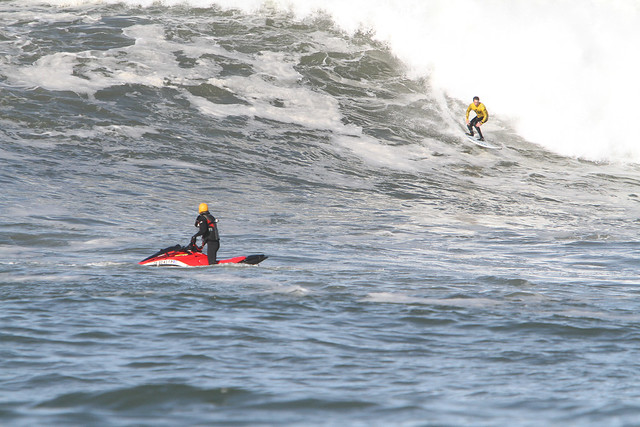
I think being caught in a wave in one’s life is one of the most humbling things around. All your ideas of yourself as a competent, together adult just fall to pieces, and you are just in the raw reality of your response, which may be very unimpressive. Being humbled is not such a bad thing, actually. From a place of humility there is room for learning, and for receiving. You have fallen, and those who love you carry you in their arms. Those people who ride giant waves are supported by other surfers on jet skis, who risk their own life in the waves by going in and rescuing a fallen friend. Sometimes you can be the rescuer, sometimes you are rescued. Both roles are important, both need the other.


As part of exploring this question, I wanted to talk to someone who really knew about waves, first-hand. I had a long chat with a friend who is also a Zen priest, and a life-long fanatical surfer.

 What I realized, talking with him, is that, to a surfer, every wave you ride makes you stronger, makes the body wiser and more able to ride the next wave. A surfer rides the waves with the body’s wisdom, not the mind’s. Surfers fall over and over again, and get up and meet the next wave. Learning to ride the waves of life is like that too. I want to tell the older people here that this is a place where age and experience are a tremendous advantage.

You might be surprised at the story of the genesis of Outward Bound, the famous wilderness survival school. Outward Bound is a nautical term for a ship leaving behind the safety of the harbor for the open sea. The school was developed in the 1930s because it had been noticed that when there was a shipwreck at sea, paradoxically the older, more experienced sailors were more likely to survive than the younger, stronger sailors. Apparently, with shipwrecks, as with many other things, practice matters. We learn something each time we fall, each time we’re shipwrecked.

Falling is not a mistake; it’s what we need to meet the next wave, to build our capacity for uncertainty, for joy in the face of hardship, for compassion, for resilience. We aren’t born with these qualities; they are forged in the waves.

And this is where I think compassion is the most important thing: compassion for yourself if you have fallen, if the wave is too much for you, and compassion for others, for the whole world, all of us caught in the waves in one way or another.

Take a moment to think about your own resources, your own hard-earned life wisdom about how best to ride – or fall- in the waves....

I asked my friend the surfer/Zen guy about what it was like when he got caught in a wave, and I thought he’d give me some deep wise Zen answer. You know what he said? He said, when I’m caught in a wave, all there is is fear. There’s no room for anything else, no time for big thoughts or nice ideas (on second thought, maybe this really is a deep wise Zen answer). There is just “Help!” and hardly even that. And this reminds me of the story about ways to pray, that there are really only two kinds of prayer: Help, and Thank You.  And I would add perhaps, a third, wordless prayer, from the story of my friend and the grizzly: awe.

Finally, all waves have their end, subside into foam, re-enter the sea. That terrible grief, that tremendous confusion, that desperate love, eases, eventually, miraculously. Waves are impermanent, just as we are. As solid and overwhelming as they can seem, they have their time and then they change. We do too, whether we have ridden the wave or struggled in the foam, our life carries us past and into new waters.


I want to close with an inspiring quote from our old friend Henry David Thoreau:

You must live in the present, launch yourself on every wave, find your eternity in each moment. Fools stand on their island opportunities and look toward another land. There is no other land, there is no other life but this.

Friday, April 6, 2012

Big Waves


Sometimes you are going along, living your daily life with all its small joys and small sorrows, and in a moment, in a split-second, everything changes. The earthquake, the tsunami, the moment of violence, one of the infinite forms of the shockingly unexpected breaks over you; your world pivots on its axis, and when you look up, your life is no longer what it was.
Last Friday I was at Tennessee Valley Beach, north of the Golden Gate Bridge in Marin County, California. As you approach the beach through the gentle rolling hills that flank the valley, it looks placid, even a little dull. But at the last moment, where the path shifts to sand, the view opens up to magnificent, cormorant-strewn, awe-inspiring cliffs, as stark and uncompromising as the rugged cliffs of the Scottish Isles. I walked with a friend through the gray, foggy valley, and when we arrived at the beach, the waves were big, thundering up against the cliffs, the wind catching the crests and blowing the foam back like the manes of giant white horses.

Each wave had its own signature, as it encountered the coastline, each one shaped by wind and current into a unique form. I could have watched all afternoon, taking photographs of the beautiful meetings of rock and ocean. My friend wandered off toward the hills, and I stayed on the sloping beach twenty feet or so from the waves, camera in hand.

Then, in a moment, everything changed. A wave, one that seemed just like the others as it approached me, came on to the beach - and kept coming. I looked down and saw the line of foam coming my way, and then I turned and ran toward higher ground, laughing a little to myself. But the wave was faster than I was, and reached me just as I stepped into a patch of saturated sand that caught and held me as I sank into it. I fell to my knees, no longer laughing, and the wave came over the berm and surrounded me, filling up the lower area of the beach where I was.
I scrambled up, holding my camera above the water, soaked to the waist and frightened, realizing that no one could see me on this part of the beach, and that I must find a way to get out of the water before the wave turned and headed back oceanward, carrying me with it. I made it to a higher area and then watched the water continue to fill where I had been, turning the moments-before bare sand beach into a swirling, deep pool. Then, as the wave retreated, its force was strong enough to erode the area where I stood, and I had to move still further away as the wave ate away at my refuge.
Photo by Paphio, Flickr
Afterward I stood and watched the waves again, and they were as they had been before, breaking many feet away, acting just as one would expect waves to act. My friend returned and I explained what had happened, though it must have seemed unreal, a story from dream or nightmare. I had heard of "rogue waves," but had never really believed that people could be swept off beaches into the ocean by a wave they never saw before it engulfed them.
We watched for a long time, and no wave came up the beach and over the berm again. I was wet but fine. Nothing much had happened, but my body knew that it had felt a moment where everything could have changed, when a great force meets an individual life and wrenches it, irrevocably, into a new story, or the end of the story.
*     *    *    *
I have another friend who spent years as a climbing guide in Nepal and South America, but later returned to his hometown (and mine) in Indiana. We try to have adventures together, every once in a while. Our best one was a few years ago, when we spent a joyous few days climbing together in Joshua Tree, sleeping out on big slabs of granite, walking the sandy washes, laughing and joking and eating camp food. My memories of that trip are still vivid and sweet. 

Over the years I have tried to talk him into finding a way back to the mountains and wilderness, but until recently he could never figure out a way to make it happen. But, finally, over the last year, he had fallen in love with southern Colorado, and he was getting ready to move. I was so happy for him.
Although I didn't know it when I encountered the wave on the beach, that same morning my friend was attacked, caught in another kind of rogue wave. He was back in my hometown, working on his house, and he had been arguing with some teenage boys about littering in the alley. They had sworn at him and threatened to "get him." Later he saw them a block away, and several boys surrounded him. He fended off blows, and then one of the boys hit my friend in the face. He fell, knocked unconscious by an enormous, unexpected blow, the tsunami, the earthquake, the pivot. When he came to consciousness, blood everywhere, unable to see clearly, he saw the blurred form of the boys, running away, and laughing.
They had focused only on his face, using some kind of weapon - brass knuckles or something else. They had done enormous damage. It had been deliberate and violent, sadistic, intentional. He was rushed to the local hospital, and then to the trauma hospital an hour and a half away. A few days later he underwent face reconstruction surgery, more than eight hours on the table while three surgeons painstakingly rebuilt bone and cartilege. And my friend does not have insurance.
And the frightening "boys" who did such damage, and who laughed as they ran away, have not been arrested yet.
I found out about the attack on Saturday, as I was preparing for a potluck birthday party - my own birthday party, as a matter of fact, a couple of days early. And I felt my life pivot too, with grief and sorrow. Suddenly a celebration no longer mattered, was no longer possible. I cried  - for him, for everything that had changed with the attack, for a world where this is possible, for the strange fate that had brought him under those fists, in conjunction with those murderous boys, just as he was preparing for a new life. Every day these things happen to strangers in unfamiliar places, and we read about them in the newspaper, but I knew the exact place my friend had been attacked: I had grown up just a stone-throw away, played in the alley where he was surrounded, intimately know the houses and streets around him.  I knew his face, his smile, his laugh.
Always, when these things happen, there's a desperate longing to go back and make it happen differently: don't go down that alley, don't argue with those boys, don't stand on that beach. But time seems more irrevocable and implacable at these moments than it does in ordinary life. There is no going back.
I remember realizing, in my early twenties, that I tended to think of life as basically stable, and accidents or disasters as some kind of mistake, some wrongness intruding into the peace of "just living." But of course, disasters are as much part of life as any other moment, and just as inevitable.
A few years ago I saw the documentary Riding Giants, about the guys who ride the largest waves in the world. When everyone else retreats from the beach, these guys go and meet thirty-foot waves and launch themselves into them. There's no second-guessing and no turning back once they're committed. To turn back or hesitate is to be pulverized by the wave.
Photo by Rick Bucich (Flickr) of Zach Wormhoudt, Maverick's Surf Competition 2010
I was mesmerized by the film. At the time I saw it, I was grieving the violent death of a beloved cat, and struggling with a chronic illness, and I felt caught in the waves of my life, tumbled around, lost and gasping for air. But what I saw on the screen was a radically different approach: a willingness to play in the big waves that come our way, to ride them, to let their power carry us, to not turn away.
Several days after the attack I had a chance to talk with my friend (amazed that he could talk at all, given his injuries) and I saw the same quality of willingness in him that I had seen in Riding Giants: he was riding the giant wave of what had happened to him, not fighting it, not being pulverized by it. Maybe it's due to all his years as a climber on the high peaks of the Himalayas, facing disaster with every rockfall and avalanche, but I heard not one whine from him in our conversation, and I was talking to a guy who had every reason to whine, every reason to be completely freaked out. But instead, he was clear and calm. He calmed me, which was a little bit embarrassing.
At the end of our conversation I realized that I had my own story backwards. I had been feeling sorry for myself - all these disasters ruining my birthday - when actually I had been given the finest birthday present of all: my friend was alive.
I think perhaps this is a big part of the reason that I practice Zen, sitting on a black cushion every morning in front of my altar, spending big chunks of my life in silent retreats. I want to learn to ride giants, to cultivate a mind steady enough to turn toward the wave, for myself and for others. When a surfer rides a really big wave, and gets caught, his only hope is to be rescued by his friends, who go in on a jet-ski, risking their own lives, to pull him out. They know the next time may be their turn.
Photo by Rick Bucich (Flickr), Maverick's Surf Competition 2010 
I'm not naturally very tough or very brave - not like my friend - but I figure that every moment that I can bear what's going on in my mind and body as I sit in silence, even if it's only a little bit uncomfortable, a little bit unbearable, I am cultivating a tiny bit more capacity for the waves. Maybe one day I too can ride giants, play in the rogue waves when they come rolling in, and learn to surf the big mysteries of life and loss and death. That's my wish, for myself and every one of us. 
And if it gets to be too much, I hope all of us have friends who can go in there with us, reach out a steady hand, and bring us to shore.

Tuesday, December 27, 2011

Post-Christmas Musings


This Christmas I found myself thinking about all the ways we celebrate Christmas, and the extraordinary complexity - emotional, familial, logistical, spiritual, financial - of relationship with this holiday (the "holy-daze," says one friend).

Therapists have told me that the time between Thanksgiving and Christmas is their busiest time of the year: people who have never darkened the doorway of a shrink suddenly find themselves at their wits' end. And yet we're all supposed to be happy, "merry" even, which of course just makes it worse for those poor souls who, for one reason or another, find themselves a few shades short of the requisite emotions. I've observed that even those who profess to thoroughly enjoy Christmas tend to get just a wee bit stressed.

Not to mention the whole confusing issue of gifts: Just for the kids? How about all those coworkers?  Does anyone even want this stuff? Will anyone like my presents? Do I go into debt to match the family's expectations? Who will I offend if I don't give a gift?

And, if you're like me, the political and economic questions start piling up too: How can I justify this consumerism? What about all the people who have nothing? But should I be supporting my local craftspeople and small businesses? What about donations instead?

My father is a sociologist, and one of his more playful sociological studies was an exploration of the ten unwritten "rules" of Christmas gift giving in the Midwestern town of Muncie, Indiana (called "Middletown" in the study). There are Tree Rules and Wrapping Rules, and Who Gives What to Whom Rules, and none of them are written down or even seen as rules. Everyone thinks they're freely choosing what they do at Christmas. Every time I read this study I recognize my own behaviors in it, and am both amused and horrified. Are we really so predictable, so driven by our unspoken cultural habits and pressures?

All that aside, I had a wonderful, albeit highly untraditional Christmas this year. And I heard a lot of stories from others about their Christmas celebrations and conundrums.

I spent my Christmas house-sitting for a friend in Northern California, so that she and her daughter could travel to Florida to be with family. My co-celebrants were a black-and-white miniature Australian shepherd and two black-and-white cats. The dog and the cats, unfortunately, are not on speaking terms, which is perhaps not so different from many family Christmas situations. Nonetheless, I was extraordinarily happy.

On Christmas Eve I drank hot apple cider, had a couple of phone chats with family, admired the beautifully decorated Christmas tree in the house, and listened to early music with the dog on my lap, considering how strange and wonderful it was that I was entirely alone and utterly happy, feeling the mystery of the renewal that Christmas signifies.

On Christmas Day I made a colorful organic salad for Christmas dinner for twenty residents of the local homeless shelter, dropped it off, and went for a long sunny romp at the local beach with the dog.


Later I had a phone conversation with an elderly friend who had broken her leg a few weeks ago and found herself spending Christmas in a rehabilitation center. Rather than being full of pity for herself (as I probably would be in her situation) she was overcome with gratitude - for the miracle of being alive, moment by moment, and for the miracle of her body's slow but steady healing. I was moved to tears as I listened to her.

Then I went to another older friend's house and shared a traditional Christmas dinner with her interesting grown family. We stayed up and talked until the wee hours of the morning, ushering in the end of Christmas with our wide-ranging conversation.


So what can I deduce from this about Florence and her perfect Christmas? Well, apparently she needs a healthy dose of solitude and quiet, music, time to feel the sacredness in the moment, a sense of purpose and service, a few warm animals, a little bit of time with beloved people (but not too much), good food, and a teaspoon of the beauty of the natural world.

Then there is my friend D., who was my inspiration this year. She was the one who organized the meal for twenty at the homeless shelter. She traveled to India earlier this fall, and when she came back she was, as she said, completely unable to stomach the idea of doing Christmas as her family had always done it. She said, "The world is changing, and we have to do things in a way that takes care of others."

She convinced her husband and children to try something very different, and astonishingly, they agreed. They bought toys for a local toy drive instead of gifts for each other, raised money for three Vietnamese children who need heart operations, and made Christmas dinner for the shelter, which the whole family delivered. Clearly for her, the perfect Christmas is one that honors her commitment to helping others.

Another friend, T., who is Jewish, buys presents for all the post office workers and takes them to the post office the week before Christmas, just when the stress and grumpiness of the customers is at its height.

I know others who spent Christmas deep in the sweetness of their family, doing nothing much other than being with one another, cooking together, eating together, appreciating each other and what they have as a family.

But lots of people I know spent Christmas in ways that did not nourish their hearts or align with their true expression. I know someone who is struggling financially (as so many are) who was expected by her children to play "grandma" with all the expected presents for the grandkids, far beyond her means. I know another grandmother who was struggling with a family request to give fewer presents than she wanted to. Others spent Christmas in ways that were conventionally "merry" but left them, mysteriously, empty and sad.

There are tremendous social and familial pressures at this time of year. My friend D. was very lucky that her family agreed with her radical requests. We all have such strong opinions about how Christmas "should" be, and woe to the person who requests or needs to do it differently.

Usually my writing here is not polemical: I'm not trying to convince you of anything, but rather to share my thoughts about something that has caught my heart or my mind. But in this case I want to admit that I have an agenda. I have a big Christmas wish for next year, and this is it: that we each support ourselves and each other to celebrate Christmas in the way that is truest to each one of us, no matter how strange or radical or untraditional it may seem.

Christmas tree at Muir Beach
The world IS changing, as my friend D. said, and it would be a beautiful thing if we could allow those we love to change too, and find ways of celebrating the season with fewer trips to the shrink (and, I might add, the mall!) and greater happiness and meaning. What better gift could we give one another?

If your loved one wants to spend Christmas alone with a dog at the beach, or helping out at the local homeless shelter, let her! If your loved one wants to go far away to a place where no one celebrates Christmas, let him! If someone asks not to give or receive presents, honor that difficult and brave request. If presents are important to you or others, find a way that they really matter, are truly appreciated, and are not merely an obligation, an empty gesture. If a family member is suffering financially, release him or her from the burden of reciprocity. Invite someone who is unwillingly alone to share your Christmas feast. Think of those for whom Christmas is a dark time, and see if you can bring a little light.


Perhaps, somewhere in there, each one of us, regardless of our religion, will rediscover the spirit of Christmas, for ourselves: the spirit of love, of kindness, of generosity, and of renewal. This is my hope.

Saturday, November 19, 2011

The Shadow of an Anchovy


My mother-in-law's family were poor peasants, and they would tell the story of being so poor that instead of having meats at the center of the round of polenta, they had a single small anchovy hanging over the center, casting its shadow. They said that the shadow of the anchovy was all they had to bring a little richness to the polenta.  
                                                                                                          -  Peggy Haines-Capelli
I was in Italy at the end of October and beginning of November, in the provinces of Tuscany, Umbria, and Le Marche. I was more than a traveler there: I was named for Florence - Firenze to my mother and those who knew me as a child - and my childhood was woven with the narrow streets and convent cloisters, churches and olive groves of Firenze and Tuscany, as I traveled back and forth with my art-historian single mother between the surreally different worlds of the American Midwest and Italy.

Fields, vineyards and villa, Setignano

From the time I was five until I was fifteen, we lived in Florence for part of every year. I went to kindergarten and fifth grade in Italian schools. I spoke Italian. Some of who I am came from that life, so far-away and mysterious to my American school-mates. I hadn't been back in many years, and this trip was a poignant, sweet chance to be there again with my mother, while it is still possible for both of us.

Although Italy is wealthy now, when I was a child - thirty, forty years ago - Italy was poor, third-world poor, and we were poor too, despite (or maybe because of) our bicontinental life.

The convent on Via Giuseppe Giusti
When I was small, we lived in a convent pensione across the street from the archives where my mother did her research. She couldn't afford child care, so in the early morning, when I was still asleep, she would go out, buy a roll and jam, sneak back in and leave it by the bed for me. When I woke up I would find my roll waiting for me, and for the rest of the morning, until lunchtime, I would lie in bed, get crumbs all over the sheets, and read, endlessly.

If I really needed something, the Italian nuns were down below, cooking in the big dark kitchen, cleaning the already-shining floors in the mostly empty main rooms, or cultivating the garden behind the building. I remember eating zucchini flowers for the first time, deeply comforting pastina in brodo with grated parmigiano on top, hard Tuscan bread. A great treat was a single Baci, the chocolate and hazelnut "kiss" made by Perugino, or an aranciata, an orange soda.

When we lived in Italy for longer times, we rented an apartment from an English doctor who owned a farmhouse in the hills to the west of the city. The contadini, the traditional Italian peasants who worked the land, lived down below us, next to their animals. Every morning I would wake to the sound of the cart and white oxen going by below our windows, slowly, slowly, with much shouting.

Two white oxen in the Tuscan hills

Our back windows looked out over a quintessential, "romantic" Tuscan landscape: hills, olives, dark spires of cipressi (cypresses), stone walls, the old stone village of Pian dei Giulari perched along one side of the valley, just down the road from us. What was concealed was the poverty, the backbreaking work, the deep knowledge that knew how to rebuild the stone walls, how to prune the olives, how to breed the oxen, how to survive. Now most of the contadini, as a culture, are gone, gone to work the well-paying jobs in the cities, and the absentee landlords struggle to keep the vineyards and groves alive without that deep and unacknowledged wisdom.

Sheep and stone trough

I remember, vividly, walking as a child on a country road and looking down into a farmyard where a contadini family was gathered around a round of polenta. Polenta was peasant food - no city restaurant would have dreamed of featuring it on a menu - and it was formed into enormous flat cakes, as wide as a circular table. It was cut with a string into wedges (this fascinated me), and each person at the table would eat their wedge toward the middle. In the middle would be whatever protein the family might have, and whoever could eat their wedge most quickly would get more of what was there.

A meat shop in Norcia - yes, those are boars' heads

While we were in Italy this time, we spent time with Peggy Haines-Capelli, an American art historian whom I knew and loved as a child and who, unlike us, chose Italy as her home and country. She eventually married an Italian journalist, and is now a widow. She told us the story of her husband's family and the anchovy as we sat around her round table, eating food we had brought back from our trip into the mountains of Umbria: famous tiny lentils from the town of Castellucio, pecorino cheese, salame called "mules' balls" from Norcia, with a white center of lard - a feast somewhere between a picnic and a high tea, rich with the stories of our trip to the wild and mysterious Monti Sibillini, the mountains of the sibyls. When I heard Peggy's story, probably in mid-bite of something delicious, it felt like a koan: what is the taste of the anchovy's shadow?

Quinces in farmer's market, Florence
While I was in Italy I was puzzling over the particular flavor of Italian life - the tremendous soul and depth that can be felt in the simplest village piazza or in the most elegant Florentine coffee bar. There is an appreciation of the sensuous things of the world, which, far from seeming superficial and materialistic, actually feels life-affirming, ancient, hugely sane. How do they do it? And how is it, that with all the force of modernism and wealth and speed, it is still alive, a heart at the center of things, something that can be tasted in the olive oil sitting on a trattoria table or in the syrupy intensity of a morning one euro espresso at the train station? And this story, of the anchovies...I think it's a key. I think it's a teaching story, perhaps for all of us.

Chestnuts, hazelnuts, fennel, honey in a farmer's market, Florence

We live like gods, these days. Not necessarily happy gods, but gods nonetheless. Few of us can imagine the poverty that would have a whole family only able to eat what is essentially ground field corn and water. No doubt life was hard, even sometimes hellish, for that family gathered around the polenta and that single, hanging anchovy. It drove the man who would become Peggy's husband to spend his life dedicated to defending the poor and oppressed.

House for a cat, Narni

But there is also something quintessentially elegant and clever in the story of the anchovy's shadow, although I can't quite put my finger on what it is. If there is only one anchovy to bring a little something to your polenta, what do you do? Can you appreciate the shadow of an anchovy, its salty, fishy scent perfuming the air as you eat? Can you raise your empty glass to your neighbor? Can you laugh a little, at yourself and at life, which is only providing this one little fish? Can you take what you have, a little or a lot, and make a feast? That's what it is - it's something about creating a feast out of famine, out of so little, a kind of grace, in both senses of the word.

View from hermitage, San Euitizio in Valle

That's what I feel in Italy, when I'm there: a soulful, embodied willingness to live, whatever comes. Maybe it's my projection on the place and its people, but I don't think so...I feel and see it with the part of me that was formed there. And as the country teeters on the edge of economic collapse, after so few decades of relative wealth, I think, "Well, maybe they'll be fine. Maybe they haven't forgotten how to live, under those designer clothes and behind those smart phones. Maybe they could teach the rest of us a few things about living."


"Life is too short", graffiti on a rural wall

And as I imagine a loaf of Tuscan bread, just water and flour and yeast, that intentionally hard crust to protect the soft interior, no salt because who could afford salt - and then I remember how profoundly GOOD it is, in its simplicity, in its poverty - it gives me courage.

If we are all (or most of us) going to get poorer in the future, which seems like a distinct possibility, let's do it with class. Let's celebrate the shadow of the anchovy.


This essay is dedicated to Signor Mauro Meniconi, the proprietor of a roadside porchetta van in rural Umbria, and one of the secret saints of the world.

For more photos, go to https://picasaweb.google.com/Firenze33/Italy

Sunday, August 28, 2011

Kitten Teachings


A few weeks ago my neighbor here on the shores of Willapa Bay knocked on my front door. She was planning to leave the next day for a week-long trip. When I answered the door, she looked a little wild-eyed. "Florence," she said, "I'm sorry to bother you, but there are two kittens trapped under an abandoned house down the street. What should we do?" We walked down the street together, and soon we could hear desperate, high-pitched, piercing mews emanating from a dilapidated house.

Two impossibly tiny, nearly identical tabby kittens were in the crawl-space beneath the house, clinging to a small screened-in entryway and crying piteously. If kittens can scream, they were screaming. There are sounds that young mammals make in distress that are nearly impossible to ignore: the crying of a baby, the whimpering of a pup, the sound of hungry, frightened kittens. Wherever their feral mother had gone, she had been gone too long for them, or wasn't coming back at all. The sounds were unmistakably the sounds of little animals in extremis. I thought of my priest vows to be of benefit to all beings. It was too late to walk away. We looked at each other. "OK," we said, "let's do something."

We got a cat carrier, then went back to the kittens and tried to figure out how to extricate them from their crawl-space prison. With the help of another neighbor, we pried the screen off the small opening, and he crawled in. The kittens retreated, but were too small to go far. All we could see of the rescuer were his lower legs, but then his arm reached back to us, holding a trembling tiny bit of fur, blue eyes wide, striped legs spread wide. A minute later, another one appeared.

We popped them into the carrier and carried them back to my neighbor's house. They were very young, much younger than we had thought when we first saw them. Their blue eyes didn't focus, their ears were just unfurling and they wobbled more than they walked. We tried giving them milk (not a good idea, we later learned) but it was clear that they were too young to drink. They were trembling violently, clearly chilled, and mewing incessantly. Neither of us had any idea what to do. A call to the local rural animal shelter yielded only a recorded message.


We did what we all do these days, when faced with a dilemma: we went online. We learned that the kittens were perhaps just a bit over three weeks old, were almost certainly not weaned, and would need to be bottle-fed every few hours. They would not be able to maintain their own body temperatures and would need to be kept warm. They didn't even know how to urinate or defecate on their own. They were too young to go to a shelter, and might be euthanized if we tried. We should not have attempted to feed them - a chilled kitten should never be fed, and shouldn't be given cow's milk - our first big mistakes, blessedly irrelevant because they couldn't figure out what to do with the milk anyway.

My neighbor looked at me. We both knew she was leaving early the next morning. I had already promised to take care of her five-month-old Akita puppy while she was gone. "Of course," I said, wondering what my week was going to be like, wondering what I'd just promised to do.

So for the next week, with the help of my neighbor's kids and their father, I became a kitten mom. I coaxed them to eat, first unsuccessfully trying to feed them from a miniature kitten bottle filled with warm formula,  then from a mixture of warm formula and canned kitten food that they waded into and emerged from covered from paws to tail in what they were supposed to be eating. They would come straight to me afterward, to get warm, and then I'd be covered with formula and kitten food too. I washed them, I massaged their bellies to encourage them to defecate, I found them a surrogate mother to cuddle up to at night (a stuffed camel toy, just about the right size), I checked their heating pad every two hours. Mostly, I worried about them.


The first few days were the hardest. Although they'd had enough life force to get themselves into our hands and out from under the crawl space, I wasn't sure their life force would be enough to keep them going, especially in the hands of someone who had no idea what she was doing. The first night they spent at my house in their little cat carrier I barely slept. I kept wondering if I would wake to a dead kitten, or two dead kittens, and the thought seared me into wakefulness over and over again, listening for their small sounds. They were so fragile, so incapable of taking care of themselves. They had moved from the category of "other" and anonymous to the category of "beloved" in just a few hours.

That was the most extraordinary thing to me, to watch my own attachment develop so quickly, to care for them as if they had been in my life for years rather than hours. This seems to be one of the most basic of human capacities: the imperative to protect and care - for one another, for children, for wounded strangers, for the vulnerable and frightened. I could no more have chosen not to care for those kittens than I could have chosen not to breathe.


I was also shocked by how much I suffered over them, how completely neurotic I became, overnight. I worried about them nearly all the time. I felt responsible for their lives, moment after moment. A simple mistake on my part, a little carelessness, and they would be dead. I wondered how the parents of a newborn, or the parents of a sick child, stand that suffering. And here I must express my thanks to Cherie Kearney, who connected me to her friend Barb Hoover, a long-time foster kitten mom who gave me much-needed advice over the phone. Otherwise I might have gone right over the edge, not sure whether I was doing anything right at all. It turns out that it's hard to learn to take care of kittens via the internet (I'm sure the same could be said for babies) - I needed an old hand, and thanks to Cherie and Barb, I got one.

Then there were the moments when these tiny scraps of life curled together peacefully on my lap, small enough that I could hold both of them in my cupped hands, or when they clumsily climbed up on to the gigantic mountain of me, or when they looked into my face with their barely focused blue eyes. Then it was worth all the kitten food smeared on my clothing, and all the neurotic agitation. I could almost see the heart-strings that ran from my heart to their small faces.


And the miracles! They didn't know how to purr on Day 1. By Day 2 they were emitting tiny crackling noises. By Day 3 they were purring on my chest. They didn't know how to wash themselves on Day 1. By Day 4 they were swiping themselves with their paws, not very effectively. By the end of the week they'd learned how to wash everywhere but under their chins (that took quite a bit longer - weeks, actually!). I got them a miniature litter box and scratched in it with my fingers. One of them came stumbling over and started scratching too. Within a day they knew what to do in the litter box, and squatted there like real cats, looking a little puzzled but also pleased. I saw them wrestle together the first time, on about Day 3.  Their development was so rapid, it was like stop-motion photography, like a flower blooming, like the sun rising.

What had started out as bewildering and frightening became joyful and astonishing.


They - and I - survived the week. My neighbor came back and took them into her care with her kids' help. It was hard to let them go. They are now about six weeks old, and running around like little hellions. One's eyes are almost green, the other's still blue. We think they are both males, or maybe one is male and the other female (it's surprisingly hard to tell, graphic internet photos notwithstanding). My neighbor is still considering whether it's right to keep them - there are a lot of coyotes and raccoons around here, and kitties tend to be short-lived. If just the right home came along, someone who would take the two together, they might let them go. Otherwise, long-lived or short-lived, they do appear to have wormed themselves quite well into my neighbor's heart.

And I just donated to my local animal rescue group - HAVA - the Harbor Association of Volunteers for Animals- because the plight of kittens and puppies and dogs and cats and all the other creatures we take into our care, neglect, abuse, forget, abandon, has become vivid to me. I don't want kittens, any kittens, to starve under an abandoned house. All animals are these two kittens I cared for, deserving a good life, a chance to grow up and grow old.

I learned a lot from those kittens. I saw my ferocious protectiveness, my fear, my care, my capacity to love. I saw how life - any life - has a way of insisting, against the odds, on staying alive, on growing, on becoming. And beyond any words, our lives touched, intimately.

I will always be part of them, and they of me, however long they pounce and purr and climb in this precarious world.

May their lives be long, and bright, and lovely.


And a postscript, nearly a year later. I drove up to the house today, after being gone for several months, and was greeted by both kittens, now grown up and full of piss and vinegar. Here's a picture of one them.


Tuesday, August 2, 2011

Running the Edge of the World

Tokeland, Willapa Bay Southern Washington Coast ---


For the last sunny week or so I've been running barefoot on the big beaches to the north of here. Running's new - it's been a long time since I've been well enough to run - and running barefoot along the wet shiny salt-spray-and-wind edge of the continent is wholly new. The sand is packed hard from the breakers, almost as hard as pavement, and the shorebirds dash wildly into and out of the waves, just as I veer inland when a big wave comes in. Otherwise I like to run where the waves spread out into a fine mirror for the sky, my feet splashing in the shallow sheet of water.

Everything is reduced down to just a few "things", almost not things at all - sand    ocean    line of dunes   shorebirds   terns    sun   sky. There's a sense of edge, but not a hard edge - a constantly shifting, literally fluid edge.  Running the edge of the world.


James Swan, in his record from 1851 of the earliest white settlement of this part of the coast, writes about traveling along this very beach from Grays Harbor to "Shoalwater Bay" (now Willapa Bay). Inland were huge dark cedar and spruce forests, deep bogs, steep hills - but a person could drive a coach and four horses down the hard-packed open sand. Washington beaches are still classified as "public highways" - a legacy of the time, not so long ago, when they were the only way up and down the wet and wild Pacific coast.

I say "this very beach" but the beach I've been running on is called Washaway Beach. It's the fastest eroding shoreline in North America. What is beach now was once land, just a few years ago. Hundreds of feet of coastline a year disappear into the ocean, houses that were once well inland now stand tipped nearly over the edge of the sandy bank, the entire town of North Cove (church, coast guard station, cemetery) occupied a sandy peninsula now entirely underwater, where Pacific waves break at low tide, the graves moved inland, bones and headstones and all. Where I run this year will be ocean next year, the edge moving inexorably inland.

So what beach do I run on? Do I run on James Swan's beach? Where is the edge?


This time of year the shorebirds are just beginning to return from their far northern nesting grounds, some to stay here for the winter, others to go south south south, unimaginably far south. They're tired. Today I saw a whole group resting beside the waves, little white balls of feathers, heads tucked in, a gull presiding over them. I run a long way around the shorebirds. The last thing they need is to have to fly unnecessarily, after what they've been through. I cringe when I see a dog on the beach, joyously chasing them.


Right now it's all semipalmated plovers and sanderlings, the plovers gazing meditatively off into the middle distance, the sandlerings running like wind-up toys back and forth from one good feeding area to another, flying up together like a school of silvery fish flickering in the air. It took me about a half an hour to move slowly slowly up to a group of sanderlings today, to get close enough to see what they were with my small binoculars, but slow enough not to spook them.


This is why I don't want to spook them - the plovers have just arrived from their nesting grounds in the Arctic and subarctic, and they're headed south for the winter. Some of them are headed to....hang on to your hat here....Patagonia. More of the sanderlings stay around for the winter, but they nest even farther north, only in the High Arctic above the Arctic Circle, and some of them migrate 5,000 miles or more to South America. This is serious flying for birds smaller than a robin. I don't even travel that far, wanderer that I am.

So the shorebirds and I share the beach, all of us travelers, here for a little while before we head south, and the beautiful Caspian terns fly overhead staring into the water and croaking "like a crow being strangled" (as a friend of mine described them). When it's windy the dry sand moves in a fine sheet across the hard-packed wet sand, and the effect is mesmerizing, like running in a shallow desert river.

There is a joy that can seize a person in a place like that, running in the wind in all that space and light. I'm not sure where it comes from, or why it arrives. The spirit grows wide, spreading itself out. There's nothing outside that brightness, for a while.