Showing posts with label generosity. Show all posts

Thursday, March 17, 2016

Busy, Busy


Yumiko Fujii doing calligraphy on Ofuda (household tablets) for shrine visitors
After thirty years of hanging around retreat centers, Zen centers, monasteries, churches, and other places of the religious life, and now here at Tsubaki Grand Shrine, I have noticed a great paradox. When a person comes as a guest to these places (as I was a guest at the Snowmass Monastery in December, and wrote about in Snow Idyll), they are refuges and places of renewal. I see people walking the well-swept grounds of Tsubaki, strolling from here to there under the great trees and bowing in front of the exquisite shrines, and I can almost feel the tension melting from their shoulders, the weight that they carry day after day being released in the beauty and quiet. Anyone who has spent time at a retreat center has felt the same thing. I remember watching fellow retreatants at Spirit Rock watching a bird, or even a gopher (generally not admired) their faces alight with appreciation. 

But if you live and/or work at such a place of retreat and renewal...well, that's a different story altogether!! Who keeps everything together? Who cleans your room before you arrive, cooks the food lovingly, does the ceremony, makes the ofuda, dusts the altar, handles the reservations? And are they in a state of relaxed bliss? (I can imagine my friends who have lived at San Francisco Zen Center smiling knowingly as they read this.) Being here has convinced me that this may be a universal phenomenon: to create a place of renewal and ease, you need a bunch of very busy people, working very hard. To have a place of traditional beauty, you need a bunch of people with laptops and copy machines, hidden somewhere out of sight.

The office of Tsubaki Grand Shrine, on a quiet day. No visitor would see this.
Tsubaki Grand Shrine employs about seventy people: twenty Shinto priests of various ranks (male and female: mostly male), miko (shrine maidens), security, people who take care of the guest house where I'm staying, a calligrapher, even a person who makes sure brides don't trip in their traditional shoes walking the uneven paths. And they are working at a dead run for most of the day. Even during the week there are almost continuous ceremonies going on in the haiden, the main hall. Just like Zen Center, the priests officiate in a rotation. Closed circuit television broadcasts the ceremonies into the office. Miko who aren't doing a ceremony stand behind booths of amulets for sale, protective charms for health and safety. 

A few of the many amulets for sale at Tsubaki

Ever since I arrived here, I have been so reminded of first being a guest and then living and working at Green Gulch Farm and Zen Center, which has about fifty people who are non-guests. As a guest, I strolled the exquisite gardens and walked to the beach, my spirit filled with happiness and a sense of peace. As a resident, later, I was one of the people making beds, dusting the guest house, and dealing with what felt like endless waves of guests: "It's Friday, and there are three groups coming in for the weekend...and we need a complete turnover in the guest house, and has anyone set up the meeting room..?" 

It's the same here. Today is Friday, and it's still pretty quiet, except for the college kyudo (archery) group that has been here week, shouting in the distance, and the visitors in twos and threes, but if this weekend is anything like the last one, there will be wedding parties showing up soon, and the office will be filled with frantic looking priests taking ceremonial robes on and off and answering the phones, only to open the sliding door and walk out into the public areas as calm as can be, waving another family in to the purification hall and treating them as if they, and only they, matter, as if the rest of the world, and all those phones, have disappeared utterly. 

This weekend is also the weekend of O-Higan, the Japanese equinox ceremony and festival for those who have died, and since there is a Buddhist temple on the grounds here, there will be a ceremony here, with many people coming. Along with the regular work, then, there is the special work of the special days that punctuate the calendar. 

Sacred sakaki branches in the hallway, with shide (folded paper) waiting to be taken out and used in ceremonies
Is one face of a religious institution more "true" than the other? Is the "busy, busy' and financial realities of running an organization more real than the experience of peace that a visitor has here? Or vice versa? I might have thought so, once. In the years I longed to live in the Zen monasteries I visited, I thought living there was like visiting, and it was only when I lived there that I understood the difference. This can come as quite the shock and disillusionment. 

But now I think that the life of service that is expressed by those who serve in places like this, most perfectly expressed by that morning sweeping here, before anything else-- that life of service, busy as it is, is the counterpoint to the experience of the so beautifully taken-care-of visitor, . They are two sides of the coin, each needing the other. Without guests, no service. In fact, without guests, no Shinto shrine, no Zen Center, no monastery.  And without service, no guests. 

In Chado, the Way of Tea (which I know very little about), and in Zen, there is the idea of guest and host. These ways of being are complementary and sacred. Sometimes we are the guest, sometimes the host. The host serves, the guest receives. But fundamentally they aren't two separate ways of being - they are interconnected and interdependent, "empty" of own-being -- there can't be one without the other. Before we eat a formal meal in Zen, we say: "May we realize the emptiness of the three wheels: giver, receiver, and gift."  


Of course, it's the same as a Unitarian Universalist minister. It's a very full life, but most people who come on Sunday can't imagine what a minister is doing all week. Contemplating the universe, studying quietly, walking around town? But no, most ministers I know are literally on the run from one meeting to another, visiting someone in the hospital, and putting out fires of various sorts, and ministers work an insane number of hours - sixty, seventy hours a week is not uncommon. A friend of mine gave a sermon to her church about "a day in the life of a minister," and people came up to her afterward,  shocked and amazed. They had had no idea.

This degree of work and busyness looked more than a little unhealthy to me, as I was considering going into the ministry, but so far I seem to have found a way to moderate it, at least in my own ministry. My favorite line about ministry is from my favorite book about ministry, Eugene Peterson's, The Contemplative Pastor (I'm paraphrasing here): "To put the modifier "busy" in front of the word "pastor" is like putting "embezzling" in front of "banker" or "adulterous" in front of "spouse!" Strong words, indeed. But I think part of what he is talking about is not how just how many hours a minister works, but how that minister works. As busy as the staff is here, I feel a deep well of calm and kindness in them as well, which I'm sure visitors here feel too. I think that is what Eugene Peterson may have meant. How do you connect with and replenish that well, so that no matter how many fires you are dealing with, each person you meet feels like they are truly at the center of your presence and attention, and not only "feels like" but actually is at the center of your attention?  

For me, part of the way to replenish the well is to take joy in the service, whatever that service is. The calligrapher here put it well this morning, "I am so grateful for the chance to be here, making these Ofuda for people, putting my prayers into each one as I brush the characters." I feel joy, sweeping the paths for the visitors. I feel joy back home writing a sermon, providing a few moments on Sunday morning for people to connect with a larger understanding, to learn and to sing and sometimes to cry. That is how my own experience of spirituality has changed, over the years. As much as I appreciate times of retreat and inwardness, I also  love being on this side now, the side with the broom, the side making the place where others can find a moment of peace in the midst of the difficulties of a human life.


Tuesday, December 27, 2011

Post-Christmas Musings


This Christmas I found myself thinking about all the ways we celebrate Christmas, and the extraordinary complexity - emotional, familial, logistical, spiritual, financial - of relationship with this holiday (the "holy-daze," says one friend).

Therapists have told me that the time between Thanksgiving and Christmas is their busiest time of the year: people who have never darkened the doorway of a shrink suddenly find themselves at their wits' end. And yet we're all supposed to be happy, "merry" even, which of course just makes it worse for those poor souls who, for one reason or another, find themselves a few shades short of the requisite emotions. I've observed that even those who profess to thoroughly enjoy Christmas tend to get just a wee bit stressed.

Not to mention the whole confusing issue of gifts: Just for the kids? How about all those coworkers?  Does anyone even want this stuff? Will anyone like my presents? Do I go into debt to match the family's expectations? Who will I offend if I don't give a gift?

And, if you're like me, the political and economic questions start piling up too: How can I justify this consumerism? What about all the people who have nothing? But should I be supporting my local craftspeople and small businesses? What about donations instead?

My father is a sociologist, and one of his more playful sociological studies was an exploration of the ten unwritten "rules" of Christmas gift giving in the Midwestern town of Muncie, Indiana (called "Middletown" in the study). There are Tree Rules and Wrapping Rules, and Who Gives What to Whom Rules, and none of them are written down or even seen as rules. Everyone thinks they're freely choosing what they do at Christmas. Every time I read this study I recognize my own behaviors in it, and am both amused and horrified. Are we really so predictable, so driven by our unspoken cultural habits and pressures?

All that aside, I had a wonderful, albeit highly untraditional Christmas this year. And I heard a lot of stories from others about their Christmas celebrations and conundrums.

I spent my Christmas house-sitting for a friend in Northern California, so that she and her daughter could travel to Florida to be with family. My co-celebrants were a black-and-white miniature Australian shepherd and two black-and-white cats. The dog and the cats, unfortunately, are not on speaking terms, which is perhaps not so different from many family Christmas situations. Nonetheless, I was extraordinarily happy.

On Christmas Eve I drank hot apple cider, had a couple of phone chats with family, admired the beautifully decorated Christmas tree in the house, and listened to early music with the dog on my lap, considering how strange and wonderful it was that I was entirely alone and utterly happy, feeling the mystery of the renewal that Christmas signifies.

On Christmas Day I made a colorful organic salad for Christmas dinner for twenty residents of the local homeless shelter, dropped it off, and went for a long sunny romp at the local beach with the dog.


Later I had a phone conversation with an elderly friend who had broken her leg a few weeks ago and found herself spending Christmas in a rehabilitation center. Rather than being full of pity for herself (as I probably would be in her situation) she was overcome with gratitude - for the miracle of being alive, moment by moment, and for the miracle of her body's slow but steady healing. I was moved to tears as I listened to her.

Then I went to another older friend's house and shared a traditional Christmas dinner with her interesting grown family. We stayed up and talked until the wee hours of the morning, ushering in the end of Christmas with our wide-ranging conversation.


So what can I deduce from this about Florence and her perfect Christmas? Well, apparently she needs a healthy dose of solitude and quiet, music, time to feel the sacredness in the moment, a sense of purpose and service, a few warm animals, a little bit of time with beloved people (but not too much), good food, and a teaspoon of the beauty of the natural world.

Then there is my friend D., who was my inspiration this year. She was the one who organized the meal for twenty at the homeless shelter. She traveled to India earlier this fall, and when she came back she was, as she said, completely unable to stomach the idea of doing Christmas as her family had always done it. She said, "The world is changing, and we have to do things in a way that takes care of others."

She convinced her husband and children to try something very different, and astonishingly, they agreed. They bought toys for a local toy drive instead of gifts for each other, raised money for three Vietnamese children who need heart operations, and made Christmas dinner for the shelter, which the whole family delivered. Clearly for her, the perfect Christmas is one that honors her commitment to helping others.

Another friend, T., who is Jewish, buys presents for all the post office workers and takes them to the post office the week before Christmas, just when the stress and grumpiness of the customers is at its height.

I know others who spent Christmas deep in the sweetness of their family, doing nothing much other than being with one another, cooking together, eating together, appreciating each other and what they have as a family.

But lots of people I know spent Christmas in ways that did not nourish their hearts or align with their true expression. I know someone who is struggling financially (as so many are) who was expected by her children to play "grandma" with all the expected presents for the grandkids, far beyond her means. I know another grandmother who was struggling with a family request to give fewer presents than she wanted to. Others spent Christmas in ways that were conventionally "merry" but left them, mysteriously, empty and sad.

There are tremendous social and familial pressures at this time of year. My friend D. was very lucky that her family agreed with her radical requests. We all have such strong opinions about how Christmas "should" be, and woe to the person who requests or needs to do it differently.

Usually my writing here is not polemical: I'm not trying to convince you of anything, but rather to share my thoughts about something that has caught my heart or my mind. But in this case I want to admit that I have an agenda. I have a big Christmas wish for next year, and this is it: that we each support ourselves and each other to celebrate Christmas in the way that is truest to each one of us, no matter how strange or radical or untraditional it may seem.

Christmas tree at Muir Beach
The world IS changing, as my friend D. said, and it would be a beautiful thing if we could allow those we love to change too, and find ways of celebrating the season with fewer trips to the shrink (and, I might add, the mall!) and greater happiness and meaning. What better gift could we give one another?

If your loved one wants to spend Christmas alone with a dog at the beach, or helping out at the local homeless shelter, let her! If your loved one wants to go far away to a place where no one celebrates Christmas, let him! If someone asks not to give or receive presents, honor that difficult and brave request. If presents are important to you or others, find a way that they really matter, are truly appreciated, and are not merely an obligation, an empty gesture. If a family member is suffering financially, release him or her from the burden of reciprocity. Invite someone who is unwillingly alone to share your Christmas feast. Think of those for whom Christmas is a dark time, and see if you can bring a little light.


Perhaps, somewhere in there, each one of us, regardless of our religion, will rediscover the spirit of Christmas, for ourselves: the spirit of love, of kindness, of generosity, and of renewal. This is my hope.

Tuesday, March 23, 2010

Blessings

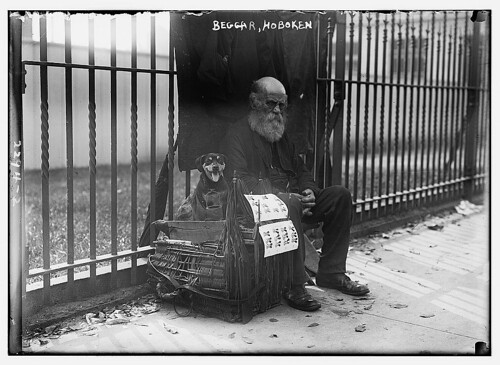
Library of Congress, Prints and Photographs Division, Washington, D.C. 20540 USA, hdl.loc.gov/loc.pnp/pp.print

It’s a cold, sunny November day in San Francisco, and I’m walking up Fillmore Street near Japantown. I don’t live in the city, but I enjoy coming in for the day from my little place in the oak-covered hills to the north. I’ve already indulged in a fine latte at a tiny French cafĂ©, sitting at a table in the sun reading the New York Times and feeling comfortably and exquisitely urbane. Now I’m near the Duxiana store, which sells high-end luxury mattresses, and I notice an older man sitting on an overturned bucket by the corner. He’s wearing a gray canvas smock and he’s holding an empty soup can carelessly in his right hand. He’s looking across the street, as if he’s just resting there on his bucket, resting rather than begging. I walk by him and up to the gorgeous windows of Duxiana, and then I remember my tax.

I used to live in the country in the Pacific Northwest. Every few months I’d drive to Seattle, and invariably, as I came down the off-ramp from the freeway I would see a person at the corner near the first traffic light, usually holding a hand-lettered cardboard sign: “Need food or a job,” “Please help,” “Mother and two children,” ”Veteran.” I would roll down the window and hand a few coins or a dollar or two to whoever was on the corner that day. I began to think of this as my “city tax.” I was coming to Seattle to enjoy the city for the day; the least I could do was hand a few coins to someone willing to stand on a busy off-ramp in the ceaseless drizzle.

I know and understand the arguments against handing money to homeless people. But I tend to see asking for money on the street as a very difficult, very poorly paid job, one that I – and most people I know - would be utterly unwilling to do. I can’t imagine standing on the street for hours at a time on sore feet, begging for help, ignored, sometimes cold or wet or both, all for a little bit of cash, perhaps barely enough to buy a warm cup of coffee.

So I’m standing by the Duxiana windows, looking in at the beds as soft as clouds, and I remember all this. I turn and walk back to the man with his bucket and empty soup can, and I drop a little money in the can. He’s surprised. Without thinking, I also touch his hand and wish him well. He, in turn, looks me in the eyes and says, “Bless you, bless you.” And I feel blessed. Thoroughly and genuinely blessed and warmed and touched, like a sudden shaft of sunlight on a dark day.

This is what I’ve found, from these many years of giving money to people on the street - men and women with their shopping carts in big cities like Washington D.C. or New York or San Francisco, homeless pierced teenagers in small towns, old ladies dressed in black on the steps of churches in Mexico, gypsies playing accordions in Italy or in Greece - the response, nearly every time, from every sort of person in every language, is “Bless you,” or “God bless you.”

This is the most wondrous and mysterious thing to me. I hand fifty cents to a stranger and they bless me, like an ancient ceremony, like the kiss on the head by a wise man or woman. I never expect the blessing – why should they bless me from their cold street corner, comfortable and secure and oblivious as I am? And yet, when the blessing appears, I understand again that this is what they have to offer. When you have nothing, what can you offer but your blessing? And perhaps, when you have nothing, when you find yourself begging for food or change while others walk by you on the way to warm restaurants and cafes, your blessing is a gift far beyond what even you yourself can know.

All I know is that it feels like more than a fair exchange. Fifty cents in my pocket will buy me very little happiness; a blessing, a real blessing, and that glance into each others’ eyes, is beyond price.

Wednesday, December 30, 2009

In the Deep Midwinter

We all have our ways of celebrating the winter holidays. Some ways are more eccentric than others, I'll admit. This year I spent the day after Christmas looking for birds from dawn to dusk. The next day, the 27th of December, I spent the whole day in a silent retreat led by a Theravadan Buddhist nun. I've been thinking about these two days and how, mysteriously, they reflect one another. Each was a day of silence, of careful awareness, of gratitude, and of giving.

My bird-watching day was no random event: I was participating in the Christmas Bird Count, a census of birds in the western hemisphere that has been conducted annually over a few weeks in mid-winter by the Audubon Society for more than a hundred years.

According to the Audubon website, the count was begun in 1900 by an early bird conservationist, Frank Chapman, as an alternative to Christmas "side hunts" where hunters competed against each other in teams for the largest number of birds killed in a day. Now more than 50,000 volunteers in 17 countries participate in the count, and the results are used by ornithologists and conservation organizations to monitor the health of bird populations in their winter ranges.

I did the count with a friend, and we were assigned to an area of about one by seven miles in the hills above Bolinas Lagoon, out on the outer coast just north of San Francisco. Our day began at about 5:15 am - hours before either of us normally wakes up - followed by a groggy breakfast and a drive in the dark across the hills to the coast.

We're relative neophytes, so we were paired with two more experienced birders - an ecologist and an ornithologist - whom we met just before dawn in a muddy parking lot near the lagoon.

After minimal introductions, we headed up into the hills in silence, all four of us listening intently to the tweets and chirps and little sounds all around us in the dim woodland, though really only two of us (guess which two?) knew what they were hearing. Every few minutes someone would see something and we would all be peering into the tangle with our binoculars, trying to see a sparrow or a towhee or whatever might be lurking there, keeping a count of how many birds of each species we saw or - in the case of our companions - heard.

And so the day went, mostly in silence, hiking on or off trail through the canyons filled with coast live oak (and poison oak) or willow and bay, sometimes up in the chaparral or grassland of the open hills, sometimes all four of us together and sometimes split apart, each one of us completely intent on seeing and counting, eyes and ears and senses fully engaged, not stopping to eat or chat or even sit down. It was cold and gray, and in the afternoon it started to rain, first gently and then with determination, and we kept working as long as we could, until the rain came down so heavily in the early dusk that we were blinded and the birds were essentially invisible.

Part of what I loved about the day was the way that EACH BIRD MATTERED. In ordinary birdwatching, when I see one kinglet, I'm pleased, but the next one I see doesn't matter so much, and by the tenth I'm usually oblivious. But in the Christmas Bird Count, each raven, each crow, each jay matters, no matter how common, no matter how many have been seen before. Ah, if only we treated everything this way!

After a nine hour day in the cold and rain and muck, We drove back across the foggy slopes of Mt. Tamalpais to a warm cafe where we sat and drank hot chocolate, still in our wet jackets, still completely focused on the count. We added up what we had seen: sixty-three species, about average for a Christmas Bird Count in this area.

For each species our leader added up our individual counts, "Robins?" he would say, "how many robins?", and each of us would peer at our wet notebooks and scribbled, pencilled, nearly illegible numbers. "Sixteen, no, wait a minute, that's twenty, with those four I saw near the farmhouse," remembering the bright birds high up in the trees like so many orange Christmas ornaments. "Kestrels?" and we would get into a brief discussion about whether MY two kestrels were the same or different birds than the ones someone else had seen hovering like tiny kites above the hills.

Then we all shook hands and went our separate ways out into the dark. Our little count will be added to the count for all of southern Marin County, and that will be added to counts all across the hemisphere, and someday someone might comb through the data, noticing that this year, like the last few, no oak titmice were seen on the Marin coast, another population winked out, or our fleeting glimpse of a peregrine might tell a researcher that peregrines still hunt the flocks of ducks out in Bolinas Lagoon, a conservation victory after the birds came so close to extinction.

Strange to know that what felt so inconsequential - our day of effort counting robins and chickadees - would be added into a grand continental pattern created by thousands of people and hundreds of thousands of birds, a tapestry across time and space and the usual barriers between species. Even now as I write this there are people out with binoculars and spotting scopes, perhaps in your neighborhood, looking up into the trees, recording the often unnoticed life that fills the air with song and flight.

***************************

The next morning I woke up early again and drove to Spirit Rock Meditation Center, part way back toward the coast. Another gray, foggy day. The grassy hills of Spirit Rock were lost in the cold fog, but inside the meditation hall a hundred people or more sat quietly on chairs or cushions. At the front of the room were two striking women, both with shaved heads, one in brown robes, one in white: Ajahn (which means teacher) Anandabodhi and a novice nun, Anagarika Santussika.

Ajahn Anandabodhi and two other siladharas (nuns that take ten precepts, including celibacy, not handling money, depending entirely on alms, and eating only once per day) just arrived in San Francisco to start the first Buddhist nun's community in North America (Saranaloka).

Photo from Saranaloka website

The nuns, who are British, come from a monastery in Great Britain, the only one I know of in the west that trains nuns as well as monks. Although a women's order of nuns has been part of the Buddhist world since the time of the Buddha, the history of women renunciants is a history of marginalization. In many parts of Asia the women's order has died out altogether; in other areas women practice as nuns but in desperate poverty, not supported by lay people in the same ways that monks are, and often not empowered to teach.

As a consequence of this sad history, in all my years of meditation practice with many teachers, I had never been taught by a Buddhist nun before this midwinter day. I sat down near the front and listened as the Ajahn gave basic meditation instructions, struck by her clarity and steadiness. Then the hall settled into silence, silent sitting alternating with silent walking out under the dripping trees.

Usually at one day retreats each person brings their own bag lunch, but for this event, which was also offered without charge (monks and nuns cannot charge for the teachings), we were invited to bring something to share and to offer to the nuns, since they can only eat what is explicitly offered. At about 11 AM, when the nuns eat their one meal for the day, Ajahn Anandabodhi came and received the individual dishes from those of us who had brought an offering, gently taking the dish from our hands and placing it on the tables. Then she and her novice nun offered a meal blessing. Afterward we all went through the line, sharing the bounty of a hundred gifts to one another.

I've written before of how moved I am when I see the power of generosity, and this day I felt it very deeply, almost to tears, seeing both the radical trust of these women's lives, and the tremendous kindness of my fellow retreatants. It was particularly poignant to know that after two thousand years of being pushed aside, ordained women could now step forward with their gifts and be appreciated, even celebrated.

This is the best of us as human beings, I think, this generosity, just as the generosity and caring of the Christmas Bird Count represents the best of us - crazy people willing to go out in all weather in the depth of winter while their friends and relatives are at the mall or in front of the television, all for the sake of the birds of our world.

I spent the rest of the afternoon in silence and attention, just as I had the day before, though my attention was on breath and silence itself, rather than birdsong and movement, and I was grateful to be drier (!). When I walked outside, once again I saw each crow, each jay, each black phoebe, and almost without thinking found myself counting them, amused and glad at the way that my vision had been clarified by the day before.

These two worlds are both my worlds - the world of inner attention and the world of birds and trees and fog....I am so grateful for both of them, and for the people who share my love for them.

In the depths of winter, nourishment and renewal.

Monday, December 7, 2009

A Table for Four Hundred


I celebrated Thanksgiving this year up in Sonoma County. Ah, it was great. We had organic roasted vegetables from local farms, a huge selection of fine cheeses, fresh organic artisanal bread, organic roast turkey, poached wild salmon, roast lamb, local pears poached in Merlot, a selection of locally-produced wines, overflowing tables of pies and deserts.... There were linen tablecloths, white napkins, china, and lovely garden flower arrangements on every table.

And this cost nothing, not for us and not for the other four hundred people celebrating together, whether poor or rich, young or old. We went up early and spent all day with about fifty other volunteers, guided by some of the best chefs in the county, turning boxes and boxes of donated organic food from local farms and from Whole Foods into a free Thanksgiving feast, and then some of us helped serve, and then we sat down at the beautiful tables and enjoyed the abundance with everyone else, just as one does at home with friends and family.


And abundance it was - an abundance of kindness, of laughter, of good will and hard work, gourmet food and great wine, all offered generously. Kids ran around everywhere, older folks in wheelchairs chatted together or with families nearby, and street people sat next to doctors, lawyers and migrant workers. The feeling in the big community center hall was like one big four-hundred-person smile.

There were people who would have spent Thanksgiving alone, people who came to spend Thanksgiving with their friends, people who spoke no English, people who volunteered every year, people taking food back for bedridden family members - every sort of person, in every sort of situation, side by side at the long, happy tables.

What I found most inspiring was the way that there were no boundaries. I've served Thanksgiving in shelters, and found it very moving, but this was something else, a wide hospitality and a wide open door for whoever wanted to enter, vineyard owner or street kid. And no cheap donated old vegetables and canned food on paper plates, dressed up pitifully as a "Thanksgiving meal". This was the best of the best, served with love and pride.

It reminded me of Dorothy Day's radical Catholic teaching of how to be with the poor or homeless: "Bring them bread and roses." Not just bread: people need roses too - dignity and beauty. Herding a bunch of poor people into a line for canned cranberries and green beans is better than nothing, but it's not roses. Creating a place where everyone is welcome, where rich and poor sit down together, and where everyone is served beautiful, organic food - that's I think what Dorothy Day meant by 'roses'.

Over the years I've struggled with my relationship with Thanksgiving. On the one hand it seems like a perfectly lovely holiday, a celebration of the harvest and of gratitude. On the other hand, sometimes I feel that it has degenerated into a kind of family food orgy, the table groaning under vast plates of food, soon to be followed by a vast mess in the kitchen and the next day by Black Friday, the beginning of the Christmas buying frenzy. Maybe it's because most of us don't grow our own food, so the food has lost its connection to the land and its abundance. Perhaps my problem is a feeling that in a country that has grown fat on the wealth of the world, something is subtly off about a holiday that's primarily about consumption.

Some years I've fasted for the day. A few times I treated it as a normal work day - it was a fabulous day to get a lot done and I had an entire six story building to myself. But those things didn't feel quite right, as if I was out of step with something quite important, even primal. Last year I served a Thanksgiving meal in a shelter in Flagstaff, Arizona - not a very good Thanksgiving meal, to be honest, served amidst the bunk beds in a cold concrete-block building - but the gratitude on the faces of the men there was palpable, and I felt like I was finally touching something closer to the way I want and need to celebrate this holiday.

This year I'm in the Bay Area, and although there are plenty of poor people here, there aren't many free Thanksgiving meals, especially outside the churches and Salvation Armies. I was spending Thanksgiving with a friend who is allergic to organized religion, so those places were not possibilities for us. When I found out about the Sonoma Thanksgiving, I was intrigued by the idea, and my friend was particularly delighted about the organic turkey, so we traveled an hour north into the little town of Sonoma, and proceeded to have so much fun that I'm surprised it was legal.

I don't know why it's SO MUCH FUN to work really, really hard to make a free Thanksgiving, but believe me, it is. My friend carved organic turkeys to his heart's content, to the admiration of the other guys. I had the rather amusing job of trying to serve roasted parsnips to a highly skeptical crowd, "What are those? Parsnips? What are they? What do they taste like? No thank you." (A hint to other Thanksgiving volunteers: don't get stuck with the parsnips.)

Nonetheless, it was great. At the end of the day, after helping with the mountain of dishes, we were exhausted and utterly happy. The four-hundred-person smile had seeped into us and our sense of a true participation in 'Thanksgiving' was deep and complete.

Maybe the message of Thanksgiving is not just abundance, but generosity. Perhaps that's why we were so utterly happy - we had spent the day drenched in generosity, poached in generosity like those pears in Merlot (mmmmm...those were good).


Many thanks to Gary Edwards, the mastermind behind the Sonoma Community Center Thanksgiving, who somehow coordinated a bunch of raw, restless recruits and got a hundred-course meal out on time, the other great chefs and caterers, the many volunteers, the farms and businesses that donated food, and to Bob Kinsey, one of the loyal volunteers who took the photos in this post.
We'll be back for the Christmas Day meal!