Showing posts with label gratitude. Show all posts

Thursday, December 31, 2015

Snow Idyll


From Thomas Merton: There is a pervasive form of contemporary violence to which the idealist most easily succumbs: activism and overwork. The rush and pressure of modern life are a form, perhaps the most common form, of its innate violence. To allow oneself to be carried away by a multitude of conflicting concerns, to surrender to too many demands, to commit oneself to too many projects, to want to help everyone in everything, is to succumb to violence. The frenzy of our activism neutralizes our work for peace. It destroys our own inner capacity for peace. It destroys the fruitfulness of our own work, because it kills the root of inner wisdom which makes work fruitful.”
Years ago my friend Ruth Ozeki told me about a famous Japanese book from the 14th century, Essays in Idleness (or The Harvest of Leisure), written by a  Japanese Buddhist monk. I suppose she thought I would appreciate the book because of my own forays into the country of idleness, or, as I said for a few years, “gainful unemployment.” Now I am gainfully and happily employed in the work of ministry, which is a 24/7 sort of job (maybe I’m making up for my years of idleness!), but I find that times of idleness are even more important, not less, in this life I have now.

And so I found myself here in a stone hermitage at St.Benedict’s monastery, otherwise known as Snowmass Monastery, for five solo days in the heart of winter, starting Christmas Eve, because, luckily for me, my current Colorado congregation celebrates Winter Solstice rather than Christmas, and so my winter holiday obligations were officially over. This Trappist monastery on nearly 4,000 acres of land, up above Snowmass in the Colorado Rockies, home of Father Thomas Keating, maintains a few small hermitages, offered freely, in the Benedictine spirit of hospitality.


I’ve been in seminary and trying to learn the art of ministry for years now, so this kind of open time has just not been possible for a long time. As I drove the snowy roads on Christmas Eve from my house in the valley up into the wild open mountains, I wondered, “Will I remember how to just be? Will I be frantically trying to study something, just out of habit? Will I feel guilty that I am not answering emails?”

I did remember how to be idle! I suppose it’s not surprising, given how much of my life I’ve spent in silent retreat. I turned into the mile-long road to the monastery, sitting at 8,000 feet in a snowy bowl surrounded by high ridges, and felt the deep familiarity of entering sacred space; drove up the hill to the hermitages and felt something in my heart ease. 


I parked and walked up the snowy path to my little octagonal hut, rabbits (more on rabbits later) scattering this way and that under the trees, and I felt home in the silence. And so for five days I  drifted, dreamed, sat in zazen, slept, watched sky, watched snow fall, read poetry, wondered, wandered, opened, breathed.


I found a phrase from a dream about process theology, dreamt more than a year ago, in my journal – the journal I have barely written in this past year - “Everything brimming over with divinity.” That’s what it was like. On Christmas Day is began to snow, and it snowed and snowed, all day, all night, the light crystalline snow of western Colorado, like feathers and sugar combined, glittering in the light, everything covered up with snow, mountains hidden, and I remembered Norman Fischer’s story of being a young Zen student and wandering in the snow reciting the Heart Sutra, around and around in a sort of joyful delirium. A rabbit came and peered in at me, its paws on the glass door,  then hopped away into the storm.


In the afternoon of Christmas Day I put on my big warm winter boots and my warm down jacket and headed out in the snow, my car already buried. It seemed like I was the only one here. I found the path down to the main retreat house, through the Gambel oak, and kicked my way down through the deep powdery snow. Half way there I could just make out the outlines of a bench, completely covered. I unburied an edge of it and sat down, warm, the only sound the delicate sound of snowflakes landing on me – my hat, my eyelashes, my jacket, my boots. I was so still for so long that a rabbit (I told you would be hearing more about rabbits) came right up alongside me, looked at me, and hopped way.


The next day was clear, a blindingly blue sky and snow sort of day. I shoveled out my path and around the car (greeting the rabbits, of course), helped a monk dig out his plow, which had nearly been swallowed up by snow, and then sat and read and thought and drank tea.  

I thought my heart might burst with happiness and gratitude. And that night I walked the mile or so down the road through the open fields to the main monastery for vespers, the air so cold it was nearly frightening, despite my layers and the thermos of tea in my pack. 

In the dark the monks sang songs to the Holy Family and to Mary, and afterwards I walked back, only now the full moon had risen over the hills, and miles of snowy mountains were illuminated with its brilliance.

And so it went. Ordinary moments -- making meals and eating, brushing teeth, shoveling snow. Sleepy moments. Waking to moonlight. Moments of tears, of gratitude, of laughter. Taking off the armor, re-acquainting myself with my life and my practice, remembering why I am doing the work I am doing, and what matters. 

It is such a privilege, to be able to take time out from work and ordinary life for this plunge into beauty and solitude. If I had fewer resources, if I had a family to care for, if the great generosity of the donors to this place had not manifested in a way that makes being there affordable.....so many causes and conditions had to come together to make this possible. I never take for granted how much silence and depth have been part of my life, and what a blessing they have been. 

May all who need idleness find a way to it.   


Saturday, November 3, 2012

Final Shuso Note: Perfect In Our Imperfection


It's been almost a week since the shuso ceremony - and the end of the Everyday Zen fall practice period - on Sunday the 28th of October. The image I have, when I think of the ceremony now, is of a brightly colored, flower-bedecked boat full of revelers, gradually receding toward the horizon, the music growing fainter with each day. I have feelings of poignancy, amazement, and gratitude, slowly fading as I take on what's next in my life. I'm in Santa Fe, New Mexico now, about to help a dharma friend lead his first seven-day retreat, sitting at an old wood desk in an adobe house surrounded by pinon pines and junipers, a long way from the California coast and the my dear companions on the path there.

I thought I would try, for those of you who have never seen a shuso ceremony,to describe it, as best I can, though some of what it is won't fit in words. The ceremony is the culmination of a traditional Zen practice period, or ango, a time of intensive practice and training. It is also the culmination of a time of training of the person who has been chosen as shuso, or head student, for the practice period. It is a doorway, an initiation, and an intimate dance between the shuso and the people in the practice period. What is required of the shuso during the ceremony seems, from the outside, to be nearly impossibly difficult. Not only does the ceremony require elaborate choreography, intense concentration and memorization, but the shuso must also :show up" authentically and spontaneously in response to deep and searching questions.

Our ceremony with Everyday Zen was held at the beautiful Marin Headlands, north of the Golden Gate bridge, at the end of a day of meditation. We rent space on an old military base just above the ocean beach. All day long you can hear the waves and birds and foghorns.


The ceremony is exceedingly formal and intricate.It starts with a procession into the hall, led by a person ringing a small, high-toned bell, then the teacher, who is walking with an immense black staff, then the teacher's attendant, then the shuso, carrying an ornate Japanese fan, then the benji (more on the benji later) who carries a smaller staff and a book wrapped in cloth, then a person at the end with a pair of wooden clappers. As they walk, there is an impressive set of sounds: the "ding" of the little bell, a pause, the "clack!" of the clappers, a pause, and then an answering deep "boom" of a drum from within the meditation hall. All punctuated by the sound of the teacher's staff as it hits the ground.

I've sat in the meditation hall as a student for many shuso ceremonies, and hearing the approach of the procession is an awesome experience. You know the shuso is walking toward something frightening and wonderful, and that he or she is in the procession, arriving, arriving....

In the hall, all the people in the practice period are seated in a tight block, their cushions or chairs right up against one another. On the other side of the hall is another block of people: former shusos, all of whom have been invited by the current shuso to the ceremony. In my case, the former shusos were senior people from Everyday Zen and from The San Francisco Zen Center, people I have lived with and practiced with over decades. In addition, other friends came from around the country to witness the ceremony. On either side of the altar is a cushion: on the left of the altar, the teacher's cushion; on the right, the shuso's.

Shuso fan, photo by Wendy Lewis
After the usual Zen bows, everyone sits down and the teacher's attendant carries the book all the way around the blocks of people from the teacher to the shuso, walking very, very slowly, while the Heart Sutra is chanted. When he or she arrives in front of the shuso, they bow together and the shuso takes the book (still holding the fan in one hand: the fan is never put down for the duration of the ceremony). Traditionally, the first koan from the Blue Cliff Record record is read, "Bodhidharma's Vast Emptiness," but in Everyday Zen we read another koan from the Record of the Gateless Gate  (this isn't the translation we use, but is the closest one I could find online):

Zhaozhou asked Nanquan, “What is the Way?”  Nanquan said, “Ordinary mind is the Way.” Zhaozhou said, “Shall I try to direct myself toward it?” Nanquan said, “If you try to direct yourself toward it, you will move away from it.” Zhaozhou said, “If I don’t try, how will I know it is the way?” Nanquan said, “The way is not concerned with knowing or not knowing.  Knowing is illusion; not knowing is blank consciousness.  If you truly arrive at the Great Way of no trying, it will be like great emptiness, vast and clear.  How can we speak of it in terms of affirming or negating?”

Zhaozhou immediately realized the profound teaching.

Then the shuso gets up and slowly, slowly walks, carrying the book, the other way all the way around the hall, around the blocks of people, to the teacher (there are a lot of these long slow walks during the ceremony). The teacher and shuso exchange bows, the shuso bows to the people in the hall, and then the teacher hands the shuso a long wooden staff, the teaching staff. Once again, slowly, slowly, the shuso walks with the staff held horizontally in both hands at eye level (trying desperately not to hit anyone in the head) all the way back around the room to the shuso's seat.

The benji, who is a person in the community who has been side-by-side with the shuso through the whole practice period,stands up and reads an original poem to start the question and answer for the ceremony. My friend Anne Connolly read her poem:

a wandering monk returns to these shores
in the gathering fall light
shakes her sleeves — “empty!” — she says,
and then in a neat dharma trick pulls out
mirrors brooms imposters fools
centuries of women ancestors tumbling forth
with curves like you’ve never seen on form and emptiness
and fierce compassion offered for our awakening.

Now let us hear the shuso!


Then I recited some memorized verses, while sitting and holding the staff horizontally: 

This is the dharma staff, five feet long. Once a black snake on Vulture Peak, it became the Udumbara flower. Sometimes it is a dragon, swallowing heaven and earth; sometimes a vajra sword, giving and taking life. This staff is now in my hands. Though just a mosquito biting an iron bull, I cannot give it away. Dragons and elephants, let us call forth the dharma! Give me your questions! (And the shuso turns the staff vertically and pounds it on the floor: bang!)

Then, starting with the benji, each person in the practice period (in our case, about 50 people) asks a dharma question, and the shuso responds. The dharma question is short, but is meant to be a real question, from the person's own life and practice. And the shuso has to respond, with heart and authenticity. At the end of each question, the shuso hits the staff on the floor. It is all very dramatic. After the practice period asks questions, then all the former shusos ask a question. Altogether, about 75 people asked me a question in the ceremony.

This is where I learned the most important thing from the ceremony. Answering these questions is impossible. How could any person know "the answer" to someone's deepest question? How could the shuso show up completely for person after person after person? There's no way anyone can do it. But here's what I learned, the great secret: "I" couldn't do it, not on my own. The only way I could do it was with the help of everyone in the room and in the container of the ritual. In a sense, we all did it, though maybe, if someone was a casual observer, it might appear that "I", Florence, did it. There was this tremendous flow of mutual support and love in the room, and in that field this impossible thing was possible. It was like enacting a miracle, or, as Norman Fischer wrote once, "like a group poem." Everyone making something very beautiful, together.

After the questions, there were more walks around the room, more bows, more handing of objects back and forth, and then congratulatory statements from various people, the former shusos, the teacher, and, in my case, my other teachers: Bruce Fortin, who is my current Zen teacher; Jeff Kitzes, my long-timer therapist and a Zen Master in the Korean Kwan Um Zen school; and James Baraz, one of the founders of Spirit Rock, a vipassana teacher, and my very first teacher when I began practicing in the 80s. Having Bruce, Jeff, and James there was extraordinarily sweet. All three of them are men who lead with their hearts. 

And of course, the teacher of the practice period, my teacher for more than twenty years, Norman Fischer, without whom I would never have found the path of Zen, never ordained, and never had a chance to be shuso. Norman and I have been through so much over these many years: the years he, as a relatively new teacher, came up to lead retreats in the Pacific Northwest; his time as abbot of Zen Center; my divorce and illness; the beginnings of the Everyday Zen sanghas; misunderstandings, working together, mutual support, mutual frustration, my needing to step away from the formal role as his student, his forgiveness of me, my forgiveness of him.... Somehow, the practice period and the ceremony was big enough to hold all of what we have been over so many years, with grace and clarity. 

Near the end of the ceremony, the shuso says these words, after profuse apologies for all the mistakes he or she has made:

"Let us continue to practice together in this lifetime and times to come, perfect in our imperfection. 

Isn't that just it, in all relationships, in life itself? "Perfect in our imperfection"? It's in moments like the end of the shuso ceremony, and in these words, that I remember, vividly, clearly, why I am a student of Zen. Humble, wild, poetic, connected, and full of heart - that's the Zen that called me more than two decades ago, and that still calls me, every morning, to the black cushion and the ongoing mystery of the path.


Anne C., Sue M, Norman Fischer, me, ARobin O., Mary Ann S, just after the ceremony. Photo by Ren Bunce.
Finally, I just have to say to anyone reading this who was part of the Fall 2012 Everyday Zen Practice Period: Thank you for your practice, for your support, for your love, and for walking the path with me. I will be grateful to you for the rest of my life. "May we continue to practice together in this lifetime and times to come!"

Saturday, November 19, 2011

The Shadow of an Anchovy


My mother-in-law's family were poor peasants, and they would tell the story of being so poor that instead of having meats at the center of the round of polenta, they had a single small anchovy hanging over the center, casting its shadow. They said that the shadow of the anchovy was all they had to bring a little richness to the polenta.  
                                                                                                          -  Peggy Haines-Capelli
I was in Italy at the end of October and beginning of November, in the provinces of Tuscany, Umbria, and Le Marche. I was more than a traveler there: I was named for Florence - Firenze to my mother and those who knew me as a child - and my childhood was woven with the narrow streets and convent cloisters, churches and olive groves of Firenze and Tuscany, as I traveled back and forth with my art-historian single mother between the surreally different worlds of the American Midwest and Italy.

Fields, vineyards and villa, Setignano

From the time I was five until I was fifteen, we lived in Florence for part of every year. I went to kindergarten and fifth grade in Italian schools. I spoke Italian. Some of who I am came from that life, so far-away and mysterious to my American school-mates. I hadn't been back in many years, and this trip was a poignant, sweet chance to be there again with my mother, while it is still possible for both of us.

Although Italy is wealthy now, when I was a child - thirty, forty years ago - Italy was poor, third-world poor, and we were poor too, despite (or maybe because of) our bicontinental life.

The convent on Via Giuseppe Giusti
When I was small, we lived in a convent pensione across the street from the archives where my mother did her research. She couldn't afford child care, so in the early morning, when I was still asleep, she would go out, buy a roll and jam, sneak back in and leave it by the bed for me. When I woke up I would find my roll waiting for me, and for the rest of the morning, until lunchtime, I would lie in bed, get crumbs all over the sheets, and read, endlessly.

If I really needed something, the Italian nuns were down below, cooking in the big dark kitchen, cleaning the already-shining floors in the mostly empty main rooms, or cultivating the garden behind the building. I remember eating zucchini flowers for the first time, deeply comforting pastina in brodo with grated parmigiano on top, hard Tuscan bread. A great treat was a single Baci, the chocolate and hazelnut "kiss" made by Perugino, or an aranciata, an orange soda.

When we lived in Italy for longer times, we rented an apartment from an English doctor who owned a farmhouse in the hills to the west of the city. The contadini, the traditional Italian peasants who worked the land, lived down below us, next to their animals. Every morning I would wake to the sound of the cart and white oxen going by below our windows, slowly, slowly, with much shouting.

Two white oxen in the Tuscan hills

Our back windows looked out over a quintessential, "romantic" Tuscan landscape: hills, olives, dark spires of cipressi (cypresses), stone walls, the old stone village of Pian dei Giulari perched along one side of the valley, just down the road from us. What was concealed was the poverty, the backbreaking work, the deep knowledge that knew how to rebuild the stone walls, how to prune the olives, how to breed the oxen, how to survive. Now most of the contadini, as a culture, are gone, gone to work the well-paying jobs in the cities, and the absentee landlords struggle to keep the vineyards and groves alive without that deep and unacknowledged wisdom.

Sheep and stone trough

I remember, vividly, walking as a child on a country road and looking down into a farmyard where a contadini family was gathered around a round of polenta. Polenta was peasant food - no city restaurant would have dreamed of featuring it on a menu - and it was formed into enormous flat cakes, as wide as a circular table. It was cut with a string into wedges (this fascinated me), and each person at the table would eat their wedge toward the middle. In the middle would be whatever protein the family might have, and whoever could eat their wedge most quickly would get more of what was there.

A meat shop in Norcia - yes, those are boars' heads

While we were in Italy this time, we spent time with Peggy Haines-Capelli, an American art historian whom I knew and loved as a child and who, unlike us, chose Italy as her home and country. She eventually married an Italian journalist, and is now a widow. She told us the story of her husband's family and the anchovy as we sat around her round table, eating food we had brought back from our trip into the mountains of Umbria: famous tiny lentils from the town of Castellucio, pecorino cheese, salame called "mules' balls" from Norcia, with a white center of lard - a feast somewhere between a picnic and a high tea, rich with the stories of our trip to the wild and mysterious Monti Sibillini, the mountains of the sibyls. When I heard Peggy's story, probably in mid-bite of something delicious, it felt like a koan: what is the taste of the anchovy's shadow?

Quinces in farmer's market, Florence
While I was in Italy I was puzzling over the particular flavor of Italian life - the tremendous soul and depth that can be felt in the simplest village piazza or in the most elegant Florentine coffee bar. There is an appreciation of the sensuous things of the world, which, far from seeming superficial and materialistic, actually feels life-affirming, ancient, hugely sane. How do they do it? And how is it, that with all the force of modernism and wealth and speed, it is still alive, a heart at the center of things, something that can be tasted in the olive oil sitting on a trattoria table or in the syrupy intensity of a morning one euro espresso at the train station? And this story, of the anchovies...I think it's a key. I think it's a teaching story, perhaps for all of us.

Chestnuts, hazelnuts, fennel, honey in a farmer's market, Florence

We live like gods, these days. Not necessarily happy gods, but gods nonetheless. Few of us can imagine the poverty that would have a whole family only able to eat what is essentially ground field corn and water. No doubt life was hard, even sometimes hellish, for that family gathered around the polenta and that single, hanging anchovy. It drove the man who would become Peggy's husband to spend his life dedicated to defending the poor and oppressed.

House for a cat, Narni

But there is also something quintessentially elegant and clever in the story of the anchovy's shadow, although I can't quite put my finger on what it is. If there is only one anchovy to bring a little something to your polenta, what do you do? Can you appreciate the shadow of an anchovy, its salty, fishy scent perfuming the air as you eat? Can you raise your empty glass to your neighbor? Can you laugh a little, at yourself and at life, which is only providing this one little fish? Can you take what you have, a little or a lot, and make a feast? That's what it is - it's something about creating a feast out of famine, out of so little, a kind of grace, in both senses of the word.

View from hermitage, San Euitizio in Valle

That's what I feel in Italy, when I'm there: a soulful, embodied willingness to live, whatever comes. Maybe it's my projection on the place and its people, but I don't think so...I feel and see it with the part of me that was formed there. And as the country teeters on the edge of economic collapse, after so few decades of relative wealth, I think, "Well, maybe they'll be fine. Maybe they haven't forgotten how to live, under those designer clothes and behind those smart phones. Maybe they could teach the rest of us a few things about living."


"Life is too short", graffiti on a rural wall

And as I imagine a loaf of Tuscan bread, just water and flour and yeast, that intentionally hard crust to protect the soft interior, no salt because who could afford salt - and then I remember how profoundly GOOD it is, in its simplicity, in its poverty - it gives me courage.

If we are all (or most of us) going to get poorer in the future, which seems like a distinct possibility, let's do it with class. Let's celebrate the shadow of the anchovy.


This essay is dedicated to Signor Mauro Meniconi, the proprietor of a roadside porchetta van in rural Umbria, and one of the secret saints of the world.

For more photos, go to https://picasaweb.google.com/Firenze33/Italy

Saturday, March 12, 2011

All At Once


Isn't it strange, the way so many things are happening at the same moment? At this moment,as I write this or you read this, an inconceivable number of events are occurring: someone is experiencing the greatest happiness, another the greatest grief; there is an avalanche cascading down a mountain slope and somewhere else a light rain has begun to fall; a small creature is being born and another creature is dying; a new star is forming, and somewhere another star is winking out, its light and heat fading away into darkness. All at once.

Yesterday and the day before I experienced this mystery with particular vividness. Thursday night I was reading from Wildbranch at a local bookstore with two of the book's contributors. It was a lovely night, and local friends came out to hear us. I shared a story from a reader of the book, who had told me that she had given up reading environmental literature because it was too depressing, but she had realized that Wildbranch was about love, love and intimacy with our world, and love is a more potent force for action than despair. I felt so happy about the book and what it offers, so happy to be sharing it and reading from many contributors.

I came home from the reading to the news of the earthquake and tsunami in Japan, which had happened as we read. 

I was up much of the night, knowing that there could be a tsunami on the west coast of North America, and concerned for my little retreat cabin a few feet above high water on the Washington coast, my neighbor and her children, and my sweet friends who were staying in the cabin that night. I knew enough about tsunamis to know that they can cross whole oceans in a matter of hours without much diminution of their force. I knew that the county had called for an evacuation of all houses at sea level, including mine and those of my neighbors.


Several of us at the reading had arranged to go hiking the next day. The next morning I left for the hike before the time that the first major waves would come ashore. I had reached my friends who were staying at the cabin, and they had left and driven back to their own home, safely above sea level, but I didn't know what would happen to the cabin and the small community around it, all of which sits just a few feet above sea level on a narrow peninsula on Willapa Bay, a stone's throw from the open ocean and the roaring surf. I've always known that it is vulnerable to an event just like this one. Would this be the time?

Then, for the next few hours, I was hiking and looking at spring wildflowers, and I don't know what happened, except that the four of us on the hike fell into a kind of grace, one of those times of magical ease and beauty, unlooked-for, unrepeatable, perfect.


It was a clear, sunny spring day after rain, the air soft and subtly misty, the ground exhaling its moisture. Our trail started high up on Mount Tamalpais, then descended the open west-facing slopes of the mountain, views far out over the ocean, north to Bolinas and south to the very tops of the towers of the Golden Gate Bridge. The grass - not just the grass, but everything, every tree, shrub, herb and moss - was deeply, brilliantly green, the hallucinatory green of March in the coastal hills. After a while the the trail entered the redwoods and turned upward again, following waterfall after waterfall back up the mountain, up mossy stone stairways.


Some of us in our little group of four knew each other well, over many years; others were just acquaintances. Two Zen practitioners, three writing teachers, one botanist. What we shared was our love of literature and the natural world, and this moment together. We talked and walked and admired flowers and mushrooms and the light through the redwoods. We took photographs and shared gingerbread and homemade coffee cake by the side of the creek. We told stories. We wandered on and off the trail. I left my walking stick by a flower and then it reappeared, leaning against a railing on an entirely different trail. The day unfolded with a kind of ease that only happens now and again, in dreams or, if we're lucky, for a few hours in waking life.

The whole time I didn't know what had become of the only place I can call home, whether the sturdy little white cottage underneath the Sitka spruce was filled with muddy water as I walked the hills, or still sitting quietly in the rain, unharmed and whole. Or what might be happening in Japan or elsewhere all along the edge of the Pacific. There was nothing I could do, but I didn't forget, and it gave a subtly different feeling to the day for me, a kind of strangeness that made the light more brilliant and the grace more poignant.

When I got back to town, many hours later, I heard from my neighbor that everything was fine. She talked about how the day had been for her, also not knowing, waiting, and the gratitude she felt for the simple gift of being fine, of having a house and safe children, of making a pot of soup and starting a fire in the woodstove. How often do any of us remember to be grateful for our lives as they are, in all their ordinary details?


Meanwhile, across the ocean, thousands of people are still missing. Tonight, as I write this, people are huddled in makeshift shelters, mourning their homes, their friends and relatives, their pets, the lives they once had - lives that can be rebuilt but which will never be the same. And I sit here, still bathed in a sense of well-being from my day in the hills, feeling happiness for what was not destroyed in my life. These things exist side by side, utterly connected and yet also independent of one another.

I read tonight that the Dalai Lama has asked people in Dharamsala, the home of the Tibetan government in exile for more than fifty years, to chant the Heart Sutra 100,000 times for the people of Japan and all who are suffering disaster.

The Heart Sutra says "form does not differ from emptiness, and emptiness does not differ from form." Another way of saying it is that I am, at the same time, both an individual with a history and an experience that is uniquely my own, and completely connected. I am affected by an earthquake across an ocean from me, and yet walked the hills as others suffered and died. We breathe air that has been in the lungs of a lion, the stomata of 300-year-old coast live oak, the nose of Buddha, but when we breathe, only we can breathe our breath, this one irreplaceable, unrepeatable breath

And on the day I die, there will almost certainly be someone walking those hills I walked yesterday, bending to look at a wildflower, smiling at a friend, breathing in the clean ocean air. We will share that moment, not knowing each other, linked inextricably.


Friday, January 21, 2011

Ode to a Favorite Place


It's been a long time since I've written here: I've been preoccupied with promoting the Wildbranch anthology (several great book readings, in San Francisco and Portland), working on a new book of Buddhist koans and stories about women, and organizing and helping to lead a women't retreat up in Washington. It's been a project-full time!

But today is a fabulously beautiful spring day in Marin County. I walked downtown from my aerie amongst the oaks and the hawks, down through the dark, cool redwoods and the creek in Blithedale Canyon, then into the quiet village of Mill Valley. I saw a friend for green tea and apple pie, then walked back through the canyon and up the hill again. Although it's not yet the end of January, we're having true spring weather. The grassy hills are ludicrously green, daffodils are in bloom, and everywhere the spring annuals are sending up leafy shoots.


I'm often astonished that I am able to live here, even if I can only afford to be here for a few months out of every year. The beauty of this area has never grown commonplace to me. Every time I see the Golden Gate Bridge from the hills behind my place, miles away, fog drifting between the towers, I'm amazed all over again. Every time I look out my window to the peak of Mount Tamalpais, or get out of my car in the evening to quiet moonlight, I'm grateful.

And the people! Marin is still a place for eccentrics and artists and meditation junkies, surviving like relic trees amidst the Lexus SUV's, and I seem to have the luck to meet them every time I turn around.

What inspired me to write today is a quote in a book by Gary Thorpe, a sort of neighbor in Marin, fellow Zen practitioner, writer, and naturalist. I don't know Gary, but I feel like I should - we've probably passed each other on the trail and sat in the dark together at Green Gulch, never knowing it. The book is a collection of short essays about Gary's quest to see a mountain lion, Caught in Fading Light. Here's the quote that caught my eye:

"Marin County, where we live, is a wonderful place to look for something. It's a land of wilderness, parks, marine sanctuaries, farmlands, small villages, and manageably sized cities. Here one can find an abundance of wildflowers and mushrooms, along with meditation centers and ethnic restaurants. There are elephant seals, car dealerships, redwood trees, high-tech industries, rare falcons, and imprisoned felons, all sharing one of the loveliest landscapes and coastlines anywhere."

This quote reminded me of another paean to Marin Countyin Alan Watt's delightful autobiography (remember Alan Watts, the first popularizer of Eastern religions?), In My Own Way. Alan spend the last decades of his life in Marin County, some of that time on a houseboat in Sausalito, and here's what he wrote about it in 1972. Now, admittedly, Marin was a little bit wilder then (in every possible way) but I detect the same spirit even now, and many of the people who were here in 1972 are still here, tucked away up the canyons. Some of them are my neighbors!

"Here in San Francisco and Southern Marin we have succeeded, more than anywhere else in the United State, in curbing the White Anglo Saxon Protestant subculture of the nation, though our slight margin of victory requires incessant vigilance...By virtue of its hilly landscape, its redwood forests and eucalyptus groves, its wayward coastline, its liberally bohemianized population, the peninsula of southern Marin has attracted imaginative people from all over the world...it has also become a powerful spiritual center of the nation, as befits the fact that its geographical center is a mountain holy to the Indians...Though not much more than twenty-five hundred feet high, Mount Tamalpais rises almost directly from sea level...Seen in the first light of dawn...the whole mass of hills, valleys, and canyons with their forests. groves, meadows and giant rocks confers an atmosphere of strange benificence.

Extraordinary people live upon it... There are mountain lions, bobcats,and deer galore, and wild goats and eagles and vultures and racoons and rattlesnakes and gophers... All these and many more wizards, yogis, artists, poets, musicians, gardeners and madmen cluster about this mountain."

So there you have it. My friends might wonder why I keep being drawn back to this place, so far from my home ground of the rainy Northwest coast. It's the light of the January sun, my 95-year-old neighbor who traveled the world as an adventuresome entomologist, the joy of walking beneath old coast live oaks draped in lichen, the library beneath the redwoods, the shorebirds by the tens of thousands, the Buddhist meditation groups in every nook and cranny (including my own household!), the beautiful white city shimmering to the south. And I do have a soft spot for mountain lions and vultures and wizards and poets and gardeners and madmen... (might even be more than a little bit one of the latter myself).


I've been thinking about gratitude, and its power to transform our habitually whiney minds into happy minds. Gratitude for place seems like a important kind of gratitude, at least for me. To bow down and kiss the ground, whatever that ground might be - granite or concrete, dirt or sand or duff or garden bed. Beauty everywhere.

And although it's true that I don't exactly live anywhere, I feel grateful for the many beautiful places that are part of my life, from the soft shoals and light of Willapa Bay, to the tawny slopes of Mt. Tamalpais, to the tremendous spaciousness and wilderness of the Mojave Desert. Even my hometown in the Midwest, with its gracious old houses and tropical summer heat, deep green - where in the world is there NOT something to celebrate of the place where you stand?

If you feel like writing a response in the comments, something about the place or places you love, please share.

Sunday, May 9, 2010

Mother's Day


On this Mother's Day I've been driving across the springtime desert, a great bouquet spread across the mountains and canyons and vast sweeps of the Southwest. And I've been thinking about the power of mothers, the sheer unbelievable exhausting work and terror and joy of mothering that women all across the world take on with their whole hearts.

In the Metta Sutta, an early Buddhist sutra about compassion and loving-kindness, the practitioner is urged to love others "even as a mother loves her only child." The Tibetans teach loving-kindness by suggesting that since all beings have, in one lifetime or another, been our mother, how can we help but feel boundless gratitude to all of them? And Prajnaparamita, the deepest possible wisdom, is described as "the mother of the Buddhas" and is always depicted as a woman.

Personally, I've been learning a few things about what it takes to be a mother, directly from the source. For the past few months, before I started my annual fieldwork, I've been the "token non-mother" in a small meditation group for mothers that my friend Monica and I started together. All the women (except me) have school age children, and some are on the second round of raising children - a child in college and a young child still at home.

We meet at 8:30 AM on Mondays, since mothers generally can't get to an evening meditation group. Anyone can show up as late as they need to, since everyone knows that getting kids off to school can be filled with the unexpected. If someone has a child home from school, she can bring him or her to the house too. After we sit together in silence on couches and chairs and comfortable cushions, we pass around a little statue of Kuan Yin, the female bodhisattva of compassion, and each woman has a few minutes to speak about anything she wants. We all listen with our full attention. Sometimes the person speaking begins to cry. Sometimes we all start to cry. Sometimes we all laugh. And then, after each woman has said what she wants to say, we talk for a bit and then go our separate ways.

Every time is moving, extraordinary, and the hard-won wisdom in the room is palpable. And each of these women, who spend all week listening and responding - to children, husbands, a whole family - have one place where she is completely listened to and heard, and where she can say whatever needs to be said, the thing that perhaps can't be said anywhere else.

This what I've learned, through the tremendous honesty of the women in the group: mothering is infinitely harder than anyone ever acknowledges (and I can imagine all the mothers reading this snorting and rolling their eyes at my great insight). My respect for mothers - any mother - has increased tenfold. All you non-mothers out there, male or female, just try it for a week. Take someone's kids for a week - even your own kids if you're not the primary caregiver - and see what it's like. See if you're not reduced to a puddle of exhaustion, frustration, infantile responses, confusion, and self-doubt by the end of the week. See if you're not horrified by the thoughts that have arisen in your mind. See if you haven't wanted, at least once, to throw something across the room, maybe even that sweet child that you love so much who has just pushed you over an edge you never imagined you had.

And yet, on the other side, ask any mother whether she regrets what she's taken on. I remember when my friend Katy had her first child, at 40, after most of a lifetime of not wanting children. She said, over and over again, "I can't believe I almost missed this. I have never felt love like this, my heart has opened wider than I knew was possible, there is nothing more wonderful." She was transformed, radiant, new-born herself. She's walked a tough road as a mother, with some terrifying moments - the kind of moments that no parent even wants to think about - but I know she would still say the same things that she said when her first beautiful daughter was born.

To be a mother is to open yourself up to everything - to all the struggle and heart-ache, to being unappreciated or even hated by your children, to risk the loss of your children, to weep, to sacrifice what matters to you for your children, to be helpless to ease their suffering, to fail and fail again. And to love with every cell in your body.

When Tibetan teachers first came to the West, they couldn't understand why their practice of generating gratitude by thinking of one's mother often went so poorly with their Western students. It seems that deep trouble between mothers and children is a hallmark of our culture. If we're lucky we can spend a few days with our mothers without going mad. But admiration? Devotion? Very rare.

We can't pretend that trouble away, but at least we can consider what it takes to be a mother, every once in a while. I know that my contact with the women I was sitting with every Monday morning has changed me irrevocably, and has given me a new view of the tremendous nobility of the practice of mothering. A bodhisattva is a being who is dedicated to the well-being of others; however imperfectly, every mother is engaged in bodhisattva practice, doing the best she can with her own heart and the challenge of a child. Now when I see a harassed mother with a screaming child - or two, or three - in the grocery store I want to bow down and kiss her fee, or at least hand her a coupon for a good massage and a glass of wine. I am in the presence of a bodhisattva.

I want to end with part of an ancient koan:

A certain laywoman was a student of a famous Zen teacher in China. From time to time she would come to the monastery to visit the teacher, and she would be treated with great respect and was housed in the teacher's best guestroom. The senior monk at the monastery resented the woman and didn't think it was proper that she was treated so well. He kept complaining to his teacher, and finally the teacher said, "If this bothers you so much, go talk to her yourself."

So the monk went off reluctantly to see the woman. When he knocked at her door with his attendants, she met him and said, "Is this a worldly conversation, or a Zen conversation?"

He said, "A Zen conversation."

She said, "Then dismiss your attendents and come in alone in a few minutes."

When he came in she was lying on the bed, naked. He pointed to her body and said (and I can imagine the tone here), "What is this?"

She said, "This is the gate through which all the Buddhas and great teachers come into the world."


Every great man, every great woman, every humanitarian, every saint, every president, every philosopher, every artist, every writer, every peacemaker has come into the world through the body of a woman. On this Mother's Day, I bow down to all women everywhere, and especially I bow down all mothers. Bravo. Bravo. Bravo.


And a special bow to my own mother, the amazing Harriet McNeal, off in Romania having more adventures as I write this. Thank you for all the ways you've taken care of and inspired me.

Tuesday, March 23, 2010

Blessings

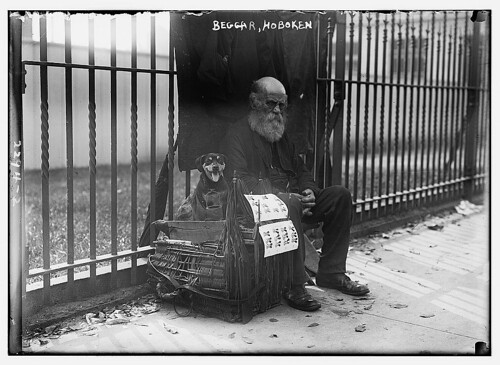
Library of Congress, Prints and Photographs Division, Washington, D.C. 20540 USA, hdl.loc.gov/loc.pnp/pp.print

It’s a cold, sunny November day in San Francisco, and I’m walking up Fillmore Street near Japantown. I don’t live in the city, but I enjoy coming in for the day from my little place in the oak-covered hills to the north. I’ve already indulged in a fine latte at a tiny French café, sitting at a table in the sun reading the New York Times and feeling comfortably and exquisitely urbane. Now I’m near the Duxiana store, which sells high-end luxury mattresses, and I notice an older man sitting on an overturned bucket by the corner. He’s wearing a gray canvas smock and he’s holding an empty soup can carelessly in his right hand. He’s looking across the street, as if he’s just resting there on his bucket, resting rather than begging. I walk by him and up to the gorgeous windows of Duxiana, and then I remember my tax.

I used to live in the country in the Pacific Northwest. Every few months I’d drive to Seattle, and invariably, as I came down the off-ramp from the freeway I would see a person at the corner near the first traffic light, usually holding a hand-lettered cardboard sign: “Need food or a job,” “Please help,” “Mother and two children,” ”Veteran.” I would roll down the window and hand a few coins or a dollar or two to whoever was on the corner that day. I began to think of this as my “city tax.” I was coming to Seattle to enjoy the city for the day; the least I could do was hand a few coins to someone willing to stand on a busy off-ramp in the ceaseless drizzle.

I know and understand the arguments against handing money to homeless people. But I tend to see asking for money on the street as a very difficult, very poorly paid job, one that I – and most people I know - would be utterly unwilling to do. I can’t imagine standing on the street for hours at a time on sore feet, begging for help, ignored, sometimes cold or wet or both, all for a little bit of cash, perhaps barely enough to buy a warm cup of coffee.

So I’m standing by the Duxiana windows, looking in at the beds as soft as clouds, and I remember all this. I turn and walk back to the man with his bucket and empty soup can, and I drop a little money in the can. He’s surprised. Without thinking, I also touch his hand and wish him well. He, in turn, looks me in the eyes and says, “Bless you, bless you.” And I feel blessed. Thoroughly and genuinely blessed and warmed and touched, like a sudden shaft of sunlight on a dark day.

This is what I’ve found, from these many years of giving money to people on the street - men and women with their shopping carts in big cities like Washington D.C. or New York or San Francisco, homeless pierced teenagers in small towns, old ladies dressed in black on the steps of churches in Mexico, gypsies playing accordions in Italy or in Greece - the response, nearly every time, from every sort of person in every language, is “Bless you,” or “God bless you.”

This is the most wondrous and mysterious thing to me. I hand fifty cents to a stranger and they bless me, like an ancient ceremony, like the kiss on the head by a wise man or woman. I never expect the blessing – why should they bless me from their cold street corner, comfortable and secure and oblivious as I am? And yet, when the blessing appears, I understand again that this is what they have to offer. When you have nothing, what can you offer but your blessing? And perhaps, when you have nothing, when you find yourself begging for food or change while others walk by you on the way to warm restaurants and cafes, your blessing is a gift far beyond what even you yourself can know.

All I know is that it feels like more than a fair exchange. Fifty cents in my pocket will buy me very little happiness; a blessing, a real blessing, and that glance into each others’ eyes, is beyond price.

Wednesday, December 30, 2009

In the Deep Midwinter

We all have our ways of celebrating the winter holidays. Some ways are more eccentric than others, I'll admit. This year I spent the day after Christmas looking for birds from dawn to dusk. The next day, the 27th of December, I spent the whole day in a silent retreat led by a Theravadan Buddhist nun. I've been thinking about these two days and how, mysteriously, they reflect one another. Each was a day of silence, of careful awareness, of gratitude, and of giving.

My bird-watching day was no random event: I was participating in the Christmas Bird Count, a census of birds in the western hemisphere that has been conducted annually over a few weeks in mid-winter by the Audubon Society for more than a hundred years.

According to the Audubon website, the count was begun in 1900 by an early bird conservationist, Frank Chapman, as an alternative to Christmas "side hunts" where hunters competed against each other in teams for the largest number of birds killed in a day. Now more than 50,000 volunteers in 17 countries participate in the count, and the results are used by ornithologists and conservation organizations to monitor the health of bird populations in their winter ranges.

I did the count with a friend, and we were assigned to an area of about one by seven miles in the hills above Bolinas Lagoon, out on the outer coast just north of San Francisco. Our day began at about 5:15 am - hours before either of us normally wakes up - followed by a groggy breakfast and a drive in the dark across the hills to the coast.

We're relative neophytes, so we were paired with two more experienced birders - an ecologist and an ornithologist - whom we met just before dawn in a muddy parking lot near the lagoon.

After minimal introductions, we headed up into the hills in silence, all four of us listening intently to the tweets and chirps and little sounds all around us in the dim woodland, though really only two of us (guess which two?) knew what they were hearing. Every few minutes someone would see something and we would all be peering into the tangle with our binoculars, trying to see a sparrow or a towhee or whatever might be lurking there, keeping a count of how many birds of each species we saw or - in the case of our companions - heard.

And so the day went, mostly in silence, hiking on or off trail through the canyons filled with coast live oak (and poison oak) or willow and bay, sometimes up in the chaparral or grassland of the open hills, sometimes all four of us together and sometimes split apart, each one of us completely intent on seeing and counting, eyes and ears and senses fully engaged, not stopping to eat or chat or even sit down. It was cold and gray, and in the afternoon it started to rain, first gently and then with determination, and we kept working as long as we could, until the rain came down so heavily in the early dusk that we were blinded and the birds were essentially invisible.

Part of what I loved about the day was the way that EACH BIRD MATTERED. In ordinary birdwatching, when I see one kinglet, I'm pleased, but the next one I see doesn't matter so much, and by the tenth I'm usually oblivious. But in the Christmas Bird Count, each raven, each crow, each jay matters, no matter how common, no matter how many have been seen before. Ah, if only we treated everything this way!

After a nine hour day in the cold and rain and muck, We drove back across the foggy slopes of Mt. Tamalpais to a warm cafe where we sat and drank hot chocolate, still in our wet jackets, still completely focused on the count. We added up what we had seen: sixty-three species, about average for a Christmas Bird Count in this area.

For each species our leader added up our individual counts, "Robins?" he would say, "how many robins?", and each of us would peer at our wet notebooks and scribbled, pencilled, nearly illegible numbers. "Sixteen, no, wait a minute, that's twenty, with those four I saw near the farmhouse," remembering the bright birds high up in the trees like so many orange Christmas ornaments. "Kestrels?" and we would get into a brief discussion about whether MY two kestrels were the same or different birds than the ones someone else had seen hovering like tiny kites above the hills.

Then we all shook hands and went our separate ways out into the dark. Our little count will be added to the count for all of southern Marin County, and that will be added to counts all across the hemisphere, and someday someone might comb through the data, noticing that this year, like the last few, no oak titmice were seen on the Marin coast, another population winked out, or our fleeting glimpse of a peregrine might tell a researcher that peregrines still hunt the flocks of ducks out in Bolinas Lagoon, a conservation victory after the birds came so close to extinction.

Strange to know that what felt so inconsequential - our day of effort counting robins and chickadees - would be added into a grand continental pattern created by thousands of people and hundreds of thousands of birds, a tapestry across time and space and the usual barriers between species. Even now as I write this there are people out with binoculars and spotting scopes, perhaps in your neighborhood, looking up into the trees, recording the often unnoticed life that fills the air with song and flight.

***************************

The next morning I woke up early again and drove to Spirit Rock Meditation Center, part way back toward the coast. Another gray, foggy day. The grassy hills of Spirit Rock were lost in the cold fog, but inside the meditation hall a hundred people or more sat quietly on chairs or cushions. At the front of the room were two striking women, both with shaved heads, one in brown robes, one in white: Ajahn (which means teacher) Anandabodhi and a novice nun, Anagarika Santussika.

Ajahn Anandabodhi and two other siladharas (nuns that take ten precepts, including celibacy, not handling money, depending entirely on alms, and eating only once per day) just arrived in San Francisco to start the first Buddhist nun's community in North America (Saranaloka).

Photo from Saranaloka website

The nuns, who are British, come from a monastery in Great Britain, the only one I know of in the west that trains nuns as well as monks. Although a women's order of nuns has been part of the Buddhist world since the time of the Buddha, the history of women renunciants is a history of marginalization. In many parts of Asia the women's order has died out altogether; in other areas women practice as nuns but in desperate poverty, not supported by lay people in the same ways that monks are, and often not empowered to teach.

As a consequence of this sad history, in all my years of meditation practice with many teachers, I had never been taught by a Buddhist nun before this midwinter day. I sat down near the front and listened as the Ajahn gave basic meditation instructions, struck by her clarity and steadiness. Then the hall settled into silence, silent sitting alternating with silent walking out under the dripping trees.

Usually at one day retreats each person brings their own bag lunch, but for this event, which was also offered without charge (monks and nuns cannot charge for the teachings), we were invited to bring something to share and to offer to the nuns, since they can only eat what is explicitly offered. At about 11 AM, when the nuns eat their one meal for the day, Ajahn Anandabodhi came and received the individual dishes from those of us who had brought an offering, gently taking the dish from our hands and placing it on the tables. Then she and her novice nun offered a meal blessing. Afterward we all went through the line, sharing the bounty of a hundred gifts to one another.

I've written before of how moved I am when I see the power of generosity, and this day I felt it very deeply, almost to tears, seeing both the radical trust of these women's lives, and the tremendous kindness of my fellow retreatants. It was particularly poignant to know that after two thousand years of being pushed aside, ordained women could now step forward with their gifts and be appreciated, even celebrated.

This is the best of us as human beings, I think, this generosity, just as the generosity and caring of the Christmas Bird Count represents the best of us - crazy people willing to go out in all weather in the depth of winter while their friends and relatives are at the mall or in front of the television, all for the sake of the birds of our world.

I spent the rest of the afternoon in silence and attention, just as I had the day before, though my attention was on breath and silence itself, rather than birdsong and movement, and I was grateful to be drier (!). When I walked outside, once again I saw each crow, each jay, each black phoebe, and almost without thinking found myself counting them, amused and glad at the way that my vision had been clarified by the day before.

These two worlds are both my worlds - the world of inner attention and the world of birds and trees and fog....I am so grateful for both of them, and for the people who share my love for them.

In the depths of winter, nourishment and renewal.

Monday, December 7, 2009

A Table for Four Hundred


I celebrated Thanksgiving this year up in Sonoma County. Ah, it was great. We had organic roasted vegetables from local farms, a huge selection of fine cheeses, fresh organic artisanal bread, organic roast turkey, poached wild salmon, roast lamb, local pears poached in Merlot, a selection of locally-produced wines, overflowing tables of pies and deserts.... There were linen tablecloths, white napkins, china, and lovely garden flower arrangements on every table.

And this cost nothing, not for us and not for the other four hundred people celebrating together, whether poor or rich, young or old. We went up early and spent all day with about fifty other volunteers, guided by some of the best chefs in the county, turning boxes and boxes of donated organic food from local farms and from Whole Foods into a free Thanksgiving feast, and then some of us helped serve, and then we sat down at the beautiful tables and enjoyed the abundance with everyone else, just as one does at home with friends and family.


And abundance it was - an abundance of kindness, of laughter, of good will and hard work, gourmet food and great wine, all offered generously. Kids ran around everywhere, older folks in wheelchairs chatted together or with families nearby, and street people sat next to doctors, lawyers and migrant workers. The feeling in the big community center hall was like one big four-hundred-person smile.

There were people who would have spent Thanksgiving alone, people who came to spend Thanksgiving with their friends, people who spoke no English, people who volunteered every year, people taking food back for bedridden family members - every sort of person, in every sort of situation, side by side at the long, happy tables.

What I found most inspiring was the way that there were no boundaries. I've served Thanksgiving in shelters, and found it very moving, but this was something else, a wide hospitality and a wide open door for whoever wanted to enter, vineyard owner or street kid. And no cheap donated old vegetables and canned food on paper plates, dressed up pitifully as a "Thanksgiving meal". This was the best of the best, served with love and pride.

It reminded me of Dorothy Day's radical Catholic teaching of how to be with the poor or homeless: "Bring them bread and roses." Not just bread: people need roses too - dignity and beauty. Herding a bunch of poor people into a line for canned cranberries and green beans is better than nothing, but it's not roses. Creating a place where everyone is welcome, where rich and poor sit down together, and where everyone is served beautiful, organic food - that's I think what Dorothy Day meant by 'roses'.

Over the years I've struggled with my relationship with Thanksgiving. On the one hand it seems like a perfectly lovely holiday, a celebration of the harvest and of gratitude. On the other hand, sometimes I feel that it has degenerated into a kind of family food orgy, the table groaning under vast plates of food, soon to be followed by a vast mess in the kitchen and the next day by Black Friday, the beginning of the Christmas buying frenzy. Maybe it's because most of us don't grow our own food, so the food has lost its connection to the land and its abundance. Perhaps my problem is a feeling that in a country that has grown fat on the wealth of the world, something is subtly off about a holiday that's primarily about consumption.

Some years I've fasted for the day. A few times I treated it as a normal work day - it was a fabulous day to get a lot done and I had an entire six story building to myself. But those things didn't feel quite right, as if I was out of step with something quite important, even primal. Last year I served a Thanksgiving meal in a shelter in Flagstaff, Arizona - not a very good Thanksgiving meal, to be honest, served amidst the bunk beds in a cold concrete-block building - but the gratitude on the faces of the men there was palpable, and I felt like I was finally touching something closer to the way I want and need to celebrate this holiday.

This year I'm in the Bay Area, and although there are plenty of poor people here, there aren't many free Thanksgiving meals, especially outside the churches and Salvation Armies. I was spending Thanksgiving with a friend who is allergic to organized religion, so those places were not possibilities for us. When I found out about the Sonoma Thanksgiving, I was intrigued by the idea, and my friend was particularly delighted about the organic turkey, so we traveled an hour north into the little town of Sonoma, and proceeded to have so much fun that I'm surprised it was legal.

I don't know why it's SO MUCH FUN to work really, really hard to make a free Thanksgiving, but believe me, it is. My friend carved organic turkeys to his heart's content, to the admiration of the other guys. I had the rather amusing job of trying to serve roasted parsnips to a highly skeptical crowd, "What are those? Parsnips? What are they? What do they taste like? No thank you." (A hint to other Thanksgiving volunteers: don't get stuck with the parsnips.)

Nonetheless, it was great. At the end of the day, after helping with the mountain of dishes, we were exhausted and utterly happy. The four-hundred-person smile had seeped into us and our sense of a true participation in 'Thanksgiving' was deep and complete.

Maybe the message of Thanksgiving is not just abundance, but generosity. Perhaps that's why we were so utterly happy - we had spent the day drenched in generosity, poached in generosity like those pears in Merlot (mmmmm...those were good).


Many thanks to Gary Edwards, the mastermind behind the Sonoma Community Center Thanksgiving, who somehow coordinated a bunch of raw, restless recruits and got a hundred-course meal out on time, the other great chefs and caterers, the many volunteers, the farms and businesses that donated food, and to Bob Kinsey, one of the loyal volunteers who took the photos in this post.
We'll be back for the Christmas Day meal!