Showing posts with label friendship. Show all posts

Tuesday, July 17, 2012

More on the Art of Riding the Waves


Since my last post about waves, I've continued to think about the big waves of life, and how to meet them. I was asked to give the guest sermon at the Eastshore Unitarian Church in Bellevue last Sunday, and my sermon was on "The Art of Riding the Waves." If you'd like to listen to it, you can download and listen to it here. Or you can read the sermon, below. Before the sermon, I told a story for children, called The Wave, which you can download and listen to here.

*******


Good morning, It is an honor to be here with you this summer Sunday morning, when you could be out enjoying one of our tardy summer days. I want to thank Ann Carden, your worship leader, for inviting me and for the beautiful and soulful process we went through together in thinking about this service.

By now in the service you must have an inkling of what the sermon is about. Ocean waves are, as in my story, nothing at all, merely temporary, beautiful, constantly changing forms of the ocean, and yet they are one of the most powerful forces we know. 


What really got me thinking about waves happened in late March this year, when I was caught in a rogue wave.One moment I was photographing beautiful wind-whipped breakers and the next moment one of those waves, which looked like every other wave, was washing around my knees and getting higher, and I was running for high ground. I experienced the sudden bodily  knowledge that if I didn’t get out of the wave, it was going to take me out to sea with it when it ebbed. I made it out, but it reminded me of the way a life can change in an instant.

Almost everyone has experienced these moments, or knows someone who has, when everything changes. The phone call in the middle of the night, the pink slip, the conversation with a doctor. Here’s something that the Zen teacher John Tarrant wrote, after he received a diagnosis of prostate cancer:

The diagnosis seemed alright at the time I got it but I observed that the small consulting room became large, time slowed down and everyone’s eyes grew big. That room became a ship hanging in space, a ship I can still visit if I wish, and sometimes do. That moment was the last moment when I hadn’t quite absorbed the news, when I didn’t quite have cancer yet.   http://tarrantworks.com/2011/12/17/five-reasons-to-get-cancer/#more-47

Of course, there are also the big waves which are not tragedies, but no less dramatic, humbling and transforming: really falling in love for the first time or the 10th time, or the birth of a child, or the power of an idea that sweeps you away and calls you to a new life.

So I started thinking about big waves, and what we can do when the waves hit, and if there might be an art to riding the waves of life, like tai chi, or surfing. So this sermon is about my exploration of this question.

When I was in my 20’s, I had a realization that has stayed with me ever since: up to that time, unconsciously, I had thought that when difficult things happened, it was sort of a mistake, something going wrong in the midst of an otherwise smooth life. I think, by the way, that this is a very middle class American idea – most people in the rest of the world know better by the time they are in their 20’s . Suddenly I realized that life, by its very nature includes disasters and accidents and unexpected changes– they aren’t aberrations, they are PART of life, just as waves are part of the ocean. A wave is a very different experience if the whole time you’re thinking, “Stop, this shouldn’t be happening, not in my life” rather than, “Ah, right, this is the nature of life. I don’t like it, but here it is, and waves hit everyone, sooner or later.”  Then, if you’re really wild and lucky, you might even be able to have the feeling of those people who ride the largest waves in the world, “Woooeee, this is a wild ride!”


Photo by Michael Hofmann
This may seem impossible, but I know someone who had just that sort of experience, a person just like you and me. A friend from Bellingham was up hiking in the Arctic National Wildlife Refuge with several other people, and a grizzly started following them one afternoon. All afternoon it followed them, getting closer and closer. They had no weapons, and they were going as fast as they could, with increasing terror. Finally they realized that the grizzly was definitely going to catch up with them, in just a few minutes, and at the bottom of a small hill they turned around and joined hands. One of them started to sing, and so they stood there, waiting for the wave, singing together. When the grizzly crested the hill, no more than 20 ft away from them, my friend said that she was amazed at what she felt: not fear but awe. The grizzly, with the light shining behind it, was the most beautiful thing she had ever seen. They sang and she felt tears running down her face. The bear paused there and they all regarded one another; then it turned around and walked away from them. 

Here’s another story about riding the waves. I have a friend who traveled on a Russian freighter from San Francisco to Asia, many years ago. He was young, and had no idea what was going to happen next in his life. The freighter left the Oakland docks at midnight, and the bay was full of fog and waves. He remembers standing on deck as the freighter crossed under the Golden Gate Bridge, and in the lights from the boat and the bridge he could see ducks on the big swells and breakers as they came into the narrow channel of the Golden Gate. The ducks were completely calm and at ease, bobbing up and down n the dark with each enormous swell. All my friend’s fear and trepidation about his life evaporated, and he says that the image of those ducks stayed with him for decades, as he lived the uncertain and unconventional life of an itinerant artist in Asia. The message he had understood was “You can trust uncertainty.” 


Ann shared an old poem with me, from 1947, written by Donald Babcock, a philosophy professor, about a duck very like the ones my friend saw. I’m going to read you a little bit of it.

… It is a duck riding the ocean a hundred feet beyond the surf.
and she cuddles in the swells.
There is a big heaving in the Atlantic and she is part of it.

She looks a bit like a Mandarin or the Lord Buddha
meditating under the Bo tree,

She can rest while the Atlantic heaves

because she rests IN the Atlantic.

Probably, she doesn’t know how large the ocean is …
          And neither do we…
                    And what does she do, I ask you?
She sits down in it.
She reposes in the immediate as if it were infinity … which it is.

That is spirituality, and the duck has it!
She has made herself a part of the boundless
by easing herself into it
                    just where it touches her.

So this brings us to perhaps the most important question: what about when the wave is too big for you to ride, when it knocks you over, tumbles you, knocks the breath out of you? What about when you can’t find a way ride the wave? What then? What do we do when the wave has pinned us to the sand and every time we try to get up we get knocked down again?

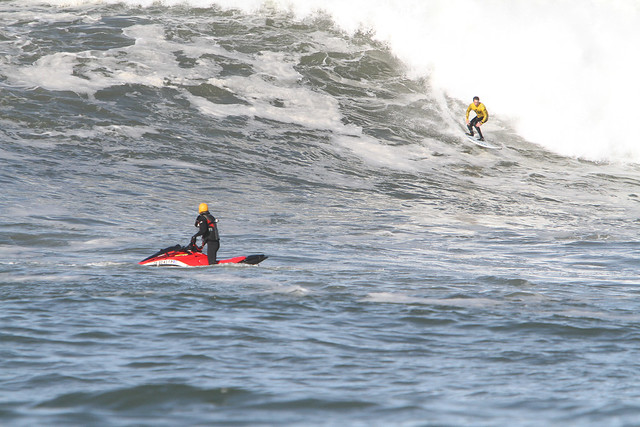
I think being caught in a wave in one’s life is one of the most humbling things around. All your ideas of yourself as a competent, together adult just fall to pieces, and you are just in the raw reality of your response, which may be very unimpressive. Being humbled is not such a bad thing, actually. From a place of humility there is room for learning, and for receiving. You have fallen, and those who love you carry you in their arms. Those people who ride giant waves are supported by other surfers on jet skis, who risk their own life in the waves by going in and rescuing a fallen friend. Sometimes you can be the rescuer, sometimes you are rescued. Both roles are important, both need the other.


As part of exploring this question, I wanted to talk to someone who really knew about waves, first-hand. I had a long chat with a friend who is also a Zen priest, and a life-long fanatical surfer.

 What I realized, talking with him, is that, to a surfer, every wave you ride makes you stronger, makes the body wiser and more able to ride the next wave. A surfer rides the waves with the body’s wisdom, not the mind’s. Surfers fall over and over again, and get up and meet the next wave. Learning to ride the waves of life is like that too. I want to tell the older people here that this is a place where age and experience are a tremendous advantage.

You might be surprised at the story of the genesis of Outward Bound, the famous wilderness survival school. Outward Bound is a nautical term for a ship leaving behind the safety of the harbor for the open sea. The school was developed in the 1930s because it had been noticed that when there was a shipwreck at sea, paradoxically the older, more experienced sailors were more likely to survive than the younger, stronger sailors. Apparently, with shipwrecks, as with many other things, practice matters. We learn something each time we fall, each time we’re shipwrecked.

Falling is not a mistake; it’s what we need to meet the next wave, to build our capacity for uncertainty, for joy in the face of hardship, for compassion, for resilience. We aren’t born with these qualities; they are forged in the waves.

And this is where I think compassion is the most important thing: compassion for yourself if you have fallen, if the wave is too much for you, and compassion for others, for the whole world, all of us caught in the waves in one way or another.

Take a moment to think about your own resources, your own hard-earned life wisdom about how best to ride – or fall- in the waves....

I asked my friend the surfer/Zen guy about what it was like when he got caught in a wave, and I thought he’d give me some deep wise Zen answer. You know what he said? He said, when I’m caught in a wave, all there is is fear. There’s no room for anything else, no time for big thoughts or nice ideas (on second thought, maybe this really is a deep wise Zen answer). There is just “Help!” and hardly even that. And this reminds me of the story about ways to pray, that there are really only two kinds of prayer: Help, and Thank You.  And I would add perhaps, a third, wordless prayer, from the story of my friend and the grizzly: awe.

Finally, all waves have their end, subside into foam, re-enter the sea. That terrible grief, that tremendous confusion, that desperate love, eases, eventually, miraculously. Waves are impermanent, just as we are. As solid and overwhelming as they can seem, they have their time and then they change. We do too, whether we have ridden the wave or struggled in the foam, our life carries us past and into new waters.


I want to close with an inspiring quote from our old friend Henry David Thoreau:

You must live in the present, launch yourself on every wave, find your eternity in each moment. Fools stand on their island opportunities and look toward another land. There is no other land, there is no other life but this.

Friday, April 6, 2012

Big Waves


Sometimes you are going along, living your daily life with all its small joys and small sorrows, and in a moment, in a split-second, everything changes. The earthquake, the tsunami, the moment of violence, one of the infinite forms of the shockingly unexpected breaks over you; your world pivots on its axis, and when you look up, your life is no longer what it was.
Last Friday I was at Tennessee Valley Beach, north of the Golden Gate Bridge in Marin County, California. As you approach the beach through the gentle rolling hills that flank the valley, it looks placid, even a little dull. But at the last moment, where the path shifts to sand, the view opens up to magnificent, cormorant-strewn, awe-inspiring cliffs, as stark and uncompromising as the rugged cliffs of the Scottish Isles. I walked with a friend through the gray, foggy valley, and when we arrived at the beach, the waves were big, thundering up against the cliffs, the wind catching the crests and blowing the foam back like the manes of giant white horses.

Each wave had its own signature, as it encountered the coastline, each one shaped by wind and current into a unique form. I could have watched all afternoon, taking photographs of the beautiful meetings of rock and ocean. My friend wandered off toward the hills, and I stayed on the sloping beach twenty feet or so from the waves, camera in hand.

Then, in a moment, everything changed. A wave, one that seemed just like the others as it approached me, came on to the beach - and kept coming. I looked down and saw the line of foam coming my way, and then I turned and ran toward higher ground, laughing a little to myself. But the wave was faster than I was, and reached me just as I stepped into a patch of saturated sand that caught and held me as I sank into it. I fell to my knees, no longer laughing, and the wave came over the berm and surrounded me, filling up the lower area of the beach where I was.
I scrambled up, holding my camera above the water, soaked to the waist and frightened, realizing that no one could see me on this part of the beach, and that I must find a way to get out of the water before the wave turned and headed back oceanward, carrying me with it. I made it to a higher area and then watched the water continue to fill where I had been, turning the moments-before bare sand beach into a swirling, deep pool. Then, as the wave retreated, its force was strong enough to erode the area where I stood, and I had to move still further away as the wave ate away at my refuge.
Photo by Paphio, Flickr
Afterward I stood and watched the waves again, and they were as they had been before, breaking many feet away, acting just as one would expect waves to act. My friend returned and I explained what had happened, though it must have seemed unreal, a story from dream or nightmare. I had heard of "rogue waves," but had never really believed that people could be swept off beaches into the ocean by a wave they never saw before it engulfed them.
We watched for a long time, and no wave came up the beach and over the berm again. I was wet but fine. Nothing much had happened, but my body knew that it had felt a moment where everything could have changed, when a great force meets an individual life and wrenches it, irrevocably, into a new story, or the end of the story.
*     *    *    *
I have another friend who spent years as a climbing guide in Nepal and South America, but later returned to his hometown (and mine) in Indiana. We try to have adventures together, every once in a while. Our best one was a few years ago, when we spent a joyous few days climbing together in Joshua Tree, sleeping out on big slabs of granite, walking the sandy washes, laughing and joking and eating camp food. My memories of that trip are still vivid and sweet. 

Over the years I have tried to talk him into finding a way back to the mountains and wilderness, but until recently he could never figure out a way to make it happen. But, finally, over the last year, he had fallen in love with southern Colorado, and he was getting ready to move. I was so happy for him.
Although I didn't know it when I encountered the wave on the beach, that same morning my friend was attacked, caught in another kind of rogue wave. He was back in my hometown, working on his house, and he had been arguing with some teenage boys about littering in the alley. They had sworn at him and threatened to "get him." Later he saw them a block away, and several boys surrounded him. He fended off blows, and then one of the boys hit my friend in the face. He fell, knocked unconscious by an enormous, unexpected blow, the tsunami, the earthquake, the pivot. When he came to consciousness, blood everywhere, unable to see clearly, he saw the blurred form of the boys, running away, and laughing.
They had focused only on his face, using some kind of weapon - brass knuckles or something else. They had done enormous damage. It had been deliberate and violent, sadistic, intentional. He was rushed to the local hospital, and then to the trauma hospital an hour and a half away. A few days later he underwent face reconstruction surgery, more than eight hours on the table while three surgeons painstakingly rebuilt bone and cartilege. And my friend does not have insurance.
And the frightening "boys" who did such damage, and who laughed as they ran away, have not been arrested yet.
I found out about the attack on Saturday, as I was preparing for a potluck birthday party - my own birthday party, as a matter of fact, a couple of days early. And I felt my life pivot too, with grief and sorrow. Suddenly a celebration no longer mattered, was no longer possible. I cried  - for him, for everything that had changed with the attack, for a world where this is possible, for the strange fate that had brought him under those fists, in conjunction with those murderous boys, just as he was preparing for a new life. Every day these things happen to strangers in unfamiliar places, and we read about them in the newspaper, but I knew the exact place my friend had been attacked: I had grown up just a stone-throw away, played in the alley where he was surrounded, intimately know the houses and streets around him.  I knew his face, his smile, his laugh.
Always, when these things happen, there's a desperate longing to go back and make it happen differently: don't go down that alley, don't argue with those boys, don't stand on that beach. But time seems more irrevocable and implacable at these moments than it does in ordinary life. There is no going back.
I remember realizing, in my early twenties, that I tended to think of life as basically stable, and accidents or disasters as some kind of mistake, some wrongness intruding into the peace of "just living." But of course, disasters are as much part of life as any other moment, and just as inevitable.
A few years ago I saw the documentary Riding Giants, about the guys who ride the largest waves in the world. When everyone else retreats from the beach, these guys go and meet thirty-foot waves and launch themselves into them. There's no second-guessing and no turning back once they're committed. To turn back or hesitate is to be pulverized by the wave.
Photo by Rick Bucich (Flickr) of Zach Wormhoudt, Maverick's Surf Competition 2010
I was mesmerized by the film. At the time I saw it, I was grieving the violent death of a beloved cat, and struggling with a chronic illness, and I felt caught in the waves of my life, tumbled around, lost and gasping for air. But what I saw on the screen was a radically different approach: a willingness to play in the big waves that come our way, to ride them, to let their power carry us, to not turn away.
Several days after the attack I had a chance to talk with my friend (amazed that he could talk at all, given his injuries) and I saw the same quality of willingness in him that I had seen in Riding Giants: he was riding the giant wave of what had happened to him, not fighting it, not being pulverized by it. Maybe it's due to all his years as a climber on the high peaks of the Himalayas, facing disaster with every rockfall and avalanche, but I heard not one whine from him in our conversation, and I was talking to a guy who had every reason to whine, every reason to be completely freaked out. But instead, he was clear and calm. He calmed me, which was a little bit embarrassing.
At the end of our conversation I realized that I had my own story backwards. I had been feeling sorry for myself - all these disasters ruining my birthday - when actually I had been given the finest birthday present of all: my friend was alive.
I think perhaps this is a big part of the reason that I practice Zen, sitting on a black cushion every morning in front of my altar, spending big chunks of my life in silent retreats. I want to learn to ride giants, to cultivate a mind steady enough to turn toward the wave, for myself and for others. When a surfer rides a really big wave, and gets caught, his only hope is to be rescued by his friends, who go in on a jet-ski, risking their own lives, to pull him out. They know the next time may be their turn.
Photo by Rick Bucich (Flickr), Maverick's Surf Competition 2010 
I'm not naturally very tough or very brave - not like my friend - but I figure that every moment that I can bear what's going on in my mind and body as I sit in silence, even if it's only a little bit uncomfortable, a little bit unbearable, I am cultivating a tiny bit more capacity for the waves. Maybe one day I too can ride giants, play in the rogue waves when they come rolling in, and learn to surf the big mysteries of life and loss and death. That's my wish, for myself and every one of us. 
And if it gets to be too much, I hope all of us have friends who can go in there with us, reach out a steady hand, and bring us to shore.

Saturday, March 12, 2011

All At Once


Isn't it strange, the way so many things are happening at the same moment? At this moment,as I write this or you read this, an inconceivable number of events are occurring: someone is experiencing the greatest happiness, another the greatest grief; there is an avalanche cascading down a mountain slope and somewhere else a light rain has begun to fall; a small creature is being born and another creature is dying; a new star is forming, and somewhere another star is winking out, its light and heat fading away into darkness. All at once.

Yesterday and the day before I experienced this mystery with particular vividness. Thursday night I was reading from Wildbranch at a local bookstore with two of the book's contributors. It was a lovely night, and local friends came out to hear us. I shared a story from a reader of the book, who had told me that she had given up reading environmental literature because it was too depressing, but she had realized that Wildbranch was about love, love and intimacy with our world, and love is a more potent force for action than despair. I felt so happy about the book and what it offers, so happy to be sharing it and reading from many contributors.

I came home from the reading to the news of the earthquake and tsunami in Japan, which had happened as we read. 

I was up much of the night, knowing that there could be a tsunami on the west coast of North America, and concerned for my little retreat cabin a few feet above high water on the Washington coast, my neighbor and her children, and my sweet friends who were staying in the cabin that night. I knew enough about tsunamis to know that they can cross whole oceans in a matter of hours without much diminution of their force. I knew that the county had called for an evacuation of all houses at sea level, including mine and those of my neighbors.


Several of us at the reading had arranged to go hiking the next day. The next morning I left for the hike before the time that the first major waves would come ashore. I had reached my friends who were staying at the cabin, and they had left and driven back to their own home, safely above sea level, but I didn't know what would happen to the cabin and the small community around it, all of which sits just a few feet above sea level on a narrow peninsula on Willapa Bay, a stone's throw from the open ocean and the roaring surf. I've always known that it is vulnerable to an event just like this one. Would this be the time?

Then, for the next few hours, I was hiking and looking at spring wildflowers, and I don't know what happened, except that the four of us on the hike fell into a kind of grace, one of those times of magical ease and beauty, unlooked-for, unrepeatable, perfect.


It was a clear, sunny spring day after rain, the air soft and subtly misty, the ground exhaling its moisture. Our trail started high up on Mount Tamalpais, then descended the open west-facing slopes of the mountain, views far out over the ocean, north to Bolinas and south to the very tops of the towers of the Golden Gate Bridge. The grass - not just the grass, but everything, every tree, shrub, herb and moss - was deeply, brilliantly green, the hallucinatory green of March in the coastal hills. After a while the the trail entered the redwoods and turned upward again, following waterfall after waterfall back up the mountain, up mossy stone stairways.


Some of us in our little group of four knew each other well, over many years; others were just acquaintances. Two Zen practitioners, three writing teachers, one botanist. What we shared was our love of literature and the natural world, and this moment together. We talked and walked and admired flowers and mushrooms and the light through the redwoods. We took photographs and shared gingerbread and homemade coffee cake by the side of the creek. We told stories. We wandered on and off the trail. I left my walking stick by a flower and then it reappeared, leaning against a railing on an entirely different trail. The day unfolded with a kind of ease that only happens now and again, in dreams or, if we're lucky, for a few hours in waking life.

The whole time I didn't know what had become of the only place I can call home, whether the sturdy little white cottage underneath the Sitka spruce was filled with muddy water as I walked the hills, or still sitting quietly in the rain, unharmed and whole. Or what might be happening in Japan or elsewhere all along the edge of the Pacific. There was nothing I could do, but I didn't forget, and it gave a subtly different feeling to the day for me, a kind of strangeness that made the light more brilliant and the grace more poignant.

When I got back to town, many hours later, I heard from my neighbor that everything was fine. She talked about how the day had been for her, also not knowing, waiting, and the gratitude she felt for the simple gift of being fine, of having a house and safe children, of making a pot of soup and starting a fire in the woodstove. How often do any of us remember to be grateful for our lives as they are, in all their ordinary details?


Meanwhile, across the ocean, thousands of people are still missing. Tonight, as I write this, people are huddled in makeshift shelters, mourning their homes, their friends and relatives, their pets, the lives they once had - lives that can be rebuilt but which will never be the same. And I sit here, still bathed in a sense of well-being from my day in the hills, feeling happiness for what was not destroyed in my life. These things exist side by side, utterly connected and yet also independent of one another.

I read tonight that the Dalai Lama has asked people in Dharamsala, the home of the Tibetan government in exile for more than fifty years, to chant the Heart Sutra 100,000 times for the people of Japan and all who are suffering disaster.

The Heart Sutra says "form does not differ from emptiness, and emptiness does not differ from form." Another way of saying it is that I am, at the same time, both an individual with a history and an experience that is uniquely my own, and completely connected. I am affected by an earthquake across an ocean from me, and yet walked the hills as others suffered and died. We breathe air that has been in the lungs of a lion, the stomata of 300-year-old coast live oak, the nose of Buddha, but when we breathe, only we can breathe our breath, this one irreplaceable, unrepeatable breath

And on the day I die, there will almost certainly be someone walking those hills I walked yesterday, bending to look at a wildflower, smiling at a friend, breathing in the clean ocean air. We will share that moment, not knowing each other, linked inextricably.


Friday, June 5, 2009

Real Capital


For every outer challenge in the world there is an internal place to stand that enables us to meet that challenge with courage, conviction and generosity. The present difficulties of the world - economic, existential, or ecological - call for a radical shift in our wants and needs and therefore our very identities. - David Whyte


I have seven friends and colleagues who are losing their jobs or who are unemployed: seven highly educated, experienced, professional people. Three of them have been been unable to find work for more than six months, despite every effort. I know other people who have lost nearly all of their savings in the last few months. Amidst the news of "recovery", I'm seeing something unprecedented in my lifetime, and despite the positive headlines, almost everyone I know feels frightened. What had seemed like solid ground beneath our feet - a job, a house - now heaves and swells like a raft in mid-ocean.

And beneath the immediate questions of livelihood lurk deeper, even more unsettling questions about the world, and many people I know feel these questions at the edges of their consciousness too, a sense that perhaps something is coming to an end, whole ways of life falling into bankruptcy, the unsustainable now evident, cracking and shifting at the seams.

I've had conversations about buying gold, buying land, growing food - all the tricks of survival - and I think those conversations are helpful as we grope toward new, and perhaps more sustainable ways of living. But I sense that all strategies of survival depend ultimately on a kind of desperate individuality, a "gonna grab me a gun and dig a hole in the ground" mentality.

And I wonder: what are the true sources of security and prosperity? How can we - I - best take of ourselves as the world bends dangerously around us? I don't pretend to know the answers, but these are some of my thoughts, based partly on the life I've been living for much of the last three years - without a home or a job, radically contingent and dependent on circumstances and on kindness.

These are the words that come to mind when I think of real security:

Friendship
Gratitude
Path

All the rest - savings and gold buried in the ground, or a gun in your pocket - might buy a little safety, for a little while, but I don't know if I'd trust any of them in the long term. That's just me, I know, and maybe for someone else those things would be enough. But let me tell you why I think friendship and gratitude and path are the real capital in a human life.

Here's a story about friendship: I know a generous, warm-hearted man who, when an old college friend of his moved to his city, offered a room in his apartment until his friend got settled. He told his friend not to worry about rent until he had a job. Eventually his friend found a very good job, and then bought a house in Seattle, and invited my friend to rent a room from him. They've shared the house for years. Now my friend is unemployed, and his savings are running thin. But his friend has already told him that if he can't pay the rent for a while, that's all right. The man I know doesn't have to lie awake at night wondering where he will live if he doesn't find a job soon. Their friendship is true capital, for both of them, as is history of generosity between them.

In my own hard times, my friends have been my deepest resource. I remember when my marriage ended and I was utterly lost, I knew that without the love of friends I would have been swept under. And at other times I have held up my friends, knowing that some day we would change roles. I can barely imagine the narrowness and vulnerability I would feel without their imperfect yet steadfast love.

When we are planning for the future, wouldn't it make sense to consider how we can best nurture our friendships and relationships? Relationships pay dividends twice, to all who are part of them: in the present, through the joy and love we can feel in one another's presence, and in the future, through the support we can offer each another if times get hard - if illness strikes, or sadness, or a hundred other difficulties.

Recent studies have shown that friendships and relationships increase longevity and happiness. And yet some people I know treat friendships as a luxury or a burden, something extra around the edges of making a living or the many tasks that can fill our days, rather than central to a human life. What if we valued others' love, and took care of it, as much or more than we valued our retirement accounts?

There's a story from the life of the Buddha of a time when his attendant and cousin, Ananda, came to him with a revelation. "Honored one," he said, "half of the holy life is in our friendship with one another." The Buddha replied, "No, Ananda, that is not right. All of the holy life is our friendship with one another."

And then there's gratitude. I've thought a lot about gratitude in the last few years, and developed a practice of it, and I've decided that it's a kind of magic. Gratitude turns fear and disappointment into a broader, brighter road. If I wake up feeling sick and all I have is my misery, the morning is very small and difficult indeed. But if remember that I also feel gratitude for the sunlight through the window, or the cup of tea in my hand, the morning expands outward into happiness, even though the difficulty is still there. In hard and frightening times, the cultivation of gratitude in a daily way could show us the possibility of happiness even if our lives are not turning out as we would wish. Sometimes money can buy us out of difficulty, but when it can't.....what do we have? The morning sun through the window, still. The sweetness of a smile.

My favorite web resource on gratitude is a site developed by Brother David-Steindle-Rast, a joy-filled Benedictine monk in his 80's: www.gratefulness.org . He has dedicated the last part of his life to teaching gratitude.

And finally, path. I was going to write, "faith", but faith is a tricky word for a Buddhist. Still, I mean faith too. What I mean is the feeling that one's life is not bound entirely by conventional identities as a consumer, or a worker, or a wife, or a student, but is instead held within a larger container, as a "child of God", or a person dedicated to awakening and compassion, or whatever it is that is a meaning far beyond and far larger than our small identities.

Several of my colleagues whose jobs are disappearing are people of faith - Baha'i or Christian - and I can see that they hold what is a disastrous event (by any standard) within a certain deep and beautiful trust. When our identities are limited, and we lose that identity, we lose everything. When we are held within vastness, within love, within a purpose beyond our small selves, the loss is different - still significant, still painful, but not shattering in the same way.

So I see these three as true capital in hard times, or for hard times to come. If each of us truly nurtured mutually supportive friendships, gratitude, and whatever path sustains us, we would be rich beyond belief, protected and blessed. The winds could roar, our house could be swept away, and we could suffer, but we would also be held by priceless gifts. What more is there to wish for in this brief life?

Wednesday, April 8, 2009

I Am Not There, I Do Not Sleep


I offer this old poem in honor of a beautiful lady, Hisako Kimura, who was born June 23rd, 1918, and who died gracefully at home this last Sunday evening, April 5, 2009. Everyone who met her loved her. Now her generous spirit has gone back into the world as a blessing.
Do not stand at my grave and weep,
I am not there, I do not sleep.
I am in a thousand winds that blow,
I am the softly falling snow.
I am the gentle showers of rain,
I am the fields of ripening grain.
I am in the morning hush,
I am in the graceful rush
Of beautiful birds in circling flight,
I am the starshine of the night.
I am in the flowers that bloom,
I am in a quiet room.
I am in the birds that sing,
I am in each lovely thing.
Do not stand at my grave and cry,
I am not there. I do not die.
Mary Elizabeth Fry

Thursday, January 15, 2009

And Yet, and Yet....


Last night I was attending the weekly seminar that my Zen teacher, Norman Fischer, offers in Corte Madera. Two days before, Norman lost his closest spiritual friend, his anam cara of 40 years, Rabbi Alan Lew. Rabbi Lew was teaching at a retreat on the East Coast, went for a walk, and died on the side of the road.

Norman and Alan practiced together at Tassajara Zen Monastery in the 1980's, and became life-long friends there. One became a Zen priest, one became a rabbi, seemingly divergent paths, but for the last three decades they have continued to practice and teach together, illuminating each other's lives and bringing back contemplative practices into American Judaism in ways that have reverberated throughout the world and have touched hundreds or thousands of people. What finer example of spiritual friendship could there be?

I didn't think Norman would be at the seminar this week. I knew he'd been with Rabbi Lew's family since Monday, carrying not only his own huge grief but the grief of the people who most loved and needed his friend. But he came and sat and spoke to us. This month we're studying the Heart Sutra , which is the most important and widely chanted text from the Buddhist emptiness teachings...teachings that form the basis of both Zen and Tibetan Buddhism.

The emptiness teachings offer a radical, fluid and open view of reality - one that emphasizes interconnection, grasplessness, boundlessness. We think we know what we are and what the world is, but it (and we) are essentially ungraspable, beyond categories and thought, not independently existing in the way we tend to think we are. This can be either frightening or freeing, depending on how comfortable one is with not knowing exactly what's going on.

There is a poem about life and reality from the end of the Diamond Sutra:

"As a lamp, a cataract, a star in space
an illusion, a dewdrop, a bubble
a dream, a cloud, a flash of lightning
view all created things like this." (trans Red Pine, 2001)

So from this perspective, even life and death are not what they seem and there's nothing to mourn. Rabbi Lew has simply (as Norman said at one point in his talk), "radically changed form". And there's truth, and sometimes even comfort in seeing things this way. But then there is the matter of the human heart.

The 18th century Haiku poet Issa endured a life of extraordinary tragedy, including the early deaths of his wife and all three of his children. His most powerful haiku was composed at the grave of his daughter, Sato:

The world of dew
is a world of dew, and yet
and yet...

No matter what we know, no matter how clearly we know that the nature of the world and our lives is fundamental impermanence, we cry when the flowers fall, or as Norman said last night, "Love dictates that I not give up my tears."

There's a beautiful koan, a Zen story, about a woman, a student of the famous teacher Hakuin, whose beloved niece had died. She was standing in front of the altar, sobbing, when another of Hakuin's students entered the hall. He scolded her and said, "I thought you were a true Zen person. Why are you crying?" (in other words, "I thought you understood the emptiness teachings, but it looks like you don't"). She turned to him and said, "My tears are my offerings to my niece, the candles and flowers on the altar to honor her life and death."

I've heard the teachings of the Heart Sutra many times, but seeing my teacher sitting in front of us in all of his tremendous sorrow, teaching with his whole body the deep paradox of life- that everything slips away, and nothing slips away, and still we cry, still we love, still we break over and over again - well, last night I felt the Heart Sutra in my bones, in the center of the center of my heart.

You can hear Norman's talk here.

Monday, December 8, 2008

Anam Cara: soul friend


“….so anam cara in the Celtic world was the ‘soul friend’. ….it originally referred to someone to whom you confessed, revealing the hidden intimacies of your life. With the anam cara you could share your innermost self, your mind and your heart. This friendship was an act of recognition and belonging. When you had an anam cara, your friendship cut across all convention, morality, and category. You were joined in an ancient and eternal way with the ‘friend of your soul’”

John O’Donohue, Anam Cara


I have been thinking about spiritual friendship recently: what it is, how it is different from other kinds of friendship, how I recognize it, what it means in my life.

In the last few months I’ve been spending time – for the first time in many years – with someone who was a soul friend, an anam cara, when I was a child and a young person. I knew, even then, that there was a different quality to this friendship, and that I needed it the way young fish need the water, or the way young birds need the air. As a teenager I entered a long time of darkness and depression, and the light of this friendship was the only light I could see. I didn’t have a name for it then. What I would say was, “Without Colleen I wouldn’t have any hope at all.”

Colleen was a student of my mother’s, thirteen years older than I was, and a Christian Scientist. You could say that we had little in common, in a relative way. But what Colleen showed and shared with me – above and beyond her love for me, which was a great gift – was the life of a person – a woman - on a spiritual path, Homo spiritualis. That was the hope that sustained me as a teenager: that a spiritual path was possible, even if I was lost, even if I didn’t know how to find it. She gave me faith and hope to walk through the darkness….showing me that the darkness itself is a prerequisite to the path.

Now, thirty years later, when Colleen and I meet, as we did the other day in the courtyard of the Heard Museum in Phoenix, sitting and talking beneath the delicate green leaves of the ironwood trees, we meet outside time, outside the particulars of our lives. Our concern is always, “What are you seeing? What are you learning? What is the leading edge of your understanding about how to live this life?”, and this concern and leaning forward is surrounded by our love for one another, which flows as easily as breathing. Without “teaching” each other anything, what each of us has come to understand shines a light on the other person’s understanding, like two ladders side by side, leaning against the sky. We walk away nourished and widened by the field between us.

Since Colleen first offered her friendship to me, I’ve been graced (and graced is the word) with an extraordinary number of anam caras, soul friends. And this is the strangest thing: in many cases these friendships have transcended every possible human difference – age, culture, faith, race, education – all that matters so much in ordinary relationships. It’s a recognition that goes beyond divisions. My friend Willie Cooper was an elderly Lummi Indian woman, married at fourteen, thirteen pregnancies, a person who loved spirituality in any form, from a weekend tent revival to the deepest secrets of traditional Salish religious practice. My friend Echodu is a Ugandan, an evangelical Christian who has witnessed sufferings that I can barely imagine. My new friend Patricia is 87 years old and sitting in a retirement home, trying to find her way. But when we look each other in the eyes, there’s just two souls meeting.

In each case we recognized each other, very quickly, as if the heart knew something the mind could barely imagine. “This person is on the path. No matter how different it may seem from my own, we are walking together.”

Time and space are shockingly irrelevant to anam caras. Colleen and I have sometimes gone years without speaking or seeing on another. It doesn’t matter. Willie Cooper is gone now, but I still hear her wisdom and feel her love. I have met people just once and felt that deep recognition, and yet we’ve never crossed paths again. Others have been life-long friends, or lovers, or teachers. But however often we meet, or whatever we may speak about, there is only one thing being said: “I know you, I see you, I understand.”

This is not to denigrate other kinds of relationships and friendships, or to elevate the anam cara to some special position. I am grateful for the people who have shared my life in all sorts of forms, and where love is between two people, what one calls it hardly matters. But I’ve come to see that I might not even be alive today without this particular kind of friendship. I might have gotten lost and never found my way. At Lummi it was understood that someone who chose to walk a spiritual path assented to a special kind of vulnerability, and they needed all the help and protection that those around them could give them. I feel that vulnerability, though I think I was born that way, rather than choosing it. I felt strange and alone as a child, different in some way I had no words for from the people around me.

My anam caras have shown me that I’m never alone.

This, I say, is what is broken by no chances, what no interval of time or space can sever or destroy, and what even death itself cannot part.” John Cassian, Conferences