Showing posts with label illness. Show all posts

Tuesday, July 17, 2012

More on the Art of Riding the Waves


Since my last post about waves, I've continued to think about the big waves of life, and how to meet them. I was asked to give the guest sermon at the Eastshore Unitarian Church in Bellevue last Sunday, and my sermon was on "The Art of Riding the Waves." If you'd like to listen to it, you can download and listen to it here. Or you can read the sermon, below. Before the sermon, I told a story for children, called The Wave, which you can download and listen to here.

*******


Good morning, It is an honor to be here with you this summer Sunday morning, when you could be out enjoying one of our tardy summer days. I want to thank Ann Carden, your worship leader, for inviting me and for the beautiful and soulful process we went through together in thinking about this service.

By now in the service you must have an inkling of what the sermon is about. Ocean waves are, as in my story, nothing at all, merely temporary, beautiful, constantly changing forms of the ocean, and yet they are one of the most powerful forces we know. 


What really got me thinking about waves happened in late March this year, when I was caught in a rogue wave.One moment I was photographing beautiful wind-whipped breakers and the next moment one of those waves, which looked like every other wave, was washing around my knees and getting higher, and I was running for high ground. I experienced the sudden bodily  knowledge that if I didn’t get out of the wave, it was going to take me out to sea with it when it ebbed. I made it out, but it reminded me of the way a life can change in an instant.

Almost everyone has experienced these moments, or knows someone who has, when everything changes. The phone call in the middle of the night, the pink slip, the conversation with a doctor. Here’s something that the Zen teacher John Tarrant wrote, after he received a diagnosis of prostate cancer:

The diagnosis seemed alright at the time I got it but I observed that the small consulting room became large, time slowed down and everyone’s eyes grew big. That room became a ship hanging in space, a ship I can still visit if I wish, and sometimes do. That moment was the last moment when I hadn’t quite absorbed the news, when I didn’t quite have cancer yet.   http://tarrantworks.com/2011/12/17/five-reasons-to-get-cancer/#more-47

Of course, there are also the big waves which are not tragedies, but no less dramatic, humbling and transforming: really falling in love for the first time or the 10th time, or the birth of a child, or the power of an idea that sweeps you away and calls you to a new life.

So I started thinking about big waves, and what we can do when the waves hit, and if there might be an art to riding the waves of life, like tai chi, or surfing. So this sermon is about my exploration of this question.

When I was in my 20’s, I had a realization that has stayed with me ever since: up to that time, unconsciously, I had thought that when difficult things happened, it was sort of a mistake, something going wrong in the midst of an otherwise smooth life. I think, by the way, that this is a very middle class American idea – most people in the rest of the world know better by the time they are in their 20’s . Suddenly I realized that life, by its very nature includes disasters and accidents and unexpected changes– they aren’t aberrations, they are PART of life, just as waves are part of the ocean. A wave is a very different experience if the whole time you’re thinking, “Stop, this shouldn’t be happening, not in my life” rather than, “Ah, right, this is the nature of life. I don’t like it, but here it is, and waves hit everyone, sooner or later.”  Then, if you’re really wild and lucky, you might even be able to have the feeling of those people who ride the largest waves in the world, “Woooeee, this is a wild ride!”


Photo by Michael Hofmann
This may seem impossible, but I know someone who had just that sort of experience, a person just like you and me. A friend from Bellingham was up hiking in the Arctic National Wildlife Refuge with several other people, and a grizzly started following them one afternoon. All afternoon it followed them, getting closer and closer. They had no weapons, and they were going as fast as they could, with increasing terror. Finally they realized that the grizzly was definitely going to catch up with them, in just a few minutes, and at the bottom of a small hill they turned around and joined hands. One of them started to sing, and so they stood there, waiting for the wave, singing together. When the grizzly crested the hill, no more than 20 ft away from them, my friend said that she was amazed at what she felt: not fear but awe. The grizzly, with the light shining behind it, was the most beautiful thing she had ever seen. They sang and she felt tears running down her face. The bear paused there and they all regarded one another; then it turned around and walked away from them. 

Here’s another story about riding the waves. I have a friend who traveled on a Russian freighter from San Francisco to Asia, many years ago. He was young, and had no idea what was going to happen next in his life. The freighter left the Oakland docks at midnight, and the bay was full of fog and waves. He remembers standing on deck as the freighter crossed under the Golden Gate Bridge, and in the lights from the boat and the bridge he could see ducks on the big swells and breakers as they came into the narrow channel of the Golden Gate. The ducks were completely calm and at ease, bobbing up and down n the dark with each enormous swell. All my friend’s fear and trepidation about his life evaporated, and he says that the image of those ducks stayed with him for decades, as he lived the uncertain and unconventional life of an itinerant artist in Asia. The message he had understood was “You can trust uncertainty.” 


Ann shared an old poem with me, from 1947, written by Donald Babcock, a philosophy professor, about a duck very like the ones my friend saw. I’m going to read you a little bit of it.

… It is a duck riding the ocean a hundred feet beyond the surf.
and she cuddles in the swells.
There is a big heaving in the Atlantic and she is part of it.

She looks a bit like a Mandarin or the Lord Buddha
meditating under the Bo tree,

She can rest while the Atlantic heaves

because she rests IN the Atlantic.

Probably, she doesn’t know how large the ocean is …
          And neither do we…
                    And what does she do, I ask you?
She sits down in it.
She reposes in the immediate as if it were infinity … which it is.

That is spirituality, and the duck has it!
She has made herself a part of the boundless
by easing herself into it
                    just where it touches her.

So this brings us to perhaps the most important question: what about when the wave is too big for you to ride, when it knocks you over, tumbles you, knocks the breath out of you? What about when you can’t find a way ride the wave? What then? What do we do when the wave has pinned us to the sand and every time we try to get up we get knocked down again?

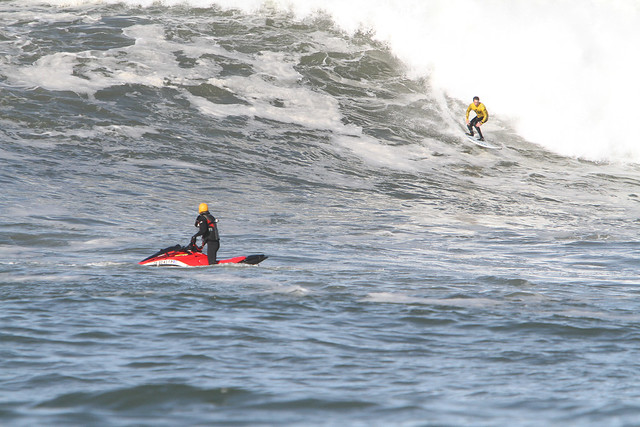
I think being caught in a wave in one’s life is one of the most humbling things around. All your ideas of yourself as a competent, together adult just fall to pieces, and you are just in the raw reality of your response, which may be very unimpressive. Being humbled is not such a bad thing, actually. From a place of humility there is room for learning, and for receiving. You have fallen, and those who love you carry you in their arms. Those people who ride giant waves are supported by other surfers on jet skis, who risk their own life in the waves by going in and rescuing a fallen friend. Sometimes you can be the rescuer, sometimes you are rescued. Both roles are important, both need the other.


As part of exploring this question, I wanted to talk to someone who really knew about waves, first-hand. I had a long chat with a friend who is also a Zen priest, and a life-long fanatical surfer.

 What I realized, talking with him, is that, to a surfer, every wave you ride makes you stronger, makes the body wiser and more able to ride the next wave. A surfer rides the waves with the body’s wisdom, not the mind’s. Surfers fall over and over again, and get up and meet the next wave. Learning to ride the waves of life is like that too. I want to tell the older people here that this is a place where age and experience are a tremendous advantage.

You might be surprised at the story of the genesis of Outward Bound, the famous wilderness survival school. Outward Bound is a nautical term for a ship leaving behind the safety of the harbor for the open sea. The school was developed in the 1930s because it had been noticed that when there was a shipwreck at sea, paradoxically the older, more experienced sailors were more likely to survive than the younger, stronger sailors. Apparently, with shipwrecks, as with many other things, practice matters. We learn something each time we fall, each time we’re shipwrecked.

Falling is not a mistake; it’s what we need to meet the next wave, to build our capacity for uncertainty, for joy in the face of hardship, for compassion, for resilience. We aren’t born with these qualities; they are forged in the waves.

And this is where I think compassion is the most important thing: compassion for yourself if you have fallen, if the wave is too much for you, and compassion for others, for the whole world, all of us caught in the waves in one way or another.

Take a moment to think about your own resources, your own hard-earned life wisdom about how best to ride – or fall- in the waves....

I asked my friend the surfer/Zen guy about what it was like when he got caught in a wave, and I thought he’d give me some deep wise Zen answer. You know what he said? He said, when I’m caught in a wave, all there is is fear. There’s no room for anything else, no time for big thoughts or nice ideas (on second thought, maybe this really is a deep wise Zen answer). There is just “Help!” and hardly even that. And this reminds me of the story about ways to pray, that there are really only two kinds of prayer: Help, and Thank You.  And I would add perhaps, a third, wordless prayer, from the story of my friend and the grizzly: awe.

Finally, all waves have their end, subside into foam, re-enter the sea. That terrible grief, that tremendous confusion, that desperate love, eases, eventually, miraculously. Waves are impermanent, just as we are. As solid and overwhelming as they can seem, they have their time and then they change. We do too, whether we have ridden the wave or struggled in the foam, our life carries us past and into new waters.


I want to close with an inspiring quote from our old friend Henry David Thoreau:

You must live in the present, launch yourself on every wave, find your eternity in each moment. Fools stand on their island opportunities and look toward another land. There is no other land, there is no other life but this.

Friday, April 6, 2012

Big Waves


Sometimes you are going along, living your daily life with all its small joys and small sorrows, and in a moment, in a split-second, everything changes. The earthquake, the tsunami, the moment of violence, one of the infinite forms of the shockingly unexpected breaks over you; your world pivots on its axis, and when you look up, your life is no longer what it was.
Last Friday I was at Tennessee Valley Beach, north of the Golden Gate Bridge in Marin County, California. As you approach the beach through the gentle rolling hills that flank the valley, it looks placid, even a little dull. But at the last moment, where the path shifts to sand, the view opens up to magnificent, cormorant-strewn, awe-inspiring cliffs, as stark and uncompromising as the rugged cliffs of the Scottish Isles. I walked with a friend through the gray, foggy valley, and when we arrived at the beach, the waves were big, thundering up against the cliffs, the wind catching the crests and blowing the foam back like the manes of giant white horses.

Each wave had its own signature, as it encountered the coastline, each one shaped by wind and current into a unique form. I could have watched all afternoon, taking photographs of the beautiful meetings of rock and ocean. My friend wandered off toward the hills, and I stayed on the sloping beach twenty feet or so from the waves, camera in hand.

Then, in a moment, everything changed. A wave, one that seemed just like the others as it approached me, came on to the beach - and kept coming. I looked down and saw the line of foam coming my way, and then I turned and ran toward higher ground, laughing a little to myself. But the wave was faster than I was, and reached me just as I stepped into a patch of saturated sand that caught and held me as I sank into it. I fell to my knees, no longer laughing, and the wave came over the berm and surrounded me, filling up the lower area of the beach where I was.
I scrambled up, holding my camera above the water, soaked to the waist and frightened, realizing that no one could see me on this part of the beach, and that I must find a way to get out of the water before the wave turned and headed back oceanward, carrying me with it. I made it to a higher area and then watched the water continue to fill where I had been, turning the moments-before bare sand beach into a swirling, deep pool. Then, as the wave retreated, its force was strong enough to erode the area where I stood, and I had to move still further away as the wave ate away at my refuge.
Photo by Paphio, Flickr
Afterward I stood and watched the waves again, and they were as they had been before, breaking many feet away, acting just as one would expect waves to act. My friend returned and I explained what had happened, though it must have seemed unreal, a story from dream or nightmare. I had heard of "rogue waves," but had never really believed that people could be swept off beaches into the ocean by a wave they never saw before it engulfed them.
We watched for a long time, and no wave came up the beach and over the berm again. I was wet but fine. Nothing much had happened, but my body knew that it had felt a moment where everything could have changed, when a great force meets an individual life and wrenches it, irrevocably, into a new story, or the end of the story.
*     *    *    *
I have another friend who spent years as a climbing guide in Nepal and South America, but later returned to his hometown (and mine) in Indiana. We try to have adventures together, every once in a while. Our best one was a few years ago, when we spent a joyous few days climbing together in Joshua Tree, sleeping out on big slabs of granite, walking the sandy washes, laughing and joking and eating camp food. My memories of that trip are still vivid and sweet. 

Over the years I have tried to talk him into finding a way back to the mountains and wilderness, but until recently he could never figure out a way to make it happen. But, finally, over the last year, he had fallen in love with southern Colorado, and he was getting ready to move. I was so happy for him.
Although I didn't know it when I encountered the wave on the beach, that same morning my friend was attacked, caught in another kind of rogue wave. He was back in my hometown, working on his house, and he had been arguing with some teenage boys about littering in the alley. They had sworn at him and threatened to "get him." Later he saw them a block away, and several boys surrounded him. He fended off blows, and then one of the boys hit my friend in the face. He fell, knocked unconscious by an enormous, unexpected blow, the tsunami, the earthquake, the pivot. When he came to consciousness, blood everywhere, unable to see clearly, he saw the blurred form of the boys, running away, and laughing.
They had focused only on his face, using some kind of weapon - brass knuckles or something else. They had done enormous damage. It had been deliberate and violent, sadistic, intentional. He was rushed to the local hospital, and then to the trauma hospital an hour and a half away. A few days later he underwent face reconstruction surgery, more than eight hours on the table while three surgeons painstakingly rebuilt bone and cartilege. And my friend does not have insurance.
And the frightening "boys" who did such damage, and who laughed as they ran away, have not been arrested yet.
I found out about the attack on Saturday, as I was preparing for a potluck birthday party - my own birthday party, as a matter of fact, a couple of days early. And I felt my life pivot too, with grief and sorrow. Suddenly a celebration no longer mattered, was no longer possible. I cried  - for him, for everything that had changed with the attack, for a world where this is possible, for the strange fate that had brought him under those fists, in conjunction with those murderous boys, just as he was preparing for a new life. Every day these things happen to strangers in unfamiliar places, and we read about them in the newspaper, but I knew the exact place my friend had been attacked: I had grown up just a stone-throw away, played in the alley where he was surrounded, intimately know the houses and streets around him.  I knew his face, his smile, his laugh.
Always, when these things happen, there's a desperate longing to go back and make it happen differently: don't go down that alley, don't argue with those boys, don't stand on that beach. But time seems more irrevocable and implacable at these moments than it does in ordinary life. There is no going back.
I remember realizing, in my early twenties, that I tended to think of life as basically stable, and accidents or disasters as some kind of mistake, some wrongness intruding into the peace of "just living." But of course, disasters are as much part of life as any other moment, and just as inevitable.
A few years ago I saw the documentary Riding Giants, about the guys who ride the largest waves in the world. When everyone else retreats from the beach, these guys go and meet thirty-foot waves and launch themselves into them. There's no second-guessing and no turning back once they're committed. To turn back or hesitate is to be pulverized by the wave.
Photo by Rick Bucich (Flickr) of Zach Wormhoudt, Maverick's Surf Competition 2010
I was mesmerized by the film. At the time I saw it, I was grieving the violent death of a beloved cat, and struggling with a chronic illness, and I felt caught in the waves of my life, tumbled around, lost and gasping for air. But what I saw on the screen was a radically different approach: a willingness to play in the big waves that come our way, to ride them, to let their power carry us, to not turn away.
Several days after the attack I had a chance to talk with my friend (amazed that he could talk at all, given his injuries) and I saw the same quality of willingness in him that I had seen in Riding Giants: he was riding the giant wave of what had happened to him, not fighting it, not being pulverized by it. Maybe it's due to all his years as a climber on the high peaks of the Himalayas, facing disaster with every rockfall and avalanche, but I heard not one whine from him in our conversation, and I was talking to a guy who had every reason to whine, every reason to be completely freaked out. But instead, he was clear and calm. He calmed me, which was a little bit embarrassing.
At the end of our conversation I realized that I had my own story backwards. I had been feeling sorry for myself - all these disasters ruining my birthday - when actually I had been given the finest birthday present of all: my friend was alive.
I think perhaps this is a big part of the reason that I practice Zen, sitting on a black cushion every morning in front of my altar, spending big chunks of my life in silent retreats. I want to learn to ride giants, to cultivate a mind steady enough to turn toward the wave, for myself and for others. When a surfer rides a really big wave, and gets caught, his only hope is to be rescued by his friends, who go in on a jet-ski, risking their own lives, to pull him out. They know the next time may be their turn.
Photo by Rick Bucich (Flickr), Maverick's Surf Competition 2010 
I'm not naturally very tough or very brave - not like my friend - but I figure that every moment that I can bear what's going on in my mind and body as I sit in silence, even if it's only a little bit uncomfortable, a little bit unbearable, I am cultivating a tiny bit more capacity for the waves. Maybe one day I too can ride giants, play in the rogue waves when they come rolling in, and learn to surf the big mysteries of life and loss and death. That's my wish, for myself and every one of us. 
And if it gets to be too much, I hope all of us have friends who can go in there with us, reach out a steady hand, and bring us to shore.

Sunday, March 22, 2009

True Nature

"The capacity of the mind is so great, it’s like space…In this world of ours, space has room for the sun and the moon and the stars, the earth and its mountains and rivers, every plant and tree, bad people and good people, bad teachings and good teachings, heavens and hells. All this exists in space. The emptiness of our nature is also like this….Our nature contains the ten thousand dharmas (things). That’s how great it is. "

The Platform Sutra of the Sixth Ancestor, trans: Red Pine


Right now I’m sitting in a motel room in Barstow, California, deep in the Mohave desert. I just made myself a cup of tea, and as I sip it I’m remembering Spirit Rock, and the many times during my month of silence this February that I sat on the bench in front of the dining hall with a cup of tea warming my hands, looking over the hills to the sky beyond. How much I appreciated each sip, how much I appreciated the sky and clouds as they changed, the echoes with other retreats when I had sat on that same bench, the breeze against my face.

In some ways, that’s all that happened for that month of silence. I sipped cups of tea, I sat in my room with my breath, I walked the beautiful open hills, I listened to birds. Sometimes I walked in rain, sometimes in sunlight. Sometimes my mind was clear and light and easy, sometimes cloudy. I could just leave it at that, and it would be accurate. At the end of a retreat, the teachers advise that if someone asks you about your retreat, just smile and say, “It was great.” That’s all people want to know anyway. But I want to say more, at the risk of saying less, because the gifts that come from retreat feel beyond the personal. They’re glimpses into what it means to be human, what we really are, what our minds can know and hold, what is possible.

The quote above is from a teaching given in 8th century China by a great Zen teacher, Hui-Neng. The teaching was so inspiring and encouraging and powerful that it has been read and memorized and quoted for the last twelve hundred years or so, in China, Vietnam, Korea, Japan, and now the West. It sounds lofty and abstract, but I think he’s just talking about something as close as this mind, right now. Space is nothing special, but it can hold everything. The human mind seems confused, but it can hold everything too: heavens and hells, happiness and sadness, birdsong and the sky and the gritty feel of sand in the palm. That’s what I saw, in this month of silence – not “saw” in the sense of “intellectually understood”, but “saw” in the sense of “directly experienced”. And it came through an unlikely teacher: pain.

Those who know me know that I’ve wrestled with a chronic illness for a long time. One of the symptoms, when the illness is active, is severe body pain, like the pain of a high fever. I was in pain when the retreat started, and for about half the time I was there. Strong pain while in silence can be quite overwhelming, because there’s no distraction, no buffer between the mind and the pain – no book to read, no movie to watch, no telephone to pick up to call a friend. I’ve left retreats because the pain was too strong and my misery was too great. But developing a relationship with the illness and with pain is important, because it’s part of my life, not anything I can push away or pretend isn’t there, and I wanted to see if something other than misery was possible.

In the first few days, I wondered whether I would have to leave. I wasn’t sure I could be in silence and hurt that much. My mind felt like a white-water river, tumultuous and frightened. But as the days passed and my mind settled, I could feel myself getting calmer and wider and happier, like that same river when it comes out of the mountains and on to the plains.

I remembered a teaching by Darlene Cohen, the author of Turning Suffering Inside Out. Darlene has had rheumatoid arthritis for thirty years, and is also a Zen teacher. One of her teachings is, “Find what doesn’t hurt, what is pleasant. That’s there too.” When we’re in pain we tend to lock on to the pain, to close down around it, but at the same time that there’s pain, there’s also sweetness – the warmth of a cup of tea, the softness of fabric against the skin – and if we’re not careful we’ll miss the sweetness altogether, lost in our bad dream. When we open up a little, there’s room for pain and pleasure, sweetness and suffering, and that changes our relationship to both.

At the same time, one of the teachers at the retreat gave a talk on a traditional Buddhist teaching about how we relate to sense experiences. Basically, every time we have a sense experience – seeing, smelling, tasting, touching, hearing, thinking – right away there’s one of three possible visceral responses to it: we like it, we don’t like it, or we’re not sure whether we like it or don’t like it. That response is almost hard-wired, although we can grow to like things we once disliked, and grow to dislike things we once liked.

What usually happens is that we miss the moment of that visceral response, and go immediately to trying to get more of it (ice cream, for instance), or less of it (physical pain, for instance). This activity actually takes up a lot of our waking energy. Traditionally it’s taught that if you can just see that initial response in a neutral way (“Oh, this is unpleasant”), without going into the cascade of “Oh, make this go away”, there’s the possibility of freedom, right in that moment.

So I applied both those teachings to the physical pain I was experiencing: I opened up my senses to the things that were happening that weren’t painful, and I just noticed when something was pleasant or unpleasant. And, miracle of miracles, I found freedom, right in the midst of the pain. I found that I could know that pain was happening without contracting around it and desperately wanting it to go away, and that the experience of not contracting was actually joyful. I could be in pain, notice the light through the leaves of the tree, feel happiness in my heart, and sip a cup of tea. Room for everything, just as Hui-Neng said. The mind vast like the sky. What a discovery.

And the strange thing was that the pain itself responded, and instead of staying steady day in and day out, it would come and go, as if it was also more free, now that I wasn’t clenched around it. And whatever it was doing, I was OK. More than OK. Really happy.

I had a dream, while I was there, that I was in a high wind, and the wind was buffeting me and pelting me with stones and silt, but my mind was peaceful and steady, even in the middle of the chaos and roar of the wind. To know that it’s possible to be peaceful in the high winds of life, and not just when things are easy ….that’s freedom.

And it’s not just possible for people who spend months in meditation. People who spend months in meditation are like astronauts going to the moon or oceanographers diving deep in the ocean – they do it for the rest of us. We may never do those things, but what they learn about the nature of the universe opens us up to new possibilities. I learned a little about my own nature, which is the same as yours – and now I offer it to you.


“In your dark
house of afflictions
keep the
sun of wisdom shining”

The Platform Sutra

Monday, December 8, 2008

Paradox and submission


I'm posting a quote I found recently....provocative, and not something a free spirit like me really likes to hear, but a powerful suggestion for the spiritual path.

"Because paradox is at our very core, the spirituality of imperfection suggests that only be embracing the dark side of our ambiguous natures can we ever come to know the light. We find ourselves only by giving up our selves, we gain freedom by submitting to the will of others...Saints and sages throughout the centuries have maintained that it is in the willingness to give up the self and give in to others that the road to human wholeness can be found. And for those who would give up "self" the first step is to give up certainty."

Ernest Kurtz The Spirituality of Imperfection

The photo is of my dear friend Michael Sawyer, a few months before his death from Parkinson's. He deeply embodied this way, in his willingness to submit to the many indignities of his disease, in his humble acceptance of dependence, and in the way he embraced all the paradoxes of being human, the dark and the light.

To see some of Michael's wild psychedelic Buddhist art, go to Michaelsawyerart.com