Showing posts with label culture. Show all posts

Monday, March 21, 2016

Respect for Everything

Tsubaki means "camellia." 
"Temples and shrines are places of festival where rituals and prayers for individuals, families and ancestors are conducted to dispel misfortune and to open the path for divine blessings. They are places where you can trace your life to its origin."

Yamamoto Yukiyasu, 97th Chief Priest of Tsubaki Grand Shrine, Introduction to Shinto: The Way of the Kami 

Shinto is notoriously slippery to talk about or write about or even think about (suitable, I suppose, for a blog titled "Slipping Glimpser"!) But I am going to try, anyway, with a healthy does of knowing that I don't know what I'm talking about.

Last night I had a rather formal dinner with the Chief Priest, Yamamoto-san and his wife Yukiko-san, along with my guide Ochiai-san as translator (although the Chief Priest speaks some English) and we talked about - or tried to talk about - Shinto. Yamamoto-san said something really wonderful, something like, "In Shinto everything is sacred: the trees, the mountains, the rocks, our ancestors. We bow to everything."

Ochia-san said to me today, "Everything has spirit, even rocks." When I explained about Western dualism, as best I could in simple English, that actually in traditional Western thought almost nothing has spirit, everything is there to be used by humanity, things are inanimate, nature is a sort of machine, even the body is a sort of machine, and the divine is far away in another realm, he looked horrified and incredulous. He couldn't imagine it.

Maybe I should just stop writing there, and we can all contemplate that for a bit, and what it would mean for this world to respect everything, to see spirit and the divine immanent in everything. But of course, being me, I'm going to keep going.

Mitsu-tomoe on the doors to the "treasure house" at Tsubaki

The tripartite symbol in the photo above is everywhere here at Tsubaki Grand Shrine: on ceremonial doors, on the ends of roof posts, on curtains and amulets. It is a primary symbol of Shinto, and is called the mitsu-tomoe, or mitsudomoe. Like all great symbols, my sense is that it has many layers of meaning. Tomoe means "turning", so I like to imagine this symbol in motion, rather than static, a turning wheel, where each of the three parts is in relationship with the others. One source writes, "The circle represents perpetual motion, the constant cycles of life, death, and renewal that govern all aspects of the universe, including divine forces." (From Shinto: A Celebration of Life). The three shapes are often said to represent heaven, earth, and human, in continuous relationship with one another. The space between is what is mysterious and hidden.

Curtains with mitsu-tomoe symbol in front of the doors of the Haiden, the main public worship hall at Tsubaki
Shinto, unlike Buddhism or Christianity, is not a religion of the book, of text, of theology, of "teachings." It strains our Western, Judeo-Christian understanding of what religion is. In fact, before the introduction of Buddhism to Japan in the 6th century, there was no such thing as "Shinto" - there was just what people did in relation to the forces of nature and divinity, without needing a name that would differentiate what they did from some other "religion." Buddhism's arrival from China made it necessary to describe what was not-Buddhism, what had been here before. The word "Shinto" is actually based on Chinese characters (also an import) that meant "way of the kami".

I loved this description of how it might have been in that early time, in a book called A Year in the Life of a Shinto Shrine, by John Nelson:

The early people felt that themselves, the land they lived upon, the mountains, rivers, trees, valleys, mist, and animals that surrounded them were all born of the Kami and thus intimately related. There was simply no such thing as an inanimate universe.

Reading that quote takes me back to what Yamamoto-san said over dinner, what Ochiai-san said to me today, and the mitsu-tomoe, the "turning circle," where human and heavenly and earthly realms are all realms of Kami, all interconnected and interdependent and animate. And I think of how the original places of the Kami were not in buildings at all, but outdoor places of power in groves and on mountaintops.

I read somewhere else that it may be that the original ceremonies for Kami took place in the meeting of the cultivated and the wild, where the Kami of the mountains and streams, so necessary for the health of the rice fields and the villages, were summoned and thanked and prayed to.  I notice that many of the large Shinto shrines I've visited, including this one, are in forests right at that intersecting place, above the fields but nestled in the lower valleys and ridges of a sacred mountain.


From high on Mount Nyudo above Tsubaki Grand Shrine. The shrine is at the base of the mountain, hidden by the farthest ridge, between the fields and the mountain.
Because of this intersection, the forests surrounding (or representing) nearly all Shinto shrines are often the only greenery in urban settings, as if a little bit of the wild is essential for the functioning of the whole, just as wild mountains and their rivers are necessary for bringing water to the fields.

I was surprised to learn that even now "Shinto" is not a term widely used in Japan (though people here were even more surprised to learn that we in America haven't heard of Shinto!). Not many people would say, "My religion is Shinto." In fact, Ochiai-san, one of the priests here at Tsubaki Grand Shrine, told me that even though many Japanese people say that they are "not religious," still, over 90 million people (out of 127 million people who live in Japan) visit one of the 80,000 Shinto shrines in Japan every year (over a million each year to this shrine alone, and at New Year's about 90,000 people visit here). There are hundreds of people walking the grounds here every week. For a non-religious country, people sure seem to appreciate something (just FYI, a "shrine" is a place of Shinto practice, and a "temple" is a place of Buddhist practice).


But it seems to me that the mitsu-tomoe represents a lot of what "the way of the Kami" is about. The cycles of birth and death, the interdependence of human and nature, the recognition of ceaseless change within a deeper harmony. It is said there are 8 million Kami in Japan, which means that there is truly nothing without an element of the sacred here, inside a shrine forest or on the busiest city street. But perhaps going to a shrine and walking under its ancient trees helps people remember, even if they don't quite know what they are remembering. People bow without quite knowing why, and something in us respects what is being bowed to.

Braided rope and paper marking the entrance to a sacred place.
The Kami don't "live" in their shrines, as we might imagine, whether the shrine is a tiny miniature house, an enormous building, a tree, or a stone. The shrine is a place where human and Kami can meet, where a human being can bow, ask the Kami for help, and the Kami become present in our human calling to them. A particular Kami, like Sarutahiko-no-okami, the main Kami here, can be enshrined in hundreds of different places (although this place is his primary place of enshrinement).

And there are almost never statues of Kami at a shrine - they are hidden, secret, and mysterious, beyond personalizing. But as Ochiai-san told me the other day, with great intensity, "The Kami are REAL." I think he was telling me that to a Shinto priest the Kami are not metaphors, myths, human constructs, or some old tradition. They are true powers, and we can be in relationship with them.

The perpetually closed doors of a small Kami shrine
I think a person could spend years at a Shinto shrine and not be able to quite say what is happening there (in fact, maybe the longer you stay, the harder it would be say), but there is something beautiful and mysterious here, in the people and the place, some depth that draws people in under the trees.

This morning, early light, no one around, I watched an older, impeccably dressed man walk in from the road, walk slowly up the avenue of huge old trees, walk first to the main shrine of Sarutahiko-no-okami, then to the shrine of the dancing Kami Ame-no-Uzume-mikoto, the beautiful one, bow twice, clap twice, ring the wooden bell in front of her shrine, bow again, and then make his way back down through the trees.

"The Kami are real."

The waterfall of the beautiful dancing Kami, Ame-no-uzume-mikoto


Monday, March 14, 2016

Of Trees and Sweeping


Day 5 at Tsubaki Grand Shrine (to read about why I'm here, read Entering Another World, my last post). Over the last few days I have been gradually transformed from my usual black-clothed Western self into "staff" at Tsubaki - first a white cotton jacket with the kanji (Chinese characters) for Tsubaki Grand Shrine over my Western clothes, then, yesterday, multi-layered full Shinto robes, all in white, that took a sweet young woman priest, Sakaka-san, about twenty minutes to put on me (today I was on my own, and no one has laughed, so I must have been successful).

The triumphant moment after getting me dressed, Sakaka-san in blue
I have never in my life worn all white, even at my own wedding, so it's an interesting transformation and experience. It helps that I've worn Zen robes for years (all black, of course). The only really horrible part of the costume were the zori - the traditional Japanese sandals with a thong between the toes - for whatever reason, they are instruments of torture for me. I tried walking around in them yesterday, trying not to grimace in pain with each step, and today I just wore my own shoes - black, of course - over the tabi socks and tabi sock protectors! Gaijin (foreigner) prerogative. I win points for knowing how to use chopsticks and how to sit in seiza (kneeling on one's feet and legs) and actually get up after service rather than falling down because my feet are asleep, so I figure not wearing zori is just fine.

I also have white gloves for cleaning. As a Zen student, I am familiar with the importance of cleaning as a spiritual practice, and my theory, after five days here, is that the Zen obsession with cleaning was something that came from Shinto, an example of religious syncretism.

Ochiai-san told me, the first day, that cleaning is integral to Shinto. Every morning we clean, before the morning service. As a sort of honorary junior priest, I join the priests in sweeping outside. Imagine several acres of shrines and gardens, linked by gravel paths and stone steps, set inside an old growth forest of ancient cedar and cypress, with a multi-layered canopy, and imagine how much falls to the ground overnight - branches, leaves, pieces of bark. By the time the first visitors arrive, nearly every square inch of gravel and stone has been swept clean. I will never walk around a temple or shrine again, blithely strolling on perfectly raked gravel, without considering that someone swept that gravel, that morning.


But I love sweeping. If they let me, I think I'd do it all day. Last night was very windy, and so there was extra detritus everywhere. I was delighted, because I knew it couldn't all be swept up before service, and I begged to go back out and sweep more. There is a great simplicity and satisfaction in sweeping, after all the complexity of my usual life. The brooms are twig brooms that effortlessly remove the light leaves, leaving the tiny pea-gravel gravel behind. I think of all the people who will visit today, and who will walk up the swept stone steps to bow at the shrines, or the subtle happiness they might feel in being in a place that feels so taken-care-of.

Walkway leading to the shrine for Ame no Uzume no mikoto, where many weddings take place


The high point of my sweeping this morning was beneath a camellia tree that overhung a small outdoor shrine. The camellias are still in bloom, and they are truly trees here - twenty, thirty feet high, or higher, forming a secondary canopy beneath the taller trees. The red flowers littered the ground, and I swept them up into a great beautiful flowery mound. Tsubaki means "camellia" - well named!


I've been doing a lot of reading about Shinto, and an important concept is purification - bringing back to harmony what has gotten dis-harmonious. Cleaning is a form of purification of the environment, bringing harmony and beauty to what is around us, just as I felt that my sweeping was a gift to everyone who will walk the paths of Tsubaki today. Anyone who has tried the "tidying" in The Life-Changing Magic of Tidying Up by Marie Kondo has probably felt this, at least for the moment that your closet was organized before entropy took over again!

I have been really struck by the way both Tsubaki and Ise (and the great Inari Shrine I visited in Kyoto on my last visit) are inside forests of ancient trees. Ochiai-san told me that the original shrines were not inside buildings at all: they were groves or stones or mountains.


The holiest place here is a patch of ground beneath the trees with three small stones, a place you could easily walk by as a tourist and think nothing of. This is the place where the grandson of Amaterasu, the "goddess" of the sun, came to earth, met by Sarutahiko-no-okami, the guardian kami who is enshrined here. In fact, behind that little patch of earth is a huge mound, in an otherwise flat area, and even though Shinto shrines generally don't have graves, this is the grave of Sarutahiko-no-okami.

Approaching the entrance to Tsubaki Grand Shrine, it is easy to be distracted by the shrine building where the "car blessings" take place. Only in the last day did I notice that there is an enormous tree in front of the building, with a shimenawa (braided rope) around it that signifies the presence of kami, and a tiny shrine at its base, and then I read that the tree is highly significant for Tsubaki. When I looked closely at it, I realized it is a huge old fir, perhaps Abies firma (momi fir), a kind of tree I haven't seen elsewhere here, where there is mostly Japanese cedar (Cryptomeria japonica) and cypress (Chamaecyparis).

The shinbuku tree at the entrance to Tsubaki
This tree is a shinboku, a sacred tree invested with kami. The little shrine at its base is there to honor the kami of the tree. And I had walked by it for four days! We are so trained to think that the sacred is inside a sacred building, not in a tree, no matter how massive. But when I really looked at the tree, awe is the word for what I felt, the definition of kami - "what evokes awe."

When I was in Japan before, we visited a small village with two of these shinboku trees- two Japanese cedar trees that were nearly 2,000 years old, each with their heavy shimenawa. flanking the path to a shrine building. If I could guess, I would guess now that what came first were the sacred trees, and only later a shrine was built that honored the kami of those trees.

Of course, almost all the trees I have mentioned are on the IUCN Red List, because Japan is a small country, and there are not many great forests left. In fact, the rebuilding of Ise and other ways that traditional culture uses the traditional woods of Japan, are an issue for the survival of the native trees. As I read in this Japan Times article about the preservation of hinoki cypress forests, the wood used at Ise: "We have to balance the protection of our environmental heritage with the protection of our cultural heritage."

Where is that balance? Perhaps one day there will be shimenawa around entire forests, protecting them from our human appetites.And yet, yesterday I sat drinking green tea in the beautiful traditional tea-house on the grounds of Tsubaki, built of all traditional materials, gazing at the tokonoma, the alcove with a seasonal scroll and flower arrangement, my spirit felt held within the simple materials of the house -- wood and clay and paper. Later I watched the white-clad artisans who are renovating a part of the tea-house, keeping alive the endangered art form of Japanese carpentry. There is something sacred in this too, and careful. I can't pit tradition against the environment - I want tea-houses to continue, and the knowledge of how to build them. I want the 2,000 year history of Ise Shrine to continue, with all it sustains.

Perhaps if we treated trees and wood with the same care that the priests sweep the gravel paths of Tsubaki each morning - well, we would live in a very different world.


Tokonoma at the Tsubaki tea house

Sunday, February 23, 2014

Japanese Pilgrimage: "No matter where you go, you can’t lose yourself."


Rinso-in from the garden
Road approaching Rinso-in
Our little group of Mountain Rain pilgrims (seventeen Canadians and me) spent five days at Rinso-in, a 500-year-old family temple in Shizuoka province. Rinso-in, though not a place where tourists generally visit, is very important to those of us who practice Zen within the lineage started by Shunyru Suzuki Roshi, who founded San Francisco Zen Center in the 1960's.

In Japan, temples are passed down from father to son, generally. Suzuki Roshi inherited Rinso-in from another Zen priest, and when he left for America, he left the temple in the care of his son, Hoitsu-san. Now, many, many years later, Hoitsu Suzuki (respectfully called Hojo-sama - "revered abbot"), now in his seventies, his wife Oka-san, his son Shungo-san (also a priest), his daughter-in-law, and his two grandchildren all live at Rinso-in.

For me, our days at Rinso-in were the heart of the pilgrimage, and I mean "heart" in every sense of the word. There was a tremendous sense of heart there, expressed by the whole family. In Zen sometimes we talk about a "family flavor" or "family way" of a particular lineage, and it's always felt to me like the family way of Suzuki Roshi's lineage, at its best, is generous, kind, and humble. Now I found myself in a place where Suzuki Roshi's own family, his actual biological descendants, live and work, and the feeling of that kindness was everywhere there.

Suzuki Roshi's family
I was also amazed by how beautiful and, in a way, how grand, Rinso-in is. All these years, when people said that Suzuki Roshi came from a small rural temple, I had imagined a run-down little place. Instead, everywhere I looked there was a graceful, dignified beauty, from the lines of the tile roofs to the exquisite pond and gardens. Rinso-in is tucked up at the head of a narrow valley, surrounded by steep slopes, and I could see why Suzuki Roshi fell in love with Tassajara when he first saw it. It must have reminded him of home.

Buddha Hall 
Every morning we sat in the old zendo, 300 years old and built to be a training place for monks. The rest of the days we cooked, worked around the temple, went for walks in the surrounding mountains, and spent time with the family. One evening Hojo-sama gave a dharma talk and question and answer for us. I took notes, as Kate McCandless and Michael Newton translated.

Old zendo and abbots chair, Photo by Kwee Downie
The talk filled me with delight and happiness. Afterward I had such a sense of pride - although pride is a funny word to use - in this particular way of Buddhism that somehow I'd been lucky enough to fall into, nearly a quarter century ago. I can't imagine another path that would be more perfect. Of course, every path is perfect, in its own way, but this one, this "family way" is deeply and thoroughly perfect for me. And of course, it has shaped me over these many years, and so perhaps I am thoroughly perfect for it too. I remember my mother used to tell me I was such a good traveler, and I would say, "That's because you've trained me!" Maybe it's like that.

Here is Hoitsu Suzuki's lovely talk, given May 19, 2013. What you can't see is his humor, sweetness, and tremendous gift for mimicry. You'll just have to imagine his impersonation of the big frogs.

Hoitsu Suzuki looking at tiny frogs in the garden. Photo By Kwee Downie
The reason human beings have so much suffering is because we’re so smart. Sometimes we think good things, but often our thoughts confuse us. We have a lot of desires: “I want this, I want that, I want to go here, I want to go there, I want to be this, I want to be that.” Shakyamuni sat down and quieted his whole being, his whole heart. When we do zazen, our heart and our whole life becomes quiet and still. If we continue the way we are we just keep running and running. Buddha asks us to stop and take a look at our lives, how they truly are.

Having desires is not a bad thing in itself; it’s how we relate to those desires. Zazen allows us to harmonize our lives with what is. It’s not a bad thing that we want things; that’s just what’s given to us. We can’t throw it away – it’s part of who we are. Or maybe we can get rid of them – desires – perhaps! [laughing]

It’s the body that does zazen. Sometimes we think, “Oh, I’m not doing zazen,” but it’s the mind that’s not doing zazen. Don’t worry about it. The body is doing zazen. Even when you think of something else, that is also doing zazen. If your body is doing zazen, that’s enough. Even if your mind is thinking things, there is also the “you” who is watching the thoughts. No matter where you go, you can’t lose yourself.

Kate McCandless and Oka-san's ikebana
There was an old teacher, two generations before Tendo Nyojo, Dogen’s teacher in China. Huanxi Zenji. He wrote the poem called “Zazen-shin”, “the acupuncture needle of zazen”. Zazen is the point of the needle. He said, “Your mind is like a pool of water. You can see the bottom and you can see a fish slowly swimming. It is like an endless sky where a bird slowly flies. And that is zazen.”

Koi in a pond at a nunnery in Ohara
Dogen changed the poem a little bit: “The mind is like a clear pool, and is the fish; a fish swims like a fish. The sky is limitless and a bird flies in the sky. A bird flies like a bird.”

Dogen Zenji says, “ If you are doing zazen, you are doing zazen, no matter what you think, just as a fish swims like a fish. You’re doing it like you.”

Just as Huanxi and Dogen said, “ The world before our eyes is vast and clear.” Around us everything is as vast and wide as the whole universe. It’s right here.

Sometimes when I breathe in, it’s not so much that I’m taking air into my body, but the air is passing through me. And bird song passing through me, light passing through me. Sometimes. We have many different experiences during zazen. Just because someone has written down or said in the past that you should feel a certain thing, don’t believe it. Really the only thing to do is sit quietly and settle your posture and breath. When you stabilize your posture, you make your mudra round, your arms round, your face and your breath round – but this is just something I feel, not something you have to do.

Old arhat statue
This is the teaching that came down from Dogen Zenji’s teacher to him, and from him to us. If you look for where your mind is, you notice, “it’s not here, it’s not here,” or, “it’s here, it’s here, it’s here.” You could look at it either way. You have a certain feeling when you do zazen, but it’s not a feeling exactly. No one is special in their accomplishment; we are all the same. If you tried to put your own experience of zazen into words, it would be impossible. Just words.

We really worry about things more than we need to. The trees, the stars, the rivers, the rocks, they don’t worry nearly as much as we do. The Buddha is inviting us, in zazen, to be like the many beings of the world – the trees, the rocks, the waters, the stones – to be in their family. To do zazen is not to be concerned with our desires to become this or become that. If you think you’ll get something out of zazen, some great idea, you’re just being sucked into the world of confusion. Good or bad in zazen is irrelevant.

Tiny frog. Photo by Susan Elbe
I was watching the pond today, and tiny little frogs were coming out and climbing up the mountain. My father loved frogs. There’s a very big kind of frog here in Japan, or maybe a toad, that almost never croaks, and doesn’t move much either. But when a little bug comes flying, it moves fast! (pantomimes a frog catching a bug)

My father was like that big frog. He was put in charge of the monastery when he was about twenty, but he had studied English and he wanted to go study zazen in a place where English was spoken. When the opportunity came, he jumped, just like that frog. “Within the stillness there is sudden movement. In movement there is stillness. Don’t forget your heart-mind.”

It took my father ten hours to prepare an hour talk in English. He must have been very busy, but when you read Zen Mind, Beginner’s Mind, it seems that he was very calm. He must have had a very calm steady heart, even though he was busy.

Shungo-san at Suzuki Roshi's ashes site, surrounded by the memorial stones of the many abbots of Rinso-in, We did a ceremony for Suzuki Roshi here. Photo by Kwee Downey.
Zazen is a good thing. It’s not a matter of being good or bad. There is no one who is good at it and no one who is bad at it.

My father went to Poland with Bill Kwong. Someone asked, “Is it OK if I do zazen as a Christian?” He answered, “So you’re Christian, but when you do zazen you are a zazen person.” Kobo Daishi, who brought Shingon Buddhism from China, didn’t tell people, “Forget about indigenous religion.” He said, “Indigenous religion is very important, and let’s practice Buddhism.” And because of that, Buddhism was able to penetrate and sink into Japanese culture.

Just do zazen. That’s it!

Question: When I’m doing something and thinking about something else, am I having a direct experience?

You can really only do one thing at once; you can really only think one thing at once. It’s really always like that. It might seem like you can think or do more than one thing at once, but you really can’t. It’s OK.

Question: What is the relationship between ceremonies and zazen?

[Quite a bit around the translation of “ceremonies”...perhaps no good Japanese word for it, but he understood when Shungo-san pantomimed hitting a mokugyo]

There is no relationship. Zazen is zazen. Ceremony is ceremony. But there is an expression of gratitude, “Thank for the teachings.” Or when we are doing our jobs. All of that is Zen. This is written in Zen Mind, Beginner’s Mind.

Why do we do ceremony?

It is all, “Thank you very much.” And also how we help support each other. The natural things we do to express gratitude are all ceremony, like bowing, or saying, “Good morning,” saying, “Thank you.” All are ceremony.

Old arhat statue
Question (my question): What kind of attitude or way of being is most important for a priest?

Shungo-san teaching chanting
[Leaning forward intently] EVERYTHING! But “everything” is very difficult. From the top of your head to the bottom of your feet you are practicing the way of Buddha. There’s no break, no wasting time. You might be angry or suffering, but you always remember your aspiration. This is very hard. But your whole body, even the bottoms of your feet, are dedicated. [The feeling here was sadness, or a strong sense of how hard the path is of a priest is, to live into these vows.] If your mouth is smiling but your eyes are angry, then you are not practicing with your whole body.

 Question: On the han it says, “Don’t waste time.” What does that mean?

Because we can only walk one path at a time, we can’t waste time. There is a much deeper way of understanding this saying, which is seeing deeply into the empty nature of time. Actually, the original text is in Chinese, and there are two ways of reading it. The typical way to read it is: “Don’t waste time.” But the other way is: “There is no time to waste,” which leaves behind our emotional confusion about wasting time. In the Chinese, it is literally, “Waste time not.” Our Zen way of understanding this passage is to look more deeply. What we mean by “path” is not some long road. It’s more like, “this instant,” and then, “this instant.”

Path to the tea house,
Question: Is it enough to practice zazen as a way to cultivate compassion, or are there other ways of developing compassion?

Old arhat statue
Tendo Nyojo said, “Do zazen only with the heart of compassion.” There are people who do zazen who think they are doing it through their own effort and strength, to get something from it, but Dogen’s teacher insisted that we can only do zazen for and with all beings.

When we are looking down in zazen, we are looking down, but not fiercely. We are open, practicing with the heart of compassion, and that’s conveyed to others by our way of being, quiet and gentle. People would always say, “Oh, your father is so kind and gentle and nice.” But we children were afraid of him. He was strict, and would yell at us. So doing lots of zazen doesn’t necessarily make you 100% nice. You will still be human.

Sitting on the tan, sitting on the zafu, becoming a Buddha – there is not one iota of difference.

Dogen Zenji became a monk because he understood that there is no way to escape change, and once you are on that path there is no turning back, and therefore no wasting time. Not that the path is straight: it’s just that there is no other way when you have that determination. Buddha's way is not something that someone can teach you; you have to find the way yourself. Your own path appears before you. It’s not about imitating someone else.

Zen is simple and easy to understand, but when we use words, we end up drifting farther and farther from the heart of Dogen Zenji’s words. Ungan Doyo, the 7th ancestor, came to the 6th ancestor. The 6th ancestor asked, “Where do you come from?” but Ungan Doyo can’t answer. He practiced for eight years, and after eight years all he can say is, “I can’t say. It’s beyond words.”

Tonight I’ve probably told you at least 800 lies. Perhaps!

*****************
The next morning Hoitsu said a formal goodbye to the group after zazen. He said he would like to come to Canada and someone said, “But our temple isn’t as nice and big as yours.” He said, “Wherever you sit zazen is a temple as vast as the universe. Like the old story of building a temple with a blade of grass [Book of Serenity, Case ?]. Wherever you sit zazen is a temple, a monastery.”
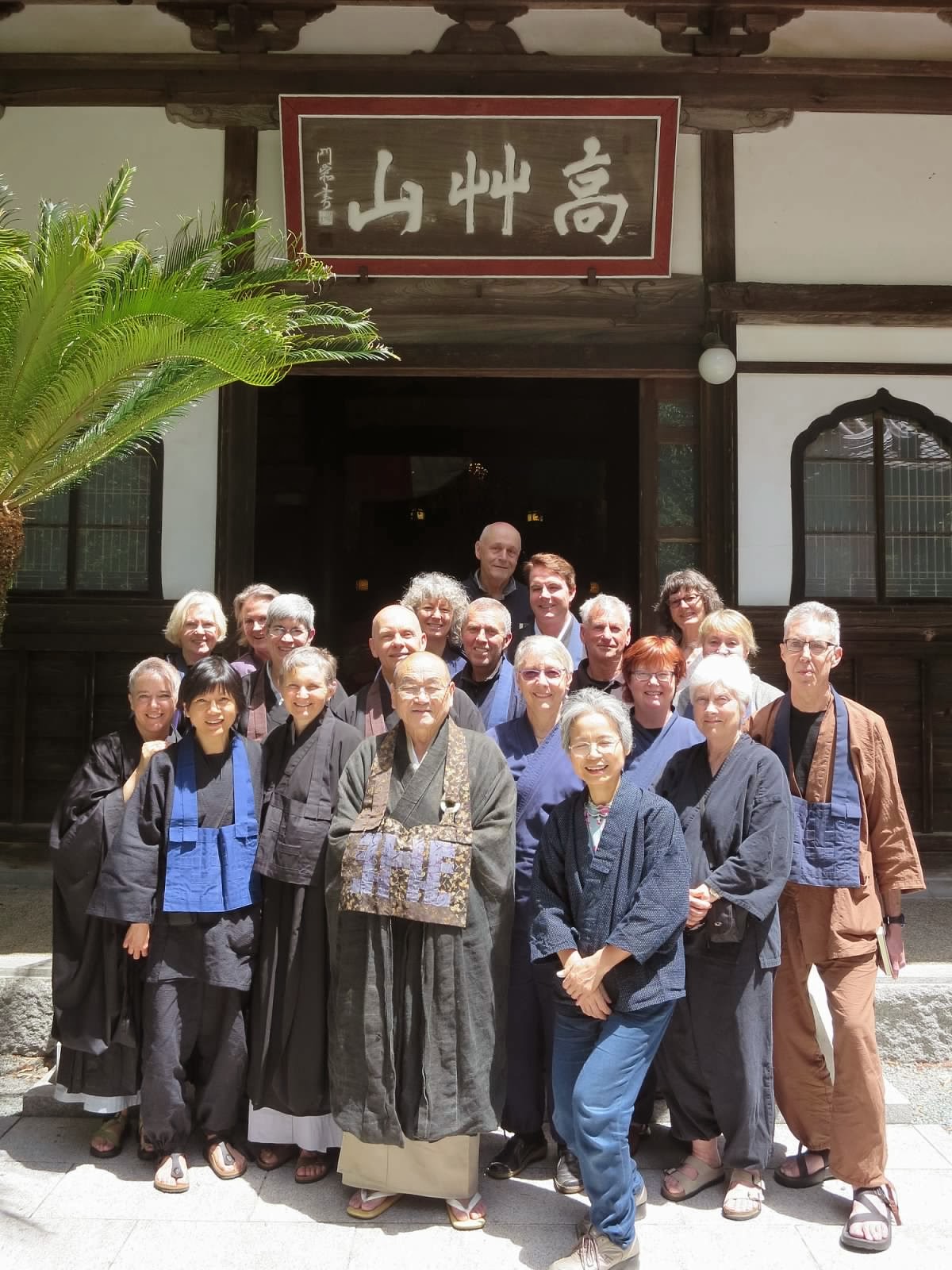


Mountain Rain with Hojo-sama and Oka-san in front of the Buddha Hall, Photo by Kwee Downie.


Tuesday, December 27, 2011

Post-Christmas Musings


This Christmas I found myself thinking about all the ways we celebrate Christmas, and the extraordinary complexity - emotional, familial, logistical, spiritual, financial - of relationship with this holiday (the "holy-daze," says one friend).

Therapists have told me that the time between Thanksgiving and Christmas is their busiest time of the year: people who have never darkened the doorway of a shrink suddenly find themselves at their wits' end. And yet we're all supposed to be happy, "merry" even, which of course just makes it worse for those poor souls who, for one reason or another, find themselves a few shades short of the requisite emotions. I've observed that even those who profess to thoroughly enjoy Christmas tend to get just a wee bit stressed.

Not to mention the whole confusing issue of gifts: Just for the kids? How about all those coworkers?  Does anyone even want this stuff? Will anyone like my presents? Do I go into debt to match the family's expectations? Who will I offend if I don't give a gift?

And, if you're like me, the political and economic questions start piling up too: How can I justify this consumerism? What about all the people who have nothing? But should I be supporting my local craftspeople and small businesses? What about donations instead?

My father is a sociologist, and one of his more playful sociological studies was an exploration of the ten unwritten "rules" of Christmas gift giving in the Midwestern town of Muncie, Indiana (called "Middletown" in the study). There are Tree Rules and Wrapping Rules, and Who Gives What to Whom Rules, and none of them are written down or even seen as rules. Everyone thinks they're freely choosing what they do at Christmas. Every time I read this study I recognize my own behaviors in it, and am both amused and horrified. Are we really so predictable, so driven by our unspoken cultural habits and pressures?

All that aside, I had a wonderful, albeit highly untraditional Christmas this year. And I heard a lot of stories from others about their Christmas celebrations and conundrums.

I spent my Christmas house-sitting for a friend in Northern California, so that she and her daughter could travel to Florida to be with family. My co-celebrants were a black-and-white miniature Australian shepherd and two black-and-white cats. The dog and the cats, unfortunately, are not on speaking terms, which is perhaps not so different from many family Christmas situations. Nonetheless, I was extraordinarily happy.

On Christmas Eve I drank hot apple cider, had a couple of phone chats with family, admired the beautifully decorated Christmas tree in the house, and listened to early music with the dog on my lap, considering how strange and wonderful it was that I was entirely alone and utterly happy, feeling the mystery of the renewal that Christmas signifies.

On Christmas Day I made a colorful organic salad for Christmas dinner for twenty residents of the local homeless shelter, dropped it off, and went for a long sunny romp at the local beach with the dog.


Later I had a phone conversation with an elderly friend who had broken her leg a few weeks ago and found herself spending Christmas in a rehabilitation center. Rather than being full of pity for herself (as I probably would be in her situation) she was overcome with gratitude - for the miracle of being alive, moment by moment, and for the miracle of her body's slow but steady healing. I was moved to tears as I listened to her.

Then I went to another older friend's house and shared a traditional Christmas dinner with her interesting grown family. We stayed up and talked until the wee hours of the morning, ushering in the end of Christmas with our wide-ranging conversation.


So what can I deduce from this about Florence and her perfect Christmas? Well, apparently she needs a healthy dose of solitude and quiet, music, time to feel the sacredness in the moment, a sense of purpose and service, a few warm animals, a little bit of time with beloved people (but not too much), good food, and a teaspoon of the beauty of the natural world.

Then there is my friend D., who was my inspiration this year. She was the one who organized the meal for twenty at the homeless shelter. She traveled to India earlier this fall, and when she came back she was, as she said, completely unable to stomach the idea of doing Christmas as her family had always done it. She said, "The world is changing, and we have to do things in a way that takes care of others."

She convinced her husband and children to try something very different, and astonishingly, they agreed. They bought toys for a local toy drive instead of gifts for each other, raised money for three Vietnamese children who need heart operations, and made Christmas dinner for the shelter, which the whole family delivered. Clearly for her, the perfect Christmas is one that honors her commitment to helping others.

Another friend, T., who is Jewish, buys presents for all the post office workers and takes them to the post office the week before Christmas, just when the stress and grumpiness of the customers is at its height.

I know others who spent Christmas deep in the sweetness of their family, doing nothing much other than being with one another, cooking together, eating together, appreciating each other and what they have as a family.

But lots of people I know spent Christmas in ways that did not nourish their hearts or align with their true expression. I know someone who is struggling financially (as so many are) who was expected by her children to play "grandma" with all the expected presents for the grandkids, far beyond her means. I know another grandmother who was struggling with a family request to give fewer presents than she wanted to. Others spent Christmas in ways that were conventionally "merry" but left them, mysteriously, empty and sad.

There are tremendous social and familial pressures at this time of year. My friend D. was very lucky that her family agreed with her radical requests. We all have such strong opinions about how Christmas "should" be, and woe to the person who requests or needs to do it differently.

Usually my writing here is not polemical: I'm not trying to convince you of anything, but rather to share my thoughts about something that has caught my heart or my mind. But in this case I want to admit that I have an agenda. I have a big Christmas wish for next year, and this is it: that we each support ourselves and each other to celebrate Christmas in the way that is truest to each one of us, no matter how strange or radical or untraditional it may seem.

Christmas tree at Muir Beach
The world IS changing, as my friend D. said, and it would be a beautiful thing if we could allow those we love to change too, and find ways of celebrating the season with fewer trips to the shrink (and, I might add, the mall!) and greater happiness and meaning. What better gift could we give one another?

If your loved one wants to spend Christmas alone with a dog at the beach, or helping out at the local homeless shelter, let her! If your loved one wants to go far away to a place where no one celebrates Christmas, let him! If someone asks not to give or receive presents, honor that difficult and brave request. If presents are important to you or others, find a way that they really matter, are truly appreciated, and are not merely an obligation, an empty gesture. If a family member is suffering financially, release him or her from the burden of reciprocity. Invite someone who is unwillingly alone to share your Christmas feast. Think of those for whom Christmas is a dark time, and see if you can bring a little light.


Perhaps, somewhere in there, each one of us, regardless of our religion, will rediscover the spirit of Christmas, for ourselves: the spirit of love, of kindness, of generosity, and of renewal. This is my hope.

Saturday, November 19, 2011

The Shadow of an Anchovy


My mother-in-law's family were poor peasants, and they would tell the story of being so poor that instead of having meats at the center of the round of polenta, they had a single small anchovy hanging over the center, casting its shadow. They said that the shadow of the anchovy was all they had to bring a little richness to the polenta.  
                                                                                                          -  Peggy Haines-Capelli
I was in Italy at the end of October and beginning of November, in the provinces of Tuscany, Umbria, and Le Marche. I was more than a traveler there: I was named for Florence - Firenze to my mother and those who knew me as a child - and my childhood was woven with the narrow streets and convent cloisters, churches and olive groves of Firenze and Tuscany, as I traveled back and forth with my art-historian single mother between the surreally different worlds of the American Midwest and Italy.

Fields, vineyards and villa, Setignano

From the time I was five until I was fifteen, we lived in Florence for part of every year. I went to kindergarten and fifth grade in Italian schools. I spoke Italian. Some of who I am came from that life, so far-away and mysterious to my American school-mates. I hadn't been back in many years, and this trip was a poignant, sweet chance to be there again with my mother, while it is still possible for both of us.

Although Italy is wealthy now, when I was a child - thirty, forty years ago - Italy was poor, third-world poor, and we were poor too, despite (or maybe because of) our bicontinental life.

The convent on Via Giuseppe Giusti
When I was small, we lived in a convent pensione across the street from the archives where my mother did her research. She couldn't afford child care, so in the early morning, when I was still asleep, she would go out, buy a roll and jam, sneak back in and leave it by the bed for me. When I woke up I would find my roll waiting for me, and for the rest of the morning, until lunchtime, I would lie in bed, get crumbs all over the sheets, and read, endlessly.

If I really needed something, the Italian nuns were down below, cooking in the big dark kitchen, cleaning the already-shining floors in the mostly empty main rooms, or cultivating the garden behind the building. I remember eating zucchini flowers for the first time, deeply comforting pastina in brodo with grated parmigiano on top, hard Tuscan bread. A great treat was a single Baci, the chocolate and hazelnut "kiss" made by Perugino, or an aranciata, an orange soda.

When we lived in Italy for longer times, we rented an apartment from an English doctor who owned a farmhouse in the hills to the west of the city. The contadini, the traditional Italian peasants who worked the land, lived down below us, next to their animals. Every morning I would wake to the sound of the cart and white oxen going by below our windows, slowly, slowly, with much shouting.

Two white oxen in the Tuscan hills

Our back windows looked out over a quintessential, "romantic" Tuscan landscape: hills, olives, dark spires of cipressi (cypresses), stone walls, the old stone village of Pian dei Giulari perched along one side of the valley, just down the road from us. What was concealed was the poverty, the backbreaking work, the deep knowledge that knew how to rebuild the stone walls, how to prune the olives, how to breed the oxen, how to survive. Now most of the contadini, as a culture, are gone, gone to work the well-paying jobs in the cities, and the absentee landlords struggle to keep the vineyards and groves alive without that deep and unacknowledged wisdom.

Sheep and stone trough

I remember, vividly, walking as a child on a country road and looking down into a farmyard where a contadini family was gathered around a round of polenta. Polenta was peasant food - no city restaurant would have dreamed of featuring it on a menu - and it was formed into enormous flat cakes, as wide as a circular table. It was cut with a string into wedges (this fascinated me), and each person at the table would eat their wedge toward the middle. In the middle would be whatever protein the family might have, and whoever could eat their wedge most quickly would get more of what was there.

A meat shop in Norcia - yes, those are boars' heads

While we were in Italy this time, we spent time with Peggy Haines-Capelli, an American art historian whom I knew and loved as a child and who, unlike us, chose Italy as her home and country. She eventually married an Italian journalist, and is now a widow. She told us the story of her husband's family and the anchovy as we sat around her round table, eating food we had brought back from our trip into the mountains of Umbria: famous tiny lentils from the town of Castellucio, pecorino cheese, salame called "mules' balls" from Norcia, with a white center of lard - a feast somewhere between a picnic and a high tea, rich with the stories of our trip to the wild and mysterious Monti Sibillini, the mountains of the sibyls. When I heard Peggy's story, probably in mid-bite of something delicious, it felt like a koan: what is the taste of the anchovy's shadow?

Quinces in farmer's market, Florence
While I was in Italy I was puzzling over the particular flavor of Italian life - the tremendous soul and depth that can be felt in the simplest village piazza or in the most elegant Florentine coffee bar. There is an appreciation of the sensuous things of the world, which, far from seeming superficial and materialistic, actually feels life-affirming, ancient, hugely sane. How do they do it? And how is it, that with all the force of modernism and wealth and speed, it is still alive, a heart at the center of things, something that can be tasted in the olive oil sitting on a trattoria table or in the syrupy intensity of a morning one euro espresso at the train station? And this story, of the anchovies...I think it's a key. I think it's a teaching story, perhaps for all of us.

Chestnuts, hazelnuts, fennel, honey in a farmer's market, Florence

We live like gods, these days. Not necessarily happy gods, but gods nonetheless. Few of us can imagine the poverty that would have a whole family only able to eat what is essentially ground field corn and water. No doubt life was hard, even sometimes hellish, for that family gathered around the polenta and that single, hanging anchovy. It drove the man who would become Peggy's husband to spend his life dedicated to defending the poor and oppressed.

House for a cat, Narni

But there is also something quintessentially elegant and clever in the story of the anchovy's shadow, although I can't quite put my finger on what it is. If there is only one anchovy to bring a little something to your polenta, what do you do? Can you appreciate the shadow of an anchovy, its salty, fishy scent perfuming the air as you eat? Can you raise your empty glass to your neighbor? Can you laugh a little, at yourself and at life, which is only providing this one little fish? Can you take what you have, a little or a lot, and make a feast? That's what it is - it's something about creating a feast out of famine, out of so little, a kind of grace, in both senses of the word.

View from hermitage, San Euitizio in Valle

That's what I feel in Italy, when I'm there: a soulful, embodied willingness to live, whatever comes. Maybe it's my projection on the place and its people, but I don't think so...I feel and see it with the part of me that was formed there. And as the country teeters on the edge of economic collapse, after so few decades of relative wealth, I think, "Well, maybe they'll be fine. Maybe they haven't forgotten how to live, under those designer clothes and behind those smart phones. Maybe they could teach the rest of us a few things about living."


"Life is too short", graffiti on a rural wall

And as I imagine a loaf of Tuscan bread, just water and flour and yeast, that intentionally hard crust to protect the soft interior, no salt because who could afford salt - and then I remember how profoundly GOOD it is, in its simplicity, in its poverty - it gives me courage.

If we are all (or most of us) going to get poorer in the future, which seems like a distinct possibility, let's do it with class. Let's celebrate the shadow of the anchovy.


This essay is dedicated to Signor Mauro Meniconi, the proprietor of a roadside porchetta van in rural Umbria, and one of the secret saints of the world.

For more photos, go to https://picasaweb.google.com/Firenze33/Italy