Sunday, May 9, 2010

Mother's Day


On this Mother's Day I've been driving across the springtime desert, a great bouquet spread across the mountains and canyons and vast sweeps of the Southwest. And I've been thinking about the power of mothers, the sheer unbelievable exhausting work and terror and joy of mothering that women all across the world take on with their whole hearts.

In the Metta Sutta, an early Buddhist sutra about compassion and loving-kindness, the practitioner is urged to love others "even as a mother loves her only child." The Tibetans teach loving-kindness by suggesting that since all beings have, in one lifetime or another, been our mother, how can we help but feel boundless gratitude to all of them? And Prajnaparamita, the deepest possible wisdom, is described as "the mother of the Buddhas" and is always depicted as a woman.

Personally, I've been learning a few things about what it takes to be a mother, directly from the source. For the past few months, before I started my annual fieldwork, I've been the "token non-mother" in a small meditation group for mothers that my friend Monica and I started together. All the women (except me) have school age children, and some are on the second round of raising children - a child in college and a young child still at home.

We meet at 8:30 AM on Mondays, since mothers generally can't get to an evening meditation group. Anyone can show up as late as they need to, since everyone knows that getting kids off to school can be filled with the unexpected. If someone has a child home from school, she can bring him or her to the house too. After we sit together in silence on couches and chairs and comfortable cushions, we pass around a little statue of Kuan Yin, the female bodhisattva of compassion, and each woman has a few minutes to speak about anything she wants. We all listen with our full attention. Sometimes the person speaking begins to cry. Sometimes we all start to cry. Sometimes we all laugh. And then, after each woman has said what she wants to say, we talk for a bit and then go our separate ways.

Every time is moving, extraordinary, and the hard-won wisdom in the room is palpable. And each of these women, who spend all week listening and responding - to children, husbands, a whole family - have one place where she is completely listened to and heard, and where she can say whatever needs to be said, the thing that perhaps can't be said anywhere else.

This what I've learned, through the tremendous honesty of the women in the group: mothering is infinitely harder than anyone ever acknowledges (and I can imagine all the mothers reading this snorting and rolling their eyes at my great insight). My respect for mothers - any mother - has increased tenfold. All you non-mothers out there, male or female, just try it for a week. Take someone's kids for a week - even your own kids if you're not the primary caregiver - and see what it's like. See if you're not reduced to a puddle of exhaustion, frustration, infantile responses, confusion, and self-doubt by the end of the week. See if you're not horrified by the thoughts that have arisen in your mind. See if you haven't wanted, at least once, to throw something across the room, maybe even that sweet child that you love so much who has just pushed you over an edge you never imagined you had.

And yet, on the other side, ask any mother whether she regrets what she's taken on. I remember when my friend Katy had her first child, at 40, after most of a lifetime of not wanting children. She said, over and over again, "I can't believe I almost missed this. I have never felt love like this, my heart has opened wider than I knew was possible, there is nothing more wonderful." She was transformed, radiant, new-born herself. She's walked a tough road as a mother, with some terrifying moments - the kind of moments that no parent even wants to think about - but I know she would still say the same things that she said when her first beautiful daughter was born.

To be a mother is to open yourself up to everything - to all the struggle and heart-ache, to being unappreciated or even hated by your children, to risk the loss of your children, to weep, to sacrifice what matters to you for your children, to be helpless to ease their suffering, to fail and fail again. And to love with every cell in your body.

When Tibetan teachers first came to the West, they couldn't understand why their practice of generating gratitude by thinking of one's mother often went so poorly with their Western students. It seems that deep trouble between mothers and children is a hallmark of our culture. If we're lucky we can spend a few days with our mothers without going mad. But admiration? Devotion? Very rare.

We can't pretend that trouble away, but at least we can consider what it takes to be a mother, every once in a while. I know that my contact with the women I was sitting with every Monday morning has changed me irrevocably, and has given me a new view of the tremendous nobility of the practice of mothering. A bodhisattva is a being who is dedicated to the well-being of others; however imperfectly, every mother is engaged in bodhisattva practice, doing the best she can with her own heart and the challenge of a child. Now when I see a harassed mother with a screaming child - or two, or three - in the grocery store I want to bow down and kiss her fee, or at least hand her a coupon for a good massage and a glass of wine. I am in the presence of a bodhisattva.

I want to end with part of an ancient koan:

A certain laywoman was a student of a famous Zen teacher in China. From time to time she would come to the monastery to visit the teacher, and she would be treated with great respect and was housed in the teacher's best guestroom. The senior monk at the monastery resented the woman and didn't think it was proper that she was treated so well. He kept complaining to his teacher, and finally the teacher said, "If this bothers you so much, go talk to her yourself."

So the monk went off reluctantly to see the woman. When he knocked at her door with his attendants, she met him and said, "Is this a worldly conversation, or a Zen conversation?"

He said, "A Zen conversation."

She said, "Then dismiss your attendents and come in alone in a few minutes."

When he came in she was lying on the bed, naked. He pointed to her body and said (and I can imagine the tone here), "What is this?"

She said, "This is the gate through which all the Buddhas and great teachers come into the world."


Every great man, every great woman, every humanitarian, every saint, every president, every philosopher, every artist, every writer, every peacemaker has come into the world through the body of a woman. On this Mother's Day, I bow down to all women everywhere, and especially I bow down all mothers. Bravo. Bravo. Bravo.


And a special bow to my own mother, the amazing Harriet McNeal, off in Romania having more adventures as I write this. Thank you for all the ways you've taken care of and inspired me.

Tuesday, March 23, 2010

Blessings

Library of Congress, Prints and Photographs Division, Washington, D.C. 20540 USA, hdl.loc.gov/loc.pnp/pp.print

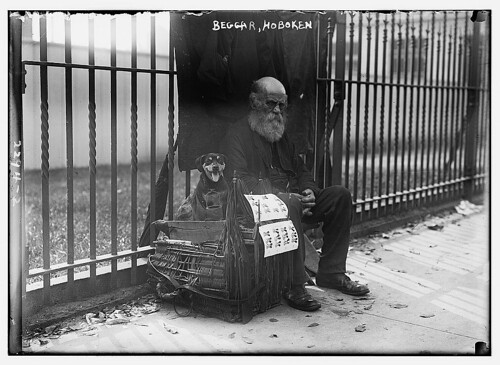
It’s a cold, sunny November day in San Francisco, and I’m walking up Fillmore Street near Japantown. I don’t live in the city, but I enjoy coming in for the day from my little place in the oak-covered hills to the north. I’ve already indulged in a fine latte at a tiny French cafĂ©, sitting at a table in the sun reading the New York Times and feeling comfortably and exquisitely urbane. Now I’m near the Duxiana store, which sells high-end luxury mattresses, and I notice an older man sitting on an overturned bucket by the corner. He’s wearing a gray canvas smock and he’s holding an empty soup can carelessly in his right hand. He’s looking across the street, as if he’s just resting there on his bucket, resting rather than begging. I walk by him and up to the gorgeous windows of Duxiana, and then I remember my tax.

I used to live in the country in the Pacific Northwest. Every few months I’d drive to Seattle, and invariably, as I came down the off-ramp from the freeway I would see a person at the corner near the first traffic light, usually holding a hand-lettered cardboard sign: “Need food or a job,” “Please help,” “Mother and two children,” ”Veteran.” I would roll down the window and hand a few coins or a dollar or two to whoever was on the corner that day. I began to think of this as my “city tax.” I was coming to Seattle to enjoy the city for the day; the least I could do was hand a few coins to someone willing to stand on a busy off-ramp in the ceaseless drizzle.

I know and understand the arguments against handing money to homeless people. But I tend to see asking for money on the street as a very difficult, very poorly paid job, one that I – and most people I know - would be utterly unwilling to do. I can’t imagine standing on the street for hours at a time on sore feet, begging for help, ignored, sometimes cold or wet or both, all for a little bit of cash, perhaps barely enough to buy a warm cup of coffee.

So I’m standing by the Duxiana windows, looking in at the beds as soft as clouds, and I remember all this. I turn and walk back to the man with his bucket and empty soup can, and I drop a little money in the can. He’s surprised. Without thinking, I also touch his hand and wish him well. He, in turn, looks me in the eyes and says, “Bless you, bless you.” And I feel blessed. Thoroughly and genuinely blessed and warmed and touched, like a sudden shaft of sunlight on a dark day.

This is what I’ve found, from these many years of giving money to people on the street - men and women with their shopping carts in big cities like Washington D.C. or New York or San Francisco, homeless pierced teenagers in small towns, old ladies dressed in black on the steps of churches in Mexico, gypsies playing accordions in Italy or in Greece - the response, nearly every time, from every sort of person in every language, is “Bless you,” or “God bless you.”

This is the most wondrous and mysterious thing to me. I hand fifty cents to a stranger and they bless me, like an ancient ceremony, like the kiss on the head by a wise man or woman. I never expect the blessing – why should they bless me from their cold street corner, comfortable and secure and oblivious as I am? And yet, when the blessing appears, I understand again that this is what they have to offer. When you have nothing, what can you offer but your blessing? And perhaps, when you have nothing, when you find yourself begging for food or change while others walk by you on the way to warm restaurants and cafes, your blessing is a gift far beyond what even you yourself can know.

All I know is that it feels like more than a fair exchange. Fifty cents in my pocket will buy me very little happiness; a blessing, a real blessing, and that glance into each others’ eyes, is beyond price.

Monday, February 15, 2010

Clinging To Words


The Saturday before last I spent the afternoon at Green Gulch Farm, my old haunt in a valley on the Marin coast just north of San Francisco, then drove the curves of Highway 1 high above the Pacific, then past Bolinas Lagoon and up Bear Valley, where the San Andreas fault separates the North American tectonic plate from the oceanic tectonic plate, and thence to the tiny town of Point Reyes Station,at the southern end of Tomales Bay.

Two of my literary heroes were reading and speaking together in Pt. Reyes that night: Robert Hass, two-time poet laureate, and Michael Ondaatje, Sri-Lankan-born author of The English Patient and other great novels. I had found out about the talk two days before, and had been almost beside myself with excitement about it.

Why, you might wonder, are two towering world literary figures hanging out in a small town in West Marin on a Saturday night? Well, they're locals- Robert Hass lives in Inverness, just across Tomales Bay from Point Reyes Station, and Michael Ondaatje spends the winter in Marin. And they're old pals. In fact, they even look alike - both grey-haired, a little short, a little paunchy, with kind faces and laugh lines around their eyes. They were doing a benefit for the Tomales Bay Library Association, which sends writers into the local schools, teaches English to ranch workers, and hosts a major literary conference every couple of years, the last one dedicated to the memory of Wallace Stegner.

As I sat in the Point Reyes "Dance Palace", the local community center, waiting for the talk to begin, I was reading the book I'd brought along, Bill Porter's Zen Baggage: a pilgrimage to China. Bill Porter, come to think of it, would have fit right in that night - he's also gray-haired, a bit round, with laugh lines around his eyes, and he's also one of my literary heroes.

Bill lives in a place like Point Reyes Station, though larger: Port Townsend, Washington. Port Townsend is - like Point Reyes Station - filled with writers and wannabe writers, tourists and poets and artists and eccentrics and organic farmers, boat-builders and old Zen guys.

Bill lived for years in Taiwan, some of those years in a Zen monastery, then started translating ancient poetry from Chinese. He and his wife came to the US a number of years ago, and now he is one of the pre-eminent translators of Chinese Buddhist sutras. Sutras are teachings of the Buddha or expositions by great teachers on Buddhist philosophy, often quite deep and difficult to understand. Translating Buddhist sutras does not make one rich: in one of his books he thanks the local food bank in his acknowledgements. His pen name is Red Pine.

Zen Baggage is the story of one of his recent wanderings around China. That night, as I sat on a hard chair in the Dance Palace waiting for my heroes, I read about a cave he visited in the Taihang Mountains. From 581 to 1100 AD, more than a thousand Buddhist sutras, each one many thousands of lines long, were carved into the stone walls of a series of nine caves. In 1100, the caves were sealed, and they were only unsealed in 1956. Every inch of these caves is covered with ancient sutras. The versions of the sutras in the caves are in many cases older than any other known version. Paper and books can be burned; stone has a way of staying around.

As Bill wandered around the caves looking at all the words, he thought of the Lankavatara Sutra, and he quotes a long passage from it: "a noble son or daughter [a Buddhist practitioner] should not become attached to words, because what is true is beyond words. ...if someone points to something with their finger, and a foolish person looks at their finger, they won't see what it is pointing at. In the same manner, foolish people become so attached to the finger of words, they refuse to abandon it to grasp the truth, even at the point of death..."

Bill appreciates the irony of this - the Lankavatara Sutra, which was revered by early Chinese Buddhists, was undoubtedly carved in stone somewhere in those caves. Monks spent years of their lives painstakingly carving words - were they attached to them? How could they not be?

After reading that passage, I had to put the book down, because Robert Hass and Michael Ondaatje were coming on stage. For the next two hours I was filled with nearly unceasing happiness at the beauty of the language in the room. Robert Hass read first. I'd been reading his poetry for years, but I'd never heard him read aloud. In his mouth his words came alive in a new way, imbued with his humility, his honesty, his willingness to be moved and amazed by the world around him. One poem was about feeling like the shadows underneath pine needles on a spring day....

I'm no fool - I know that authors are often at their best in their language, and in person are arrogant alcoholics or worse - but I couldn't help liking Robert Hass. And his writing, which had impressed me for a long time, was suddenly full of sparkles, like sunlight on water, alive in a new way for me.

Then Michael read. I read The English Patient when it was first released and won the Booker Prize, and I had thought then that it was a masterpiece (the film adaptation, as good as it was, didn't even come close to the book). To be in the presence of someone who could write a book like that...to hear his language, and to hear him talk with his old friend Robert Hass and with the audience about his writing process - well, it was extraordinary.

As I walked out into the misty night air, I considered the power of words in those two men. Their words had raised $3,000 for the Tomales Bay Library Association that night - an organization dedicated to words and to the sharing of them - and a hundred people or so had spent their evening, eyes alight, in the presence of great language and humanity.

Robert Hass's gift lies in the most minute and loving attention to detail - to the detail of a lover's shoulders, the detail of a bird's song, the detail of a facial expression or fleeting emotion - and yet that description, no matter how good, is only a simulacrum of the real thing - that pine needle, there, the needle on the tree that perhaps he looks at every day outside his office window; that actual lover, maybe not quite the woman that he saw and wrote about. I once wrote an essay about a relationship, trying to be honest and true...when the person who was the other half of that relationship read the essay, he said, "Very nice, but you know, it's fiction." And he was right. All writing is fiction. "What is true is beyond words," as the Lankavatara Sutra says.

Ah, but the beauty of words! What they can do to us! There is the beauty of the bird in the sky, but sometimes we only see it in a poet's words about the bird, revealed in its poignancy. A memory of a visual image, turned into language, written down, then heard or seen and brought into the mind of the hearer or reader, who "sees" the bird, and is stunned by the seeing. And yet, there's also a gap, between the direct experience and the re-imagined experience, and a kind of longing there, in that gap. But still, can we perhaps say that "what is true is also within words", or am I just fooling myself, caught in my own clinging to language, my own ecstatic love of language?

Later, after the talk, greedy for more Robert Hass, I looked him up on the internet and found several poems on the Poetry Foundation website that I'd never read, including one called Meditation at Lagunitas. I discovered that Robert Hass asks these same questions to himself, He says, "because there is in this world no one thing to which the bramble of blackberry corresponds, a word is elegy to what it signifies", but he keeps thinking about it, and ends the poem with, "There are moments when the body is as numinous as words... Such tenderness, those afternoons and evenings,saying blackberry, blackberry, blackberry."

So here's what I think right now... let us say - and write - blackberry - and take joy in the reading and writing, "as numinous as words", and also eat actual blackberries, the juice running down our chins, joy in both, knowing that both these words and this mouth are temporary flashings, like "dewdrops, lightning, a rainbow". There are some lines from Tennyson that have always moved me:

"Love took up the harp of Life, and smote on all the chords with might;
Smote the chord of Self, that, trembling, pass'd in music out of sight."


It's like that.


Meditation at Lagunitas

by Robert Hass

All the new thinking is about loss.
In this it resembles all the old thinking.
The idea, for example, that each particular erases
the luminous clarity of a general idea. That the clown-
faced woodpecker probing the dead sculpted trunk
of that black birch is, by his presence,
some tragic falling off from a first world
of undivided light. Or the other notion that,
because there is in this world no one thing
to which the bramble of blackberry corresponds,
a word is elegy to what it signifies.
We talked about it late last night and in the voice
of my friend, there was a thin wire of grief, a tone
almost querulous. After a while I understood that,
talking this way, everything dissolves: justice,
pine, hair, woman, you and I. There was a woman
I made love to and I remembered how, holding
her small shoulders in my hands sometimes,
I felt a violent wonder at her presence
like a thirst for salt, for my childhood river
with its island willows, silly music from the pleasure boat,
muddy places where we caught the little orange-silver fish
called pumpkinseed. It hardly had to do with her.
Longing, we say, because desire is full
of endless distances. I must have been the same to her.
But I remember so much, the way her hands dismantled bread,
the thing her father said that hurt her, what
she dreamed. There are moments when the body is as numinous
as words, days that are the good flesh continuing.
Such tenderness, those afternoons and evenings,
saying blackberry, blackberry, blackberry.

Wednesday, December 30, 2009

In the Deep Midwinter

We all have our ways of celebrating the winter holidays. Some ways are more eccentric than others, I'll admit. This year I spent the day after Christmas looking for birds from dawn to dusk. The next day, the 27th of December, I spent the whole day in a silent retreat led by a Theravadan Buddhist nun. I've been thinking about these two days and how, mysteriously, they reflect one another. Each was a day of silence, of careful awareness, of gratitude, and of giving.

My bird-watching day was no random event: I was participating in the Christmas Bird Count, a census of birds in the western hemisphere that has been conducted annually over a few weeks in mid-winter by the Audubon Society for more than a hundred years.

According to the Audubon website, the count was begun in 1900 by an early bird conservationist, Frank Chapman, as an alternative to Christmas "side hunts" where hunters competed against each other in teams for the largest number of birds killed in a day. Now more than 50,000 volunteers in 17 countries participate in the count, and the results are used by ornithologists and conservation organizations to monitor the health of bird populations in their winter ranges.

I did the count with a friend, and we were assigned to an area of about one by seven miles in the hills above Bolinas Lagoon, out on the outer coast just north of San Francisco. Our day began at about 5:15 am - hours before either of us normally wakes up - followed by a groggy breakfast and a drive in the dark across the hills to the coast.

We're relative neophytes, so we were paired with two more experienced birders - an ecologist and an ornithologist - whom we met just before dawn in a muddy parking lot near the lagoon.

After minimal introductions, we headed up into the hills in silence, all four of us listening intently to the tweets and chirps and little sounds all around us in the dim woodland, though really only two of us (guess which two?) knew what they were hearing. Every few minutes someone would see something and we would all be peering into the tangle with our binoculars, trying to see a sparrow or a towhee or whatever might be lurking there, keeping a count of how many birds of each species we saw or - in the case of our companions - heard.

And so the day went, mostly in silence, hiking on or off trail through the canyons filled with coast live oak (and poison oak) or willow and bay, sometimes up in the chaparral or grassland of the open hills, sometimes all four of us together and sometimes split apart, each one of us completely intent on seeing and counting, eyes and ears and senses fully engaged, not stopping to eat or chat or even sit down. It was cold and gray, and in the afternoon it started to rain, first gently and then with determination, and we kept working as long as we could, until the rain came down so heavily in the early dusk that we were blinded and the birds were essentially invisible.

Part of what I loved about the day was the way that EACH BIRD MATTERED. In ordinary birdwatching, when I see one kinglet, I'm pleased, but the next one I see doesn't matter so much, and by the tenth I'm usually oblivious. But in the Christmas Bird Count, each raven, each crow, each jay matters, no matter how common, no matter how many have been seen before. Ah, if only we treated everything this way!

After a nine hour day in the cold and rain and muck, We drove back across the foggy slopes of Mt. Tamalpais to a warm cafe where we sat and drank hot chocolate, still in our wet jackets, still completely focused on the count. We added up what we had seen: sixty-three species, about average for a Christmas Bird Count in this area.

For each species our leader added up our individual counts, "Robins?" he would say, "how many robins?", and each of us would peer at our wet notebooks and scribbled, pencilled, nearly illegible numbers. "Sixteen, no, wait a minute, that's twenty, with those four I saw near the farmhouse," remembering the bright birds high up in the trees like so many orange Christmas ornaments. "Kestrels?" and we would get into a brief discussion about whether MY two kestrels were the same or different birds than the ones someone else had seen hovering like tiny kites above the hills.

Then we all shook hands and went our separate ways out into the dark. Our little count will be added to the count for all of southern Marin County, and that will be added to counts all across the hemisphere, and someday someone might comb through the data, noticing that this year, like the last few, no oak titmice were seen on the Marin coast, another population winked out, or our fleeting glimpse of a peregrine might tell a researcher that peregrines still hunt the flocks of ducks out in Bolinas Lagoon, a conservation victory after the birds came so close to extinction.

Strange to know that what felt so inconsequential - our day of effort counting robins and chickadees - would be added into a grand continental pattern created by thousands of people and hundreds of thousands of birds, a tapestry across time and space and the usual barriers between species. Even now as I write this there are people out with binoculars and spotting scopes, perhaps in your neighborhood, looking up into the trees, recording the often unnoticed life that fills the air with song and flight.

***************************

The next morning I woke up early again and drove to Spirit Rock Meditation Center, part way back toward the coast. Another gray, foggy day. The grassy hills of Spirit Rock were lost in the cold fog, but inside the meditation hall a hundred people or more sat quietly on chairs or cushions. At the front of the room were two striking women, both with shaved heads, one in brown robes, one in white: Ajahn (which means teacher) Anandabodhi and a novice nun, Anagarika Santussika.

Ajahn Anandabodhi and two other siladharas (nuns that take ten precepts, including celibacy, not handling money, depending entirely on alms, and eating only once per day) just arrived in San Francisco to start the first Buddhist nun's community in North America (Saranaloka).

Photo from Saranaloka website

The nuns, who are British, come from a monastery in Great Britain, the only one I know of in the west that trains nuns as well as monks. Although a women's order of nuns has been part of the Buddhist world since the time of the Buddha, the history of women renunciants is a history of marginalization. In many parts of Asia the women's order has died out altogether; in other areas women practice as nuns but in desperate poverty, not supported by lay people in the same ways that monks are, and often not empowered to teach.

As a consequence of this sad history, in all my years of meditation practice with many teachers, I had never been taught by a Buddhist nun before this midwinter day. I sat down near the front and listened as the Ajahn gave basic meditation instructions, struck by her clarity and steadiness. Then the hall settled into silence, silent sitting alternating with silent walking out under the dripping trees.

Usually at one day retreats each person brings their own bag lunch, but for this event, which was also offered without charge (monks and nuns cannot charge for the teachings), we were invited to bring something to share and to offer to the nuns, since they can only eat what is explicitly offered. At about 11 AM, when the nuns eat their one meal for the day, Ajahn Anandabodhi came and received the individual dishes from those of us who had brought an offering, gently taking the dish from our hands and placing it on the tables. Then she and her novice nun offered a meal blessing. Afterward we all went through the line, sharing the bounty of a hundred gifts to one another.

I've written before of how moved I am when I see the power of generosity, and this day I felt it very deeply, almost to tears, seeing both the radical trust of these women's lives, and the tremendous kindness of my fellow retreatants. It was particularly poignant to know that after two thousand years of being pushed aside, ordained women could now step forward with their gifts and be appreciated, even celebrated.

This is the best of us as human beings, I think, this generosity, just as the generosity and caring of the Christmas Bird Count represents the best of us - crazy people willing to go out in all weather in the depth of winter while their friends and relatives are at the mall or in front of the television, all for the sake of the birds of our world.

I spent the rest of the afternoon in silence and attention, just as I had the day before, though my attention was on breath and silence itself, rather than birdsong and movement, and I was grateful to be drier (!). When I walked outside, once again I saw each crow, each jay, each black phoebe, and almost without thinking found myself counting them, amused and glad at the way that my vision had been clarified by the day before.

These two worlds are both my worlds - the world of inner attention and the world of birds and trees and fog....I am so grateful for both of them, and for the people who share my love for them.

In the depths of winter, nourishment and renewal.

Monday, December 7, 2009

A Table for Four Hundred


I celebrated Thanksgiving this year up in Sonoma County. Ah, it was great. We had organic roasted vegetables from local farms, a huge selection of fine cheeses, fresh organic artisanal bread, organic roast turkey, poached wild salmon, roast lamb, local pears poached in Merlot, a selection of locally-produced wines, overflowing tables of pies and deserts.... There were linen tablecloths, white napkins, china, and lovely garden flower arrangements on every table.

And this cost nothing, not for us and not for the other four hundred people celebrating together, whether poor or rich, young or old. We went up early and spent all day with about fifty other volunteers, guided by some of the best chefs in the county, turning boxes and boxes of donated organic food from local farms and from Whole Foods into a free Thanksgiving feast, and then some of us helped serve, and then we sat down at the beautiful tables and enjoyed the abundance with everyone else, just as one does at home with friends and family.


And abundance it was - an abundance of kindness, of laughter, of good will and hard work, gourmet food and great wine, all offered generously. Kids ran around everywhere, older folks in wheelchairs chatted together or with families nearby, and street people sat next to doctors, lawyers and migrant workers. The feeling in the big community center hall was like one big four-hundred-person smile.

There were people who would have spent Thanksgiving alone, people who came to spend Thanksgiving with their friends, people who spoke no English, people who volunteered every year, people taking food back for bedridden family members - every sort of person, in every sort of situation, side by side at the long, happy tables.

What I found most inspiring was the way that there were no boundaries. I've served Thanksgiving in shelters, and found it very moving, but this was something else, a wide hospitality and a wide open door for whoever wanted to enter, vineyard owner or street kid. And no cheap donated old vegetables and canned food on paper plates, dressed up pitifully as a "Thanksgiving meal". This was the best of the best, served with love and pride.

It reminded me of Dorothy Day's radical Catholic teaching of how to be with the poor or homeless: "Bring them bread and roses." Not just bread: people need roses too - dignity and beauty. Herding a bunch of poor people into a line for canned cranberries and green beans is better than nothing, but it's not roses. Creating a place where everyone is welcome, where rich and poor sit down together, and where everyone is served beautiful, organic food - that's I think what Dorothy Day meant by 'roses'.

Over the years I've struggled with my relationship with Thanksgiving. On the one hand it seems like a perfectly lovely holiday, a celebration of the harvest and of gratitude. On the other hand, sometimes I feel that it has degenerated into a kind of family food orgy, the table groaning under vast plates of food, soon to be followed by a vast mess in the kitchen and the next day by Black Friday, the beginning of the Christmas buying frenzy. Maybe it's because most of us don't grow our own food, so the food has lost its connection to the land and its abundance. Perhaps my problem is a feeling that in a country that has grown fat on the wealth of the world, something is subtly off about a holiday that's primarily about consumption.

Some years I've fasted for the day. A few times I treated it as a normal work day - it was a fabulous day to get a lot done and I had an entire six story building to myself. But those things didn't feel quite right, as if I was out of step with something quite important, even primal. Last year I served a Thanksgiving meal in a shelter in Flagstaff, Arizona - not a very good Thanksgiving meal, to be honest, served amidst the bunk beds in a cold concrete-block building - but the gratitude on the faces of the men there was palpable, and I felt like I was finally touching something closer to the way I want and need to celebrate this holiday.

This year I'm in the Bay Area, and although there are plenty of poor people here, there aren't many free Thanksgiving meals, especially outside the churches and Salvation Armies. I was spending Thanksgiving with a friend who is allergic to organized religion, so those places were not possibilities for us. When I found out about the Sonoma Thanksgiving, I was intrigued by the idea, and my friend was particularly delighted about the organic turkey, so we traveled an hour north into the little town of Sonoma, and proceeded to have so much fun that I'm surprised it was legal.

I don't know why it's SO MUCH FUN to work really, really hard to make a free Thanksgiving, but believe me, it is. My friend carved organic turkeys to his heart's content, to the admiration of the other guys. I had the rather amusing job of trying to serve roasted parsnips to a highly skeptical crowd, "What are those? Parsnips? What are they? What do they taste like? No thank you." (A hint to other Thanksgiving volunteers: don't get stuck with the parsnips.)

Nonetheless, it was great. At the end of the day, after helping with the mountain of dishes, we were exhausted and utterly happy. The four-hundred-person smile had seeped into us and our sense of a true participation in 'Thanksgiving' was deep and complete.

Maybe the message of Thanksgiving is not just abundance, but generosity. Perhaps that's why we were so utterly happy - we had spent the day drenched in generosity, poached in generosity like those pears in Merlot (mmmmm...those were good).


Many thanks to Gary Edwards, the mastermind behind the Sonoma Community Center Thanksgiving, who somehow coordinated a bunch of raw, restless recruits and got a hundred-course meal out on time, the other great chefs and caterers, the many volunteers, the farms and businesses that donated food, and to Bob Kinsey, one of the loyal volunteers who took the photos in this post.
We'll be back for the Christmas Day meal!

Thursday, November 12, 2009

Crete

Last month I traveled to the island of Crete, in the southern Greek islands. I was traveling with my 81-year-old mother, although we met up with some friends for part of our journey.

It was a very rich and full experience – it felt like several months worth of life – so much so that I’ve found it hard to write about, despite being back for more than a month. What I’ve decided is to write two posts about the trip – one of thoughts and musings about Cretan history and culture, and one more straightforward travelogue, for those of you who might want to travel there yourselves someday. This first post is the “thoughts and musings” one.

A number of people asked me, “Why Crete?” Why does a Zen Buddhist priest with not much money fly halfway around the world to visit a Greek island? The easiest answer is that I was drawn like a moth to the light of an ancient people.

Five thousand years ago, when most of my ancestors in northern Europe were probably still standing nervously behind wooden stockades hoping that the most recent wave of barbarians wouldn’t do us in (or were the barbarians headed for the stockade), an extraordinary culture grew up on Crete. We don’t know what they called themselves; the later Greeks called them the Minoans, and named their island the birthplace of Zeus, the greatest of the gods.

Crete is one of the largest islands in the Mediterranean, more than 100 miles long, and it was - and is - full of high forested mountains and deep caves, gorges and rivers and fertile soils, wild olives and wild grapes and wild herbs, surrounded by the rich waters of the southern Mediterranean.

There, a long way from the waves of barbarians, there was enough peace and enough prosperity for something utterly unique and highly sophisticated to develop, at the very dawn of Western history and culture. Their world continued for sixteen centuries. And even though the Minoan culture has been gone for 3,400 years, a few of its gifts were passed to the Greeks and Egyptians and through them, faintly, to us.

I only wish that more of those gifts had come our way. From the many archaeological sites (and it seems like every little village has at least one Minoan site), it seems that the Minoans lived with extraordinary grace, playfulness, awareness of the natural world, and appreciation of both men and women.

The shrines to their divinities were simple structures on the heights of the mountains, rather than heavy-handed temples, and most of the images of divinities that have been found are of goddesses.

The frescoes that remain in the ruins of their “palaces” are full of leaping dolphins, flowers, bold unveiled women, and lifelike animals, as if the artist could feel the animals from the inside.

Their architecture was human-centered and extremely graceful – I would happily live in a Minoan house, with its colonnades and light wells, its brightly painted walls and smooth stone floors, its clever waterways and drains, its gardens and terraces.

No fortified Minoan site has been found, nor any images of slaves. Artisans lived side by side with nobility, and Minoan artisans were the finest in the Western world at the time. They knew how to work gold into delicate filigree, how to make glass paste figurines, how to cast bronze, how to throw and fire elaborately decorated terracotta pots six feet high, how to make fantastically beautiful frescoes that have survived for four thousand years … and those are just the things we know and that survived the many earthquakes and invasions and wars since their time.

We don’t know their music or their poetry (their script has yet to be deciphered), but I imagine that it was equal to their art and craft and architecture. Some researchers believe that they were the first people to cultivate olives for olive oil and crocuses for saffron, and they had great wooden boats that traveled all across the Mediterranean. Evidence of their fine craftsmanship have been found in ancient Egyptian tombs and on mainland Greece, and there were Minoan settlements on many other islands.

I find this tremendously sustaining and uplifting. If the Minoans could create and maintain such a culture, perhaps we too can someday create and maintain a humane and graceful culture. If it was in them, it’s in us. As different as we seem to be, with our vast technologies and complex economic and social structures, genetically we are virtually the same. I know I may be idealizing them, and it’s impossible to know what it might have been like to live as a Cretan woman or farmer or artisan, but I choose to believe that there was truly something good there, so far back in our history. Their beauty, so long gone, gives me hope.

The cynics among you are probably thinking, “Yeah, and I know what happened to the Minoans. Run over by some warlike tribe from somewhere, right? The nice peaceful people never win in the end.” Well, not quite. Instead, as far as the archaeologists can tell, what destroyed the Minoans was the very land that had nurtured them. In about 1450, one of the Minoan islands, the modern-day Santorini, not far from Crete, blew up in a massive volcanic explosion, the largest in early history. Violent earthquakes and tsunamis rocked the entire eastern Mediterranean. The Minoan “palaces” and houses burned and fell into rubble, and the Minoan settlements on Santorini were buried in pumice and ash. The culture never recovered.

Fifty years later a warlike group from mainland Greece, the Mycenaeans, invaded and took over the ruins of the old palaces and settlements, driving the Minoans deep into the mountains. For a few hundred years, refugee artisans continued to make beautiful objects in these mountain holdouts, but now made of clay rather than gold. The jewels and glass and bronze was gone. The work became rougher and rougher as conditions deteriorated, and eventually even the mountain refuges disappeared.

But the Mycenaeans must have been in awe of what they found in the rubble on Crete, and maybe a few of the Minoans stayed and taught their new overlords, because many aspects of Minoan culture began to appear in Mycenaean art and myth, and spread throughout Greece. The last vestiges of the encounter between the Greeks and the Minoans is preserved in the story of Theseus and the Minotaur, the great half-bull (a symbol of the Minoan’s connection to the animal realm?) hidden in the middle of the labyrinth of the palace at Knossos.

So that’s why I went to Crete: to see, up close, the vestiges of that world. And this is the great thing about traveling…..whatever you think you will find is always not exactly what you find, and who would have it any other way? If you stay home your ideas are never shaken by reality.

I did see the palaces and the frescoes, the gold jewelry and the painted pottery, but all of it was somehow unapproachable, sanitized, inspiring but no longer alive. The ruins of the palace of Knossos were buried in busload after busload of cruise ship tourists, waiting in line for hours for the chance of a photograph in the “throne room”, their guides shouting at them in a dozen languages. All I wanted to do at Knossos was escape the crowds and go look at the birds in the pines.

The huge archaeological museum in Iraklion was undergoing renovations and only a few things were visible, although those few things were beautiful beyond belief.


I felt closest to the Minoans on top of Mount Yiouhta, which towers over ancient Knossos and the modern village of Archanes. We were there in the late afternoon, the only people on the mountain.

There was a Minoan shrine on the north peak, just a tumble-down group of stones surrounded by a half-hearted chain-link fence. On the south peak was a small Greek Orthodox church, built for local pilgrims who still walk up the mountain on holy days.

The sky was huge and misty blue, and enormous griffin vultures and a dozen hawks were catching the thermals along the ridge. It felt like a charged place, where the powers of the earth and sky meet and mingle.

* * * *

But mostly what I experienced on Crete were the many layers of post-Minoan time that sit heavily on the people and the land. One could say, with some accuracy, that Crete was a conquered place, a colonized place, from 1450 BC to 1905 AD – more than three thousand years. The Dorians, Romans, Arabs, Venetians, Turks, British and Germans all had their turn on the island. The forests were stripped from the mountains for naval fleets, leaving the soil unprotected from erosion. Goats kept the forests from growing back, leaving only stones and spiny shrubs. The people were brutalized, forcibly converted, turned into guerilla fighters hiding in caves.

Under the Turks there were bloody uprisings every few years, and every man became a warrior. While I was on the island I was reading Nikos Kazantzakis’ great book Freedom and Death, which is the fictionalized account of one of the last uprisings, and of the character of his own father. It reads like a book about modern-day Afghanistan, where the whole culture glorifies the man with the gun, the glorious, violent, hyper-masculine patriot who dies in a rain of bullets.

We stayed in the converted farmhouse of an old family in the village of Archanes, and on the walls were framed 19th century photographs of the fiercest-looking men and women I’ve ever seen, nearly every one brandishing a gun or a knife. It took the Nazis, by the way, six weeks to subdue the Cretans, and some believe that the delay cost them a victory in Russia. Without Crete, WW2 could have ended very differently.

I could still feel this in the people of Crete. They were friendly but rough; rough with each other, rough with us. Crete isn’t a gentle place; it’s a hard place, hewn through war and conquest and resistance. During the day we walked through beautiful gorges and swam in clear water, but at night my dreams were full of death, as if the ground itself was soaked with so much of it that it rose in the night like mist. The famous hand-worked Cretan knives, razor-sharp, hung incongruously in the tourist shops.

One night in the ancient city of Chania, four of us went out to hear traditional Cretan music at a small taverna in the old Turkish quarter, and for hours we sat at a table listening to the wildest, most beautiful, stirring and haunting music I’ve ever heard.

There was a small stage up front, and when we arrived there were three young men, dressed in black, one playing a lute, one playing a lyra (like a violin bowed and held upright in the lap), and one playing a small hand drum. As the night went on, other men would come in and join or replace the ones on stage, and the music grew more and more unrestrained.

My Greek friend leaned over and translated some of the songs, full of poetry - images of eagles and the sea and the moon and the mountains, unrequited desire, yearnings for freedom, love for the island (watch and listen here for to get a sense of the music I heard that night, played on traditional instruments, accompanied by photos of Crete, or here for a footage of one of the most famous Cretan lyra players, in his home village). Even without knowing the words, my eyes kept filling with tears.

Finally, late, late at night, a group of men began enacting a very old tradition – nearly lost, my Greek friend said – of linking improvised rhyming verses, like a battle in song. One would sing a verse, and then another man, staring straight into the eyes of the first, would take an image or a feeling and carry it further, turn it, and then another would turn the verse again. The intensity and fierceness between the singers was palpable, a vibrato of power, as if their feet were buried in the earth and the energy of the land was rising through them and between them.

Later I realized that my two ways of seeing the island came together that night. The Minoans aren’t gone – those men singing in the taverna are their descendents, most surely, full of poetry born from the land. And those men are also the descendents of the desperate guerillas, all softness beaten out of them by their conquerors. We carry the past in our bodies and voices, as surely as we carry the genetic gifts – and curses – handed down to us.

Now that I’ve written this, I have to admit that I don’t know why I went to Crete, really.

Maybe I went for that night of soul-stirring music in the dingy taverna in Chania.

Maybe I went for a moment standing with my mother in the crystal clear water of the Libyan Sea, while a brilliant kingfisher flashed by us, like a jewel in flight.

Maybe I needed to see and stand in a place where once something wonderful happened, for a few centuries long ago.

Like all traveling, we never really know why, though, if we’re lucky, our hearts are a little wider, a little less certain, when we come home again.

Friday, September 4, 2009

"The Mountains Belong to Those Who Love Them"


The Zen wanderer has temporarily alighted on the slopes of Mount Tamalpais, the guardian mountain that stands to the northwest of San Francisco Bay.

“Mt. Tam”, as people say around here, has been an important place to me for a couple of decades now. Green Gulch Farm, my home temple for many years, lies on its southwestern flanks in a narrow valley that leads to Muir Beach; Spirit Rock, where I’ve spend so much time in silence, lies to the north of the mountain, and on a clear day I would climb up to the ridge about the retreat center and gaze at Mt. Tam on the southern horizon.

I’ve wandered its great grassy green flowery western meadows above the Pacific, walked a pilgrimage route around it, sat with friends on the serpentine outcrops high on its slopes, slept in the dark on its northwestern flank and then woken up in deep fog, toasted the moon with wine at Inspiration Point (and gotten a ticket for being up on the peak too late), and a hundred other adventures, large and small. So now, to find myself living on the ridge above Blythedale Canyon, looking north and west to the peak of the mountain, so close it feels like I could run my hands along its rough chaparral-covered slopes…well, it’s a wonderful thing.

I’m in a studio surrounded by manzanita and coast live oak, near the end of the road and the beginning of the wild country.

My landlords are below me, in a hand-built Japanese-style house that Ed Ross, who is now 94, mostly designed and built himself, starting 60 years ago. He was an entomologist for the California Academy of Sciences for many decades, and crisscrossed India and Africa and South America and nearly everywhere else through much of the 20th century. Ed is also an extraordinary photographer, with hundreds of striking, powerful images of indigenous people from all over the world. I feel very lucky to be here for the next few months, on this land that Ed and his wife Sandy love and care for so well, sitting and writing and looking at the mountain.

Last Sunday I drove around the mountain to Green Gulch for the weekly public talk, this one given by Hoitsu Suzuki, the 70-year-old son of the late Shunryu Suzuki, who wrote Zen Mind, Beginners Mind, founded the San Francisco Zen Center, and brought Soto Zen to the West. Hoitsu stayed in Japan when his father came to America in 1959, and has lived a mostly quiet life as a temple priest at the temple that he inherited from his father.

He is my dharma great-grandfather: my teacher, Norman Fischer, was given dharma transmission (full ordination as a priest) by Mel Weitsman the abbot of Berkeley Zen Center, who was given dharma transmission by Hoitsu. So when I hear him speak, I feel like I’m hearing my great-grandfather speak. In Zen, the “feeling”, or “flavor” of a particular lineage tends to persist, and I think the flavor of Hoitsu is very gentle and warm, very unassuming and humble, “nothing special”.

Much to my delight, he talked about mountains, and what Dogen, the founder of Japanese Soto Zen in the 13th century, had to say about mountains. “The mountains belong to those who love them” is a quote from Dogen’s Mountains and Rivers Sutra (which could be translated as, "The Teachings Spoken by Mountains and Rivers”). Dogen also said that mountains are walking – we just can’t see their walking. We see what we can see, and to our little, short-lived species, mountains are static, monumental, still. But is Mt. Tam still? It is bird song and leaf-fall, underground waters, the shifting of stone, the rattle of pebbles off the trail, clouds coming and going, darkness and light and darkness and light again – with just a little shift of perception, Mt. Tam breathes and shrugs its great shoulders, gazing over the Pacific to the Farallones, breathing with me as I perch here, like a small bird in a great big tree.

Even more wonderfully, Hoitsu talked about the spirit of zazen, or meditation. He started by saying that zazen is inhalation and exhalation. And indeed it is – the breath, and the breath within the body, and the awareness of body and breath. But then he said something else. He said that zazen is also a soft, warm heart.

“A soft, warm heart”. What we do is not just what we do, or what we focus on, but the spirit we bring to it. This is true of anything, but particularly of spiritual practices. We can do a spiritual practice perfectly, but if the spirit is cold and judgmental, no amount of perfection will bring grace, to oneself or anyone else.

So that’s what I carried with me as I got up from the talk last Sunday. To remember the soft, warm heart that lives at the heart of our lives, always possible, with every breath.

Meanwhile the crows are cawing, and the wind has come up. I can see it moving the gnarled branches of the manzanitas. Gratitude to Mt. Tam, to Ed and Sandy Ross, to Hoitsu Suzuki, and to life itself, which can bring such sweetness.


Hoitsu Suzuki's talk will be posted in the next week or two, here.