Saturday, March 12, 2011

All At Once


Isn't it strange, the way so many things are happening at the same moment? At this moment,as I write this or you read this, an inconceivable number of events are occurring: someone is experiencing the greatest happiness, another the greatest grief; there is an avalanche cascading down a mountain slope and somewhere else a light rain has begun to fall; a small creature is being born and another creature is dying; a new star is forming, and somewhere another star is winking out, its light and heat fading away into darkness. All at once.

Yesterday and the day before I experienced this mystery with particular vividness. Thursday night I was reading from Wildbranch at a local bookstore with two of the book's contributors. It was a lovely night, and local friends came out to hear us. I shared a story from a reader of the book, who had told me that she had given up reading environmental literature because it was too depressing, but she had realized that Wildbranch was about love, love and intimacy with our world, and love is a more potent force for action than despair. I felt so happy about the book and what it offers, so happy to be sharing it and reading from many contributors.

I came home from the reading to the news of the earthquake and tsunami in Japan, which had happened as we read. 

I was up much of the night, knowing that there could be a tsunami on the west coast of North America, and concerned for my little retreat cabin a few feet above high water on the Washington coast, my neighbor and her children, and my sweet friends who were staying in the cabin that night. I knew enough about tsunamis to know that they can cross whole oceans in a matter of hours without much diminution of their force. I knew that the county had called for an evacuation of all houses at sea level, including mine and those of my neighbors.


Several of us at the reading had arranged to go hiking the next day. The next morning I left for the hike before the time that the first major waves would come ashore. I had reached my friends who were staying at the cabin, and they had left and driven back to their own home, safely above sea level, but I didn't know what would happen to the cabin and the small community around it, all of which sits just a few feet above sea level on a narrow peninsula on Willapa Bay, a stone's throw from the open ocean and the roaring surf. I've always known that it is vulnerable to an event just like this one. Would this be the time?

Then, for the next few hours, I was hiking and looking at spring wildflowers, and I don't know what happened, except that the four of us on the hike fell into a kind of grace, one of those times of magical ease and beauty, unlooked-for, unrepeatable, perfect.


It was a clear, sunny spring day after rain, the air soft and subtly misty, the ground exhaling its moisture. Our trail started high up on Mount Tamalpais, then descended the open west-facing slopes of the mountain, views far out over the ocean, north to Bolinas and south to the very tops of the towers of the Golden Gate Bridge. The grass - not just the grass, but everything, every tree, shrub, herb and moss - was deeply, brilliantly green, the hallucinatory green of March in the coastal hills. After a while the the trail entered the redwoods and turned upward again, following waterfall after waterfall back up the mountain, up mossy stone stairways.


Some of us in our little group of four knew each other well, over many years; others were just acquaintances. Two Zen practitioners, three writing teachers, one botanist. What we shared was our love of literature and the natural world, and this moment together. We talked and walked and admired flowers and mushrooms and the light through the redwoods. We took photographs and shared gingerbread and homemade coffee cake by the side of the creek. We told stories. We wandered on and off the trail. I left my walking stick by a flower and then it reappeared, leaning against a railing on an entirely different trail. The day unfolded with a kind of ease that only happens now and again, in dreams or, if we're lucky, for a few hours in waking life.

The whole time I didn't know what had become of the only place I can call home, whether the sturdy little white cottage underneath the Sitka spruce was filled with muddy water as I walked the hills, or still sitting quietly in the rain, unharmed and whole. Or what might be happening in Japan or elsewhere all along the edge of the Pacific. There was nothing I could do, but I didn't forget, and it gave a subtly different feeling to the day for me, a kind of strangeness that made the light more brilliant and the grace more poignant.

When I got back to town, many hours later, I heard from my neighbor that everything was fine. She talked about how the day had been for her, also not knowing, waiting, and the gratitude she felt for the simple gift of being fine, of having a house and safe children, of making a pot of soup and starting a fire in the woodstove. How often do any of us remember to be grateful for our lives as they are, in all their ordinary details?


Meanwhile, across the ocean, thousands of people are still missing. Tonight, as I write this, people are huddled in makeshift shelters, mourning their homes, their friends and relatives, their pets, the lives they once had - lives that can be rebuilt but which will never be the same. And I sit here, still bathed in a sense of well-being from my day in the hills, feeling happiness for what was not destroyed in my life. These things exist side by side, utterly connected and yet also independent of one another.

I read tonight that the Dalai Lama has asked people in Dharamsala, the home of the Tibetan government in exile for more than fifty years, to chant the Heart Sutra 100,000 times for the people of Japan and all who are suffering disaster.

The Heart Sutra says "form does not differ from emptiness, and emptiness does not differ from form." Another way of saying it is that I am, at the same time, both an individual with a history and an experience that is uniquely my own, and completely connected. I am affected by an earthquake across an ocean from me, and yet walked the hills as others suffered and died. We breathe air that has been in the lungs of a lion, the stomata of 300-year-old coast live oak, the nose of Buddha, but when we breathe, only we can breathe our breath, this one irreplaceable, unrepeatable breath

And on the day I die, there will almost certainly be someone walking those hills I walked yesterday, bending to look at a wildflower, smiling at a friend, breathing in the clean ocean air. We will share that moment, not knowing each other, linked inextricably.


Friday, January 21, 2011

Ode to a Favorite Place


It's been a long time since I've written here: I've been preoccupied with promoting the Wildbranch anthology (several great book readings, in San Francisco and Portland), working on a new book of Buddhist koans and stories about women, and organizing and helping to lead a women't retreat up in Washington. It's been a project-full time!

But today is a fabulously beautiful spring day in Marin County. I walked downtown from my aerie amongst the oaks and the hawks, down through the dark, cool redwoods and the creek in Blithedale Canyon, then into the quiet village of Mill Valley. I saw a friend for green tea and apple pie, then walked back through the canyon and up the hill again. Although it's not yet the end of January, we're having true spring weather. The grassy hills are ludicrously green, daffodils are in bloom, and everywhere the spring annuals are sending up leafy shoots.


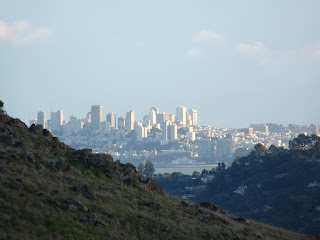
I'm often astonished that I am able to live here, even if I can only afford to be here for a few months out of every year. The beauty of this area has never grown commonplace to me. Every time I see the Golden Gate Bridge from the hills behind my place, miles away, fog drifting between the towers, I'm amazed all over again. Every time I look out my window to the peak of Mount Tamalpais, or get out of my car in the evening to quiet moonlight, I'm grateful.

And the people! Marin is still a place for eccentrics and artists and meditation junkies, surviving like relic trees amidst the Lexus SUV's, and I seem to have the luck to meet them every time I turn around.

What inspired me to write today is a quote in a book by Gary Thorpe, a sort of neighbor in Marin, fellow Zen practitioner, writer, and naturalist. I don't know Gary, but I feel like I should - we've probably passed each other on the trail and sat in the dark together at Green Gulch, never knowing it. The book is a collection of short essays about Gary's quest to see a mountain lion, Caught in Fading Light. Here's the quote that caught my eye:

"Marin County, where we live, is a wonderful place to look for something. It's a land of wilderness, parks, marine sanctuaries, farmlands, small villages, and manageably sized cities. Here one can find an abundance of wildflowers and mushrooms, along with meditation centers and ethnic restaurants. There are elephant seals, car dealerships, redwood trees, high-tech industries, rare falcons, and imprisoned felons, all sharing one of the loveliest landscapes and coastlines anywhere."

This quote reminded me of another paean to Marin Countyin Alan Watt's delightful autobiography (remember Alan Watts, the first popularizer of Eastern religions?), In My Own Way. Alan spend the last decades of his life in Marin County, some of that time on a houseboat in Sausalito, and here's what he wrote about it in 1972. Now, admittedly, Marin was a little bit wilder then (in every possible way) but I detect the same spirit even now, and many of the people who were here in 1972 are still here, tucked away up the canyons. Some of them are my neighbors!

"Here in San Francisco and Southern Marin we have succeeded, more than anywhere else in the United State, in curbing the White Anglo Saxon Protestant subculture of the nation, though our slight margin of victory requires incessant vigilance...By virtue of its hilly landscape, its redwood forests and eucalyptus groves, its wayward coastline, its liberally bohemianized population, the peninsula of southern Marin has attracted imaginative people from all over the world...it has also become a powerful spiritual center of the nation, as befits the fact that its geographical center is a mountain holy to the Indians...Though not much more than twenty-five hundred feet high, Mount Tamalpais rises almost directly from sea level...Seen in the first light of dawn...the whole mass of hills, valleys, and canyons with their forests. groves, meadows and giant rocks confers an atmosphere of strange benificence.

Extraordinary people live upon it... There are mountain lions, bobcats,and deer galore, and wild goats and eagles and vultures and racoons and rattlesnakes and gophers... All these and many more wizards, yogis, artists, poets, musicians, gardeners and madmen cluster about this mountain."

So there you have it. My friends might wonder why I keep being drawn back to this place, so far from my home ground of the rainy Northwest coast. It's the light of the January sun, my 95-year-old neighbor who traveled the world as an adventuresome entomologist, the joy of walking beneath old coast live oaks draped in lichen, the library beneath the redwoods, the shorebirds by the tens of thousands, the Buddhist meditation groups in every nook and cranny (including my own household!), the beautiful white city shimmering to the south. And I do have a soft spot for mountain lions and vultures and wizards and poets and gardeners and madmen... (might even be more than a little bit one of the latter myself).


I've been thinking about gratitude, and its power to transform our habitually whiney minds into happy minds. Gratitude for place seems like a important kind of gratitude, at least for me. To bow down and kiss the ground, whatever that ground might be - granite or concrete, dirt or sand or duff or garden bed. Beauty everywhere.

And although it's true that I don't exactly live anywhere, I feel grateful for the many beautiful places that are part of my life, from the soft shoals and light of Willapa Bay, to the tawny slopes of Mt. Tamalpais, to the tremendous spaciousness and wilderness of the Mojave Desert. Even my hometown in the Midwest, with its gracious old houses and tropical summer heat, deep green - where in the world is there NOT something to celebrate of the place where you stand?

If you feel like writing a response in the comments, something about the place or places you love, please share.

Friday, December 17, 2010

Poetic Interlude: Winter on Mount Tamalpais


Mist covers the mountain today
houses nestled in the folds of the hills,
half hidden by trees,
a Chinese landscape scroll outside the window.
All day they're cutting a huge fir across the valley
first, branches, till the tree stands bare
then, piece by piece from the top.
I miss the moment
when it no longer stands at all
clouds hide the sight.


Monday, October 25, 2010

Abundance and Diminishment, Diminishment and Abundance


This afternoon I shopped at Whole Foods, the aisles just brimming over with the beauties of the world: rare and tasty cheeses, the finest carefully-chosen organic vegetables glowing in artfully arranged piles, forty different artisan breads made by hand from stone-ground flour, Fair Trade chocolates from around the world (chocolate and lavender, chocolate and chile, chocolate and espresso beans). The food of gods and goddesses, and I'm one of them, grateful and amazed, even as I know that this abundance can only be temporary, in a world of such disparities, where so few have so much and so many have so little.


When I was a kid growing up in Terre Haute, Indiana, we shopped at the A&P grocery on 9th St - Wonder Bread, Hostess Twinkies, old wilted broccoli (who wanted fresh vegetables when canned and frozen lasted so much longer?), Folger's instant coffee.

"Organic" didn't exist.

The Wabash River flowed through town and an abandoned park on the river was my favorite haunt, but the river was so polluted that in all my years there I never dreamed of touching the water. Now my hometown has a restaurant where all the food has been grown or raised within one hundred miles, people catch and eat fish from the river, and The Nature Conservancy is working to protect the riparian forests of the Wabash which is - to my astonishment - the longest free-flowing river east of the Mississippi, an ecological treasure, a jewel.


Meanwhile, every day there is another story about the disappearing fish stocks in the world's oceans. Meanwhile the song birds are coming back from migration in fewer and fewer numbers. Meanwhile...well, you know the stories, you read them too. When I'm with a group of like-minded friends, sometimes we trade these stories, a badge of our shared despair. I've begun to wonder if this is helpful, for the song birds or for us.

When I was working in Southeast Alaska this summer, I saw abundance that seemed far beyond anything I'd ever known. The inlets and waterways were filled with diving murrelets (endangered south of Alaska), auklets and puffins; the streams were full of silver salmon; humpback whale spouts could be seen in all directions; every kelp bed was filled with flipper-waving sea otters. On land the deer barely bothered to lift their heads when we entered their rich sedge meadows; bear sign was everywhere (I would have been happy with a little less bear sign); and sandhill crane pairs trumpeted from their nests in secret muskegs.


It was wonderful and encouraging, and it would be easy to stop here, to write a few elegiac words about how the whole world must have once been like this - but it's not so simple. Here are a few examples of the not-simplicity of the abundance I saw....

Until a few years ago, there had been no sea otters in Sea Otter Sound for a hundred years or more - they had all been hunted out by the Russians and the English and anyone else who appreciated the warmth and value of otter-skin coats. Thanks to the Marine Mammal Protection Act and tireless work by biologists and others, they're back, more every year, but the local people say that they're eating all the shellfish, and the shellfish beds are barren and empty now.


The bears and deer move through a landscape that has been decimated by some of the most rapacious clear-cutting ever seen on this planet. The Tongass National Forest was, between the late 1960's and the late 1990's, nothing short of a national sacrifice area, its vast dark forests of old growth hemlock and Sitka spruce merely fodder for two huge pulp mills on the mainland, its landscape scarred by thousands of miles of roads. Our national heritage was sold for a pittance, a tiny fraction of its worth, to keep those two mills turning out toilet paper and newspaper - toilet paper no doubt sold at the A&P in Terre Haute, Indiana - and to keep the owners of those mills providing large donations to Alaskan politicians.

A small group of activists. local subsistence-based people, biologists and foresters fought to stop, or at least mitigate, the damage, and they won. The cutting on Prince of Wales Island has largely stopped (except, ironically, on native-owned lands.....that's a whole other story).


One biologist I know, who has been working on Prince of Wales for eighteen years, said he had never seen so many bears before. The bears are coming back, the forests are coming back, with each storm the land reclaims another road.

Some of the salmon I saw in such abundance are hatchery stock, moving upstream to where they were born, where they will be milked of their eggs before being hit over the head and their carcasses dumped nearby. The bears like this a lot.

Our fingerprints are everywhere, doing good, doing harm, one step forward, one step back. Sometimes we don't even know if it's good or harm, or both. Even as I write this on this rainy night, I look out on to the dark slopes of Mount Tamalpais. I am spending the winter here again because I love being in a place where open space is a stone's throw from where I sleep, where mountain lions and red-shouldered hawks are my neighbors.


Mt. Tam from outside my window

But Mount Tamalpais was - and continues to be - saved from urban sprawl by generations of wealthy or influential (or both) peope who fought and fought to protect it, some of whom are probably shopping at Whole Foods right now, debating with themselves about which fish is most "sustainably harvested" for their Saturday dinner.

The world of owls and whales and otters may be in big trouble. I suspect it is. We, goofy troublesome primates that we are, may be in very big trouble, and I'm almost certain we are. But some of us have the will and energy to fight for the world, and the world has immense powers of recuperation, of renewal, even as we mess with it in our various ways. I don't even pretend to understand what's going on, but I suspect that abundance and diminishment, kindness and rapaciousness, damage and renewal walk together.

I do know this: the rain and wind that soaks the hills tonight and that brings such misery to those without homes in the streets of San Francisco will also bring the salmon up the streams to dance their old dance above their redds again. And the willow saplings planted along those streams by a hundred volunteers will take root in the wet, take hold, begin to grow.


P.S. Let's continue the conversation...if you post an online comment, I promise to respond.


Thursday, September 9, 2010

Southeast Alaska - Second Glimpse: The XtraTuf State


A few weeks before I left for for my field work in Southeast Alaska, I was on a conference call with the four other biologists on the crew, all of whom had logged serious field time in Alaska, from seabird surveys in the remote Pribilof Islands to laying out huge timber sales on the Tongass National Forest. I was the newbie, the innocent, the lower-48-only idiot. I had no pride to lose, so I asked, “Hey, what is the best footwear for working in Southeast Alaska?”

The response was unhesitating and simultaneous: “XtraTufs, preferably with corks.”

I was not quite willing to admit at that moment that I had no idea what XtraTufs were, but I jotted the name down (Extra-Toughs? Extra-Tuffs?) in my little notebook with all the other tips (full working-man’s raingear – none of that Gore-Tex crap – boot dryers, fleece gloves with neoprene palms for the devil’s-club, Rite-In-The-Rain field paper….)

I was going to be PREPARED, by gum. I did know what corks were, though I’d never worked in them: they’re a set of wicked spikes that fit into the bottom of the sole of the boot, designed to grab on to slick logs so that you don’t go head over tea-kettle into the aforementioned devil’s-club.

(A digression here: devil’s-club, Oplopanax horridus, is a well-named Dr. Seuss-like being with enormous spiny leaves atop a long, bare spine-studded stem. I knew it well from the West Cascades of Washington, but only when I got to Alaska did I see devil’s-club growing in thickets tall enough to hide a basketball star. It seems to prefer steep slopes where an unwary sliding biologist will be likely to grab the spine-festooned stem as a last resort.)


An innocent-looking patch of devil's-club

I wasn’t so sure I wanted corks, especially after I heard stories of neophytes putting the spikes through their own raingear and shins, but I was determined to get XtraTufs, whatever they were. I went online and read this: “XTRATUFs are American-made neoprene boots that provide 100% waterproof protection with all-day comfort for the MOST SEVERE fishing, farming, and work conditions.” Sounded like the conditions I was heading toward. They looked like an expensive version of a basic rubber boot, but if my experienced Alaskan co-workers said I needed them, then clearly I needed them, and no questions asked.

Finding them – and extra-tough raingear to go with them -turned out to be another story altogether. I don’t want to go into the embarrassing details here, but I’m on the small side. I have been called (in a friendly manner) “height-challenged”, and I often save money by shopping in the children’s section of REI.

I quickly discovered that the iconic tan and brown XtraTufs are found primarily in marine supply stores, the kinds of places that cater to commercial fisherman and aspiring stars of “The Deadliest Catch”. Ditto for heavy-duty raingear. Now I KNOW there are women and children on boats all the time, but tell that to the makers of these things. In their world, all human beings are at least six feet tall and weigh over two hundred pounds. I could have fit at least two of me in the men’s extra-small rain bibs, and for a while it looked like my search for the essential XtraTufs might fail altogether.

Eventually I found a store that carried the smallest possible size of XtraTufs – men’s size 5 – and by some miracle, and with heavy socks and a pair of insoles – it seemed that they more or less fit me. I walked out the proud owner of the indispensable Alaska boots, and in retrospect, I shudder to think of how I would have felt if I had been unable to procure XtraTufs. I had no idea of their role in coastal Alaskan culture. Those of you who have been there are surely nodding knowingly now.

I will say that the raingear search was harder. Five marine stores in three different towns later, I was about to surrender and buy bright pink little girl’s raingear. I knew it was silly to care, I knew a Buddhist practitioner should be beyond “praise and gain”, but it was really hard on my dignity as a field biologist to imagine showing up in bright pink raingear. On the other hand, showing up without any raingear at all seemed like a truly bad idea.

In desperation, I spent two hours combing through a vast supply of raingear seemingly designed for Mr. Universe, until I found bright blue bibs and a jacket that I thought I could wear without tripping over my own hems or losing my hands inside the sleeves. I was quite pleased with myself, since I had avoided the deadly pink raingear, but I must admit that just the other day I put on the bibs for a walk in the rain with friends, and my friends burst out laughing. I have the sneaking suspicion that I looked like a large, overly ripe blueberry up there in the Alaskan rainforest. Maybe the only reason that the bears left me alone was that they were doubled up with laughter at the sight of me.

Photo by Emily Drew

Thus armed with a ridiculous quantity of brand new outdoor gear, I journeyed north, by Alaska airlines to Ketchikan, then by ancient float plane to Prince of Wales Island. I brought hiking boots along with my XtraTufs, because I’ve always worked in hiking boots and I couldn’t imagine that they wouldn’t be appropriate somewhere, sometime. But they weren’t.

Nothing made it clearer just how wet this part of the world really is than discovering the astonishing, absolute necessity of high waterproof boots at all times. Years ago I did wetland delineations, using plants and soil to identify boundaries of wetlands. I’m pretty sure that a wetland delineator could draw a great big circle around Southeast Alaska and call it good. There are dryer forests there, but even dry forests are covered with a dense, deep layer of sopping wet moss – moss everywhere, on the ground, on fallen logs, on upright logs, on rocks….like an emerald green blanket thrown over anything remotely horizontal. In fact, not only did I wear my boots all the time, I wore raingear nearly all the time too, rain or no rain. The first time I crawled over a big moss-covered log with no raingear on was my last.


XtraTufs doing their stuff in a mudflat

Within days I discovered - and I’m really not exaggerating much here at all - that no one wears anything on his or her feet, at any time, other than XtraTufs. Not just my seasoned field crew, but everyone. Not that we saw many people, but those we saw had XtraTufs on. Outside fading, dilapidated cabins, you could see a line of XtraTufs on the porch, matching the sizes of the men and women inside. In fact, I remember, on our last day, checking in with the floatplane company, and seeing a young, very pretty, very chic, well-dressed woman, waiting for the plane too. What was she wearing on her elegantly crossed feet? ExtraTufs, turned fetchingly down at the ankle. She made XtraTufs look like the sexiest thing north of the Canadian border.

I’ve even had a fantasy that babies have been conceived in Southeast Alaska by parents wearing nothing but XtraTufs (giving “rubbers” a whole new twist).

Here’s the funny thing, after all: XtraTufs are not all that great in the woods. Their soft and flexible neoprene provide little ankle or arch support, which are real issues when a person is on his or her feet for many hours a day, covering miles of uneven, very slippery, sometimes steep terrain. Sometimes I’d be going downhill through the endless little muddy streams and sphagnum, wincing as I twisted one ankle or the other about every five minutes. They’re probably great on a fishing boat, but a fishing boat is a far cry from the woods. A good pair of ordinary rubber boots would have probably been better. Nonetheless, I cringe to think of myself pulling out my cute little bright blue rubber boots (and oh, wouldn’t they have been fetching with my bright blue raingear?)

I have a suspicion that part of the reason terrestrial biologists wear XtraTufs in Southeast Alaska is the same reason that I might wear XtraTufs again if I went back, even if it meant sprained ankles after a day in the woods: they are a true symbol of Southeast Alaska, recognized by everyone there. They express your knowledge of the conditions and your readiness for anything – a day in the rain, a day fishing for salmon along the river, a day stalking your winter deer in the muskeg, a day out crabbing on the high seas, even a day hunting rare plants in the woods. The way they say, “This is one hell of a wet, difficult place, but I’m up for it, I’m prepared, I’m tough.”


Spencer Richter, with his pit bull Bristol and his XtraTufs

And Southeast Alaska demands a lot of her people. Her people are not just tough, but extra tough. And they have the boots to prove it.

Thursday, September 2, 2010

Southeast Alaska - First Glimpse


I'm back from three and a half weeks of work in Southeast Alaska, where I hunted rare plants as part of a team of botanists on the Tongass National Forest.

We worked on mountaintops, cliffs, salt marshes, beaches, bogs, lakes, meadows and old growth Sitka spruce forests on about a half dozen islands west of Ketchikan, most of which most people have never heard of: Prince of Wales Island (the fourth largest island in the US), Heceta Island, Whalehead Island, Blashke Island, Kosciusko Island, and Tuxekan Island, all in the Alexander Archipelago, made up of over a thousand islands off the west coast of the Alaskan mainland.

This was my first trip to Alaska. I've avoided Alaska all this years because -- and I'm just going to be really honest about this -- I'M AFRAID OF BEARS. I'm somewhat rational about this: I'm much more afraid of grizzlies than I am of black bears. But I'm also embarrassingly afraid of black bears. Embarrassing because as a field biologist for nearly twenty-five years, I should know better, or at least be a little less paranoid than some city slicker. I wouldn't have taken the job if it had been in grizzly country, but Prince of Wales only has black bears. More about bears later.

As a Southeast Alaska newbie, I wasn't sure what to expect. I had ideas - large bearded men, rain, insects, wildlife, big trees. But it's a long way from one's ideas about a place to the actual, living place. Still, some of my ideas were more or less accurate....

Large bearded men? Check - although there weren't many people on Prince of Wales, where there were men, they tended to be large and scruffy and bearded, though quite friendly. (Here's an Alaska joke for single women: "The odds are good but the goods are odd.") It's a guys' place, with an emphasis on functionality and a de-emphasis on aesthetics. In the few tiny settlements, trucks lay rotting in the weeds, minus their tires (imagine the difficulty and expense of getting a dead truck off a remote island); houses looked like they'd been put up in an afternoon a half century ago and never painted again, and blue tarps reigned supreme. One is visible as a make-shift door in the photo below. There was even a spectacular collection of enormous, long-abandoned and rusted logging equipment, called, with some heavy irony, "The Logging Museum".

The Ruff-It General Store, accessible only by boat. Whale Pass, Prince of Wales Island

Rain? Check - it rained nearly every day we were working, and on the rare days when it wasn't raining or drizzling, the underbrush was so wet that it might as well have been raining. We never really dried out, just like everything and everyone else there. The whole place is dripping wet, a great big sponge soaking up the North Pacific storms. About half the "land" is muskeg, which is essentially a spot that hasn't dried out since the last Ice Age, covered in layers of peat and sphagnum moss and carnivorous plants and little ponds and too wet even for most trees. There is no point to wearing any clothing other than layers of fleece, and no point wearing any footgear other than high rubber boots (more on those later too), preferably ones with cork spikes in the bottom ot prevent slipping off the giant wet mossy logs that must be clambered over to get anywhere.


That's me, in XtraTuf boots and rain-gear, walking through a saltmarsh.
Photo by Emily Drew.

Insects? They weren't as bad as I had feared, except for "white socks", little flies that removed chunks of flesh from our faces and necks, then worked their way under our clothing. I wouldn't know I'd been bitten (they must inject some anesthetic) until I touched my face and felt dried streams of blood. Sometime after the initial bite - hours or days later - the spot would begin to swell and itch. The itch would build to a nearly unbearable intensity, and all our faces were swollen and bloody, like sixteen-year-olds with terminal acne. It lasted about a week, until the next set of fly bites.

Me again, bug-netted, trying to document a rare plant location in a skunk cabbage swamp.
Photo by Emily Drew.

And bears? What Prince of Wales Island lacks in grizzlies, it makes up for in black bears, which like everything in Southeast - trees, slugs, devils-club, skunk cabbage - are prone to a certain gigantism. The bears on Prince of Wales are the largest black bears in North America. And like the rain, they are everywhere. I mean EVERYWHERE. Big piles of dark bear scat litter the sides of main roads, line every game trail, stand like proud monuments out in the middle of meadows, and even show up on the tops of mountains. It doesn't seem possible that any animal smaller than an elephant could produce such humongous dumps. I can't even begin to express how large these things are - the scat that is, not to mention the bears themselves, which we encountered nearly every day.

Despite an ecological understanding of the importance of large carnivores, I have to admit that I prefer my woods without bears, or, if there are bears, I prefer my bears to be secretive and shy. The bears OWN Southeast Alaska, as far as I could tell.

All that aside, though - even as I chronically damp, nervous, and covered in intensely itchy welts - every day was a wonder, an amazing encounter with a land and creatures beyond what I had ever imagined seeing. I feel grateful and lucky to have had the opportunity to work in those primeval forests, on uninhabited islands, in a dreamlike place of mists and water.

It's been hard to begin to write about it, perhaps because the scale of the experience was so large, so multi-layered. I pull one thread and a whole island lands in my lap, mud and moss and forests and all. Or perhaps because it was so far beyond what I've experienced before - flying in a small helicopter a few hundred feet above the ocean, listening to the breathing of humpback whales, walking alone along the edge of a cliff, standing in places where there is no one else for many miles, happening upon courting, bugling sandhill cranes in hidden meadows.


I hardly know how to share it. I think the only way is in little glimpses, vignettes, like getting on to one's hands and knees and looking at the moss gardens in the muskeg, up close.

So, in the next series of posts, over the next few weeks, Southeast Alaska, glimpsed.

Monday, June 21, 2010

Field Season Sabbatical From Blogging - in Alaska!


I won't be posting for at least the next month....I'm going to be in Southeast Alaska doing botanical fieldwork on Prince of Wales and other islands, with limited internet connections (but plenty of wolves!), and then traveling up in the Canadian islands. I'll post pictures and stories from the other side of all this adventuring.

Meanwhile, here's a link to the anthology that I've been working on for the last couple of years, due out in September and available for pre-order now from University of Utah Press or Amazon. The writings in the book, by nearly fifty authors, are truly beautiful and inspiring.