 |
| Rinso-in from the garden |
 |
| Road approaching Rinso-in |
Our little group of Mountain Rain pilgrims (seventeen Canadians and me) spent five days at Rinso-in, a 500-year-old family temple in Shizuoka province. Rinso-in, though not a place where tourists generally visit, is very important to those of us who practice Zen within the lineage started by Shunyru Suzuki Roshi, who founded San Francisco Zen Center in the 1960's.
In Japan, temples are passed down from father to son, generally. Suzuki Roshi inherited Rinso-in from another Zen priest, and when he left for America, he left the temple in the care of his son, Hoitsu-san. Now, many, many years later, Hoitsu Suzuki (respectfully called Hojo-sama - "revered abbot"), now in his seventies, his wife Oka-san, his son Shungo-san (also a priest), his daughter-in-law, and his two grandchildren all live at Rinso-in.
For me, our days at Rinso-in were the heart of the pilgrimage, and I mean "heart" in every sense of the word. There was a tremendous sense of heart there, expressed by the whole family. In Zen sometimes we talk about a "family flavor" or "family way" of a particular lineage, and it's always felt to me like the family way of Suzuki Roshi's lineage, at its best, is generous, kind, and humble. Now I found myself in a place where Suzuki Roshi's own family, his actual biological descendants, live and work, and the feeling of that kindness was everywhere there.
 |
| Suzuki Roshi's family |
I was also amazed by how beautiful and, in a way, how grand, Rinso-in is. All these years, when people said that Suzuki Roshi came from a small rural temple, I had imagined a run-down little place. Instead, everywhere I looked there was a graceful, dignified beauty, from the lines of the tile roofs to the exquisite pond and gardens. Rinso-in is tucked up at the head of a narrow valley, surrounded by steep slopes, and I could see why Suzuki Roshi fell in love with Tassajara when he first saw it. It must have reminded him of home.
 |
| Buddha Hall |
Every morning we sat in the old
zendo, 300 years old and built to be a training place for monks. The rest of the days we cooked, worked around the temple, went for walks in the surrounding mountains, and spent time with the family. One evening Hojo-sama gave a dharma talk and question and answer for us. I took notes, as Kate McCandless and Michael Newton translated.
 |
| Old zendo and abbots chair, Photo by Kwee Downie |
The talk filled me with delight and happiness. Afterward I had such a sense of pride - although pride is a funny word to use - in this particular way of Buddhism that somehow I'd been lucky enough to fall into, nearly a quarter century ago. I can't imagine another path that would be more perfect. Of course, every path is perfect, in its own way, but this one, this "family way" is deeply and thoroughly perfect for me. And of course, it has shaped me over these many years, and so perhaps I am thoroughly perfect for it too. I remember my mother used to tell me I was such a good traveler, and I would say, "That's because you've trained me!" Maybe it's like that.
Here is Hoitsu Suzuki's lovely talk, given May 19, 2013. What you can't see is his humor, sweetness, and tremendous gift for mimicry. You'll just have to imagine his impersonation of the big frogs.
 |
| Hoitsu Suzuki looking at tiny frogs in the garden. Photo By Kwee Downie |
The reason human
beings have so much suffering is because we’re so smart. Sometimes we think
good things, but often our thoughts confuse us. We have a lot of desires: “I
want this, I want that, I want to go here, I want to go there, I want to be
this, I want to be that.” Shakyamuni sat down and quieted his whole being, his
whole heart. When we do zazen, our heart and our whole life becomes quiet and
still. If we continue the way we are we just keep running and running. Buddha
asks us to stop and take a look at our lives, how they truly are.
Having desires
is not a bad thing in itself; it’s how we relate to those desires. Zazen allows
us to harmonize our lives with what is. It’s not a bad thing that we want
things; that’s just what’s given to us. We can’t throw it away – it’s part of
who we are. Or maybe we can get rid of them – desires – perhaps! [laughing]
It’s the body
that does zazen. Sometimes we think, “Oh, I’m not doing zazen,” but it’s the
mind that’s not doing zazen. Don’t worry about it. The body is doing zazen.
Even when you think of something else, that is also doing zazen. If your body
is doing zazen, that’s enough. Even if your mind is thinking things, there is
also the “you” who is watching the thoughts. No matter where you go, you can’t
lose yourself.
 |
| Kate McCandless and Oka-san's ikebana |
There was an old
teacher, two generations before Tendo Nyojo, Dogen’s teacher in China. Huanxi
Zenji. He wrote the poem called “Zazen-shin”, “the acupuncture needle of
zazen”. Zazen is the point of the needle. He said, “Your mind is like a pool of
water. You can see the bottom and you can see a fish slowly swimming. It is
like an endless sky where a bird slowly flies. And that is zazen.”
 |
| Koi in a pond at a nunnery in Ohara |
Dogen changed
the poem a little bit: “The mind is like a clear pool, and is the fish;
a fish swims like a fish. The sky is limitless and a bird flies in the sky. A
bird flies like a bird.”
Dogen Zenji
says, “ If you are doing zazen, you are doing zazen, no matter what you think,
just as a fish swims like a fish. You’re doing it like you.”
Just as Huanxi
and Dogen said, “ The world before our eyes is vast and clear.” Around us
everything is as vast and wide as the whole universe. It’s right here.
Sometimes when I
breathe in, it’s not so much that I’m taking air into my body, but the air is
passing through me. And bird song passing through me, light passing through me.
Sometimes. We have many different experiences during zazen. Just because
someone has written down or said in the past that you should feel a certain
thing, don’t believe it. Really the only thing to do is sit quietly and settle
your posture and breath. When you stabilize your posture, you make your mudra
round, your arms round, your face and your breath round – but this is just
something I feel, not something you have to do.
 |
| Old arhat statue |
This is the
teaching that came down from Dogen Zenji’s teacher to him, and from him to us.
If you look for where your mind is, you notice, “it’s not here, it’s not here,”
or, “it’s here, it’s here, it’s here.” You could look at it either way. You
have a certain feeling when you do zazen, but it’s not a feeling exactly. No
one is special in their accomplishment; we are all the same. If you tried to
put your own experience of zazen into words, it would be impossible. Just
words.
We really worry
about things more than we need to. The trees, the stars, the rivers, the rocks,
they don’t worry nearly as much as we do. The Buddha is inviting us, in zazen,
to be like the many beings of the world – the trees, the rocks, the waters, the
stones – to be in their family. To do zazen is not to be concerned with our
desires to become this or become that. If you think you’ll get something out of
zazen, some great idea, you’re just being sucked into the world of confusion.
Good or bad in zazen is irrelevant.
 |
| Tiny frog. Photo by Susan Elbe |
I was watching
the pond today, and tiny little frogs were coming out and climbing up the
mountain. My father loved frogs. There’s a very big kind of frog here in Japan,
or maybe a toad, that almost never croaks, and doesn’t move much either. But
when a little bug comes flying, it moves fast! (pantomimes a frog catching a
bug)
My father was
like that big frog. He was put in charge of the monastery when he was about
twenty, but he had studied English and he wanted to go study zazen in a place
where English was spoken. When the opportunity came, he jumped, just like that
frog. “Within the stillness there is sudden movement. In movement there is
stillness. Don’t forget your heart-mind.”
It took my
father ten hours to prepare an hour talk in English. He must have been very
busy, but when you read Zen Mind, Beginner’s Mind, it seems that he was very
calm. He must have had a very calm steady heart, even though he was busy.
 |
| Shungo-san at Suzuki Roshi's ashes site, surrounded by the memorial stones of the many abbots of Rinso-in, We did a ceremony for Suzuki Roshi here. Photo by Kwee Downey. |
Zazen is a good
thing. It’s not a matter of being good or bad. There is no one who is good at
it and no one who is bad at it.
My father went
to Poland with Bill Kwong. Someone asked, “Is it OK if I do zazen as a
Christian?” He answered, “So you’re Christian, but when you do zazen you are a
zazen person.” Kobo Daishi, who brought Shingon Buddhism from China, didn’t
tell people, “Forget about indigenous religion.” He said, “Indigenous religion
is very important, and let’s practice Buddhism.” And because of that, Buddhism
was able to penetrate and sink into Japanese culture.
Just do zazen.
That’s it!
Question: When
I’m doing something and thinking about something else, am I having a direct
experience?
You can really
only do one thing at once; you can really only think one thing at once. It’s
really always like that. It might seem like you can think or do more than one
thing at once, but you really can’t. It’s OK.
Question: What
is the relationship between ceremonies and zazen?
[Quite a bit
around the translation of “ceremonies”...perhaps no good Japanese word for it,
but he understood when Shungo-san pantomimed hitting a mokugyo]
There is no
relationship. Zazen is zazen. Ceremony is ceremony. But there is an expression
of gratitude, “Thank for the teachings.” Or when we are doing our jobs. All of
that is Zen. This is written in Zen Mind, Beginner’s Mind.
Why do we do
ceremony?
It is all,
“Thank you very much.” And also how we help support each other. The natural
things we do to express gratitude are all ceremony, like bowing, or saying,
“Good morning,” saying, “Thank you.” All are ceremony.
 |
| Old arhat statue |
Question (my question): What
kind of attitude or way of being is most important for a priest?
 |
| Shungo-san teaching chanting |
[Leaning forward
intently] EVERYTHING! But “everything” is very difficult. From the top of your
head to the bottom of your feet you are practicing the way of Buddha. There’s
no break, no wasting time. You might be angry or suffering, but you always remember
your aspiration. This is very hard. But your whole body, even the bottoms of
your feet, are dedicated. [The feeling here was sadness, or a strong sense of
how hard the path is of a priest is, to live into these vows.] If your mouth is
smiling but your eyes are angry, then you are not practicing with your whole
body.
Question: On the
han it says, “Don’t waste time.” What does that mean?
Because we can
only walk one path at a time, we can’t waste time. There is a much deeper way
of understanding this saying, which is seeing deeply into the empty nature of
time. Actually, the original text is in Chinese, and there are two ways of
reading it. The typical way to read it is: “Don’t waste time.” But the other
way is: “There is no time to waste,” which leaves behind our emotional
confusion about wasting time. In the Chinese, it is literally, “Waste time
not.” Our Zen way of understanding this passage is to look more deeply. What we
mean by “path” is not some long road. It’s more like, “this instant,” and then,
“this instant.”
 |
| Path to the tea house, |
Question: Is it
enough to practice zazen as a way to cultivate compassion, or are there other
ways of developing compassion?
 |
| Old arhat statue |
Tendo Nyojo
said, “Do zazen only with the heart of compassion.” There are people who do
zazen who think they are doing it through their own effort and strength, to get
something from it, but Dogen’s teacher insisted that we can only do zazen for
and with all beings.
When we are
looking down in zazen, we are looking down, but not fiercely. We are open,
practicing with the heart of compassion, and that’s conveyed to others by our
way of being, quiet and gentle. People would always say, “Oh, your father is so
kind and gentle and nice.” But we children were afraid of him. He was strict,
and would yell at us. So doing lots of zazen doesn’t necessarily make you 100%
nice. You will still be human.
Sitting on the
tan, sitting on the zafu, becoming a Buddha – there is not one iota of
difference.
Dogen
Zenji became a monk because he understood that there is no way to escape
change, and once you are on that path there is no turning back, and therefore
no wasting time. Not that the path is straight: it’s just that there is no
other way when you have that determination. Buddha's way is not something that
someone can teach you; you have to find the way yourself. Your own path appears
before you. It’s not about imitating someone else.
Zen
is simple and easy to understand, but when we use words, we end up drifting
farther and farther from the heart of Dogen Zenji’s words. Ungan Doyo, the 7th
ancestor, came to the 6th ancestor. The 6th ancestor
asked, “Where do you come from?” but Ungan Doyo can’t answer. He practiced for
eight years, and after eight years all he can say is, “I can’t say. It’s beyond
words.”
Tonight
I’ve probably told you at least 800 lies. Perhaps!
*****************
The
next morning Hoitsu said a formal goodbye to the group after zazen. He said he
would like to come to Canada and someone said, “But our temple isn’t as nice
and big as yours.” He said, “Wherever you sit zazen is a temple as vast as the
universe. Like the old story of building a temple with a blade of grass [Book
of Serenity, Case ?]. Wherever you sit zazen is a temple, a monastery.”
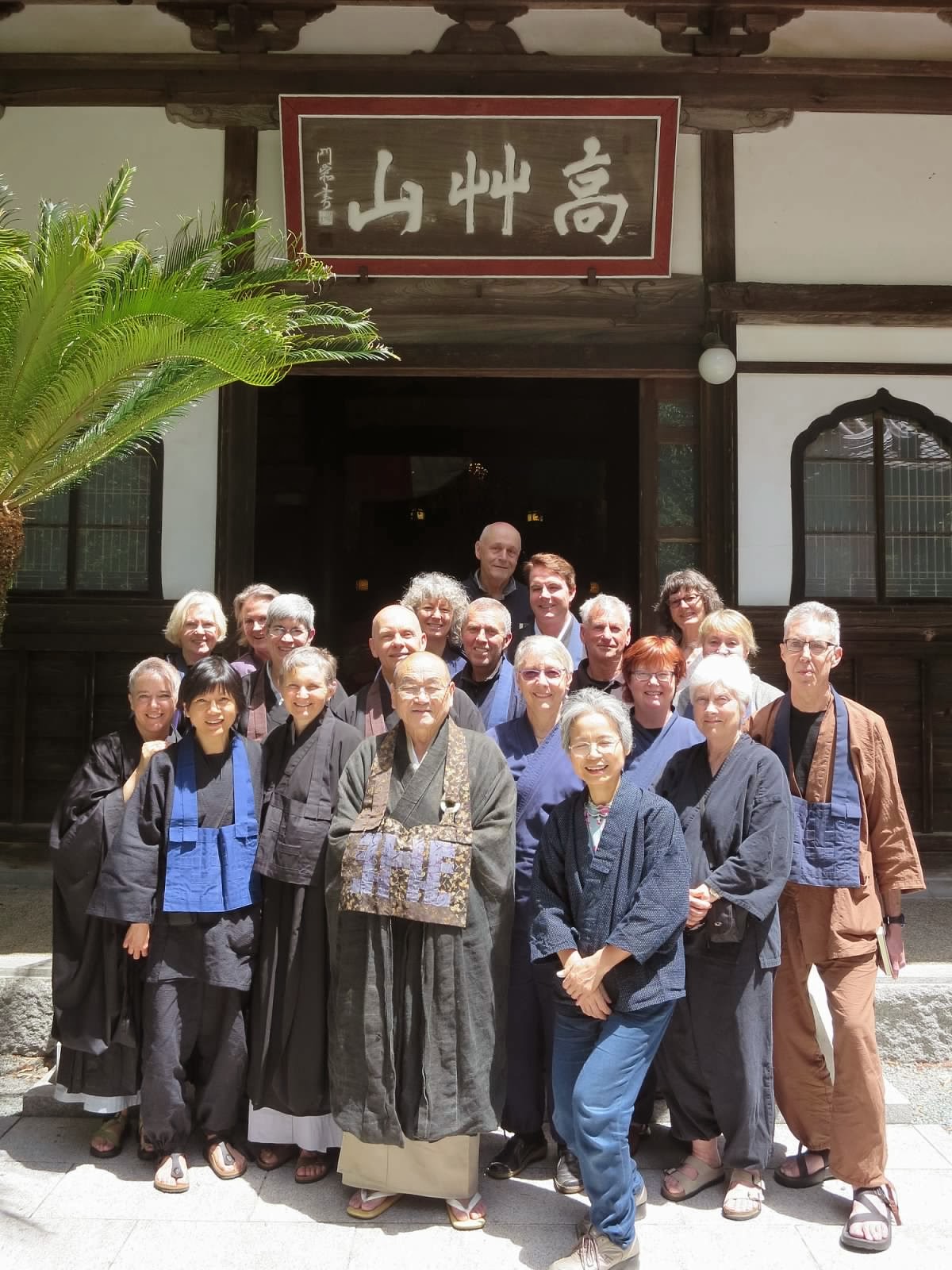 |
| Mountain Rain with Hojo-sama and Oka-san in front of the Buddha Hall, Photo by Kwee Downie. |


.jpeg)

_-_Ashby,_Massachusetts.JPG)


