Tuesday, September 25, 2012

Shuso Notes: Zen Bowls and Wake-up Bells


I'm just out of a 6-day sesshin, Zen retreat, with Norman Fischer and most of the local participants of the Everyday Zen practice period. There were about 48 of us sitting at the Santa Sabina Retreat Center in a large room from 5:30 am until 9:00 pm every day, steeping ourselves like tea bags in the clear water of silence.

A big part of Zen sesshin is a somewhat arcane meal practice called oryoki. During meals, instead of eating in the usual way, each person has their own set of three bowls, nested inside one another, wrapped up in a particular way in a cloth. The photo above shows one person's bowls all wrapped up after a meal.

Oryoki is an acknowledgement of the ancient Buddhist practice of begging for and receiving food. The Buddha ate from a begging bowl, and even today Theravadan monks have only a bowl and three robes, and they only eat if someone places food in their bowl each morning. The life of a monk is a life of radical dependence on others and trust in interconnection. When Zen monasteries started developing in China, monks grew their own food and cooked for themselves, but they maintained the tradition of the importance of the bowl, and the recognition of humility, gratitude and interdependence that it symbolizes.

Oryoki is truly a trial by fire for new Zen students. Each movement of unwrapping the bowls, of chanting, of eating, has its own choreography, and there's no way to get it entirely right, even after years of practice. For someone new to oryoki, remembering even the most basic sequence from one meal to another is a challenge, especially after hours of meditation and the general spaciness that develops after a few days on retreat. I'm sure there are people who have fantasized about throwing everything across the room with a shout, grabbing a plate and a spoon, dishing out their own food, and going outside to eat in peace.

I know this because one of my jobs for the last few years has been to provide an orientation to oryoki at the beginning of sesshin. I invariably feel like I am torturing people as we go through the innumerable steps, bewildered faces turned toward me, tension in shoulders and trembling fingers. I wish there was some way I could make it easier, but there's no way to skip a step without getting even more hopelessly lost. So I doggedly go on, hoping and praying that with humor and kindness I can ease the anxiety a little.


Then, the very next morning at breakfast, we all dive in to oryoki practice. Much of the daily rhythm and structure of a Zen monastery (and a sesshin is a temporary monastery, even if it is held at a Catholic convent!), is to some degree built around the ritual of giving and receiving that is at the heart of oryoki. It is really not intended to be a sadistic torture device, as much as it might feel that way to someone struggling with it for the first time. Its intention, from start to finish,  is to help bring powerful awareness to our usual mindless relationship to receiving and eating food, the life that makes it possible for us to live.

The Zen kitchen, which is Soto Zen is as much a practice place as the meditation hall, is focused on providing just the right food and the right amounts for those three little bowls. The kitchen is also engaged in a ritual while they're cooking. They bow to an altar in the kitchen before starting, they work in silence, and, if all goes well, the food appears at just the right moment at the beginning of a meal.

In the monastery, oryoki meals are eaten right at one's place in the meditation hall. To begin a meal, one just turns around and picks up the bowls that are right beside the meditation cushion. A team of servers bring in the pots one at a time, bowing in silence to pairs of people, dishing up the food (and there are ritualized signals for "that's enough"), then bowing again. A hall full of sixty people can all be served their food in about 15 minutes this way.

We at Everyday Zen eat at tables in the old convent refrectory, but we still serve one another in silence. Each person serves the person across the table, bowing before and after, using the same signals. We chant verses of gratitude before the meal and after. My favorite line is "May we realize the emptiness of the three wheels, giver, receiver, and gift." Everything is connected: those who grew and cooked the food, those of us who receive it, and the food itself in all its glory. Nothing can be separated out or could exist without the others.


At the end of the meal, still sitting at our places, we serve each other hot water in the largest bowl. Then, with another series of choreographed movements, we clean all three bowls and our utensils, drink most of the leftover water, make an offering of a small amount of water to the spirit world ("This water, which tastes like ambrosia, we offer to the many spirits to satisfy them"), dry everything, and pack it all back up into its neat little package. No waste, no dishes, no mess. It's brilliant.

Now's my chance to sing the praises of oryoki. As an ecologist, everything about oryoki delights me (except for the suffering it causes people who are new to it - I could do without that, but there doesn't seem to be a way out of it). I love that it is the practice of "just enough" in a culture of "never enough". I love that from the beginning to end it acknowledges interconnection, and the the interpenetration of our food and those who bring it to us and our own lives. I love that it requires attention, and even love, for what we normally think of as inanimate and use without appreciation. And once past the initial terror and awkwardness, the movements are beautiful: literally a dance of awareness.

And there is something of a feeling of a "full circle" to oryoki, even to the water offering that is poured on the base of a plant or tree outside the kitchen door. If we lived in the same way as we do oryoki, perhaps things would be a wee bit less dire than they seem to be. Much of monastic life offers similar possibilities.

The multi-religious theologian Raimundo Pannikar, in his gorgeous book on the "monastic archetype,", Blessed Simplicity, suggests that in this era monks may not be people living in monasteries in robes, but are rather people who are "called to a interiority, to a search for the center and for the heart," whatever their life circumstances. I would venture to say that with that search and commitment comes to a growing awareness of interconnection and sacredness, and from that place, naturally unfolds a monastic approach to life: a life of care, of simplicity, and of awareness. Each person who makes this choice helps the world.


And on that note, just a few throughts about ringing the wake-up bell for sesshin. That's one of the many jobs of the shuso during practice period: to go into the dark, cold meditation hall, very early in the morning, do three bows to the Buddha, pick up the bell from behind the altar, then run (run!) with the bell ringing wildly, one full circuit of the meditation hall and then past every door of every person in the sesshin. It's an ear-splitting racket in the midst of so much silence and slowness. It's like a fire alarm or an air-raid siren: "Wake up! Wake up! There's an emergency here! No time to waste!"

I was dreading getting up so early (two alarms set for 4:45 am, and hardly sleeping the first night out of a fear that I would oversleep), but I hadn't expected what it would feel like to ring the bell. Running around the meditation hall felt like a purification of the space, washing out all the stickiness from yesterday's sitting, making it fresh for a new day. And running the bell through the dark hallways, sleepy people jumping out of my way (sorry, everyone), it really did feel like an emergency. Truly, there is no time to waste.


There is a big wooden block that is struck with a mallet to call people to meditation, called a han. Hans generally have calligraphy on them that says something like what ours says: "Birth and Death is serious business, swift as an arrow, soon gone. Wake up, everyone! Don't waste this life."

I have always taken that admonition as a reminder that life is short, and so, don't put off what matters, wake up as much as you can to the nature of things, and to compassion. But now, with everything that is happening in the world, I hold it a little differently: we need every one of us to wake up, NOW, as much as possible, and find a way to live lives of greater acknowledgment of our interdependence ---- with each other, with all the creatures in this world, and with the whole world itself, even the very air we breathe, the ocean currents, the rain, the clouds. There is no time to waste.

And as oryoki teaches, there is also all the time in the world. Each moment is endless, if we're there for it. So, yes, wake up, but wake up to gratitude, to joy, to appreciation for this beautiful world, and the beautiful people all around us. Then we won't have wasted this precious life, so brief, so essential.

Sunday, September 16, 2012

Shuso Notes, Week Four: Silence


The practice period sesshin starts tomorrow at the Santa Sabina Retreat Center. Sesshin is a silent Zen retreat. Ours is six days long, and it's the beating heart of the practice period. It's the one time when a good portion of the practice period comes together, making, as we say in Zen, one body.

In a residential Zen practice period, sesshin is just a slight intensifying of the life everyone is already leading, but for us, out in the world, it is a dramatic transition into a different way of being. Cell phones are turned off, books are put down, activity is minimized, and all of us live by a schedule that starts at 5 am and goes on until 9 pm. It is a taste of the monastery.

Our sesshin is held at the Santa Sabina Center, which is an old convent, a place where Dominican nuns who were considering final vows lived and prayed. Now the nuns are gone, but I feel their presence there, in the lovely, flower-strewn, feminine inner garden, so like the courtyard gardens of Italy that I played in as a child, in the small chapel with its wooden choir stalls, in the rectory with its long tables. There is a long association between Catholic monastics and Buddhists: I think there is a similar flavor: an appreciation for silence, for depth, and for sincerity.


Silence. I remember my first silent retreat, held at another Northern California convent. The huge relief of letting the mask of my persona crack and loosen. I cried at the end, when we were all talking again, because I was so sad to feel the mask return -- that desire to be seen in a certain way, that desire to project a certain image. Many people are frightened at the thought of a silent retreat ("ack, I don't want to be alone with my mind!") but almost everyone I know has found that silence is a gift, an immense resting place where the personality can just give it up for a while. And I think there is an unnoticed hunger for silence in our culture, right alongside the fear of it. We are so seldom at rest.

I think also there is sometimes a sense that silence is an inward experience. Oddly, that's not really the case. When the voice ceases, there is suddenly room for the rest of the world: birdsong, wind sound, cars passing by. And not just sound, but all the senses waken and clear: the sight of the stars can bring tears; a cookie served at tea is the most delicious ambrosia. Silence is deeply sensual. It is interesting to think about how love making is often silent. Silence is intimate, as close as skin and breath.


But as I considered how some people in the practice period will be at the sesshin, and some people can't be at the sesshin, I started thinking about silence in a new way. There is overt silence -- the ceasing of speech -- but then there is the silence that is larger than any particular choice around speaking or not speaking, meditation or non-meditation. Silence can be found anywhere. In between my words there is silence. At the end of a breath there is silence. Most of the natural world is silent, most of the time; the tomatoes in the garden are silent, the oak trees in the back yard are silent.

And perhaps (this is something to explore) there is even silence right in the midst of the loudest sounds. Sound depends on and arises from silence, so surely silence is always there. What makes an operatic aria so exquisite? The silence that surrounds the notes. What would life be like if we were listening to the silence as well as the words of our loved ones? If we felt the silence in the middle of the city, buried in the ambulance sirens, permeating the rush of traffic?

I remember once someone talking about being annoyed by the little sounds of her fellow meditators on a retreat, and then realizing that she had set up a dualistic idea - they were "out there", snuffling, breathing too hard, whatever, and she was "in here", wanting silence and not getting it, assaulted and offended. So she started exploring what happened if she heard those sounds as her own sounds, not as something separate. Well - I leave it to your own exploration, what happened next.

So now I think it's time for me to stop talking.

I'd like to leave you with a beautiful video by Brother David, a Benedectine monk who has lived much of his own life in silence, and silence's gift has blossomed in his heart to the deepest appreciation of the world.

  
Love,

Florence

Monday, September 10, 2012

Shuso Notes Week Three: One Continuous Mistake

Detail from painting by Kaz Tanahashi

"Our life is much more fluid and instantaneous than our thoughts can capture."
                                                                   Norman Fischer, Seminar, September 5, 2012.

How could it be the beginning of the third week of the practice period already? A dharma friend mentioned that the whole idea of a practice period is arbitrary, even made up: Norman hits a big staff three times, the shuso accepts her responsibility, eighty people decide they are in a "practice period," and poof, it's a practice period! Makes you wonder how much else in life is like that.

So yes, it's made up, but this made up thing has its own kind of astonishing power. I find myself constantly surprised in this experience of being "shuso," "head student, "whatever that is (and I know what it is less than I did before I started). Surprised by my own responses, surprised by what practice period is like from this vantage point, completely not expecting what happens from one day to another.

That reminds me of a quote from Dogen that always makes me laugh : "Enlightenment is not like your conception of it....What you think one way or another before enlightenment is not a help for enlightenment." In other words, give it up! Your ideas about enlightenment, or anything else, whatever they may be, no matter how exalted or intellectually sophisticated - they're just fantasies, concepts, smoke rings. There are better ways to spend a day than spending even a moment thinking about such a thing.

Maybe Dogen's comment could be amended to, "Life is not like your conception of it...What you think one way or another about life is not a help for life!"

Photo by Michael Hofmann
I was in the Luther Burbank gardens in Santa Rosa yesterday, and saw a fountain there, a large bronze basin suspended about ten feet above a pool of water. The water fills the basin and pours over the edge in a smooth, thin sheet, but with the slightest breeze the sheet of water breaks up into momentary, beautiful patterns in mid-air, moving from one form to another, and then falling into the pool, disappearing into it.

Luther Burbank himself bred hundreds - maybe thousands - of new varieties of plants at the turn of the 20th century. Some of them, like the russet potato and hte Santa Rosa plum, are still being harvested. Others have disappeared completely, absorbed back into wherever it is they came from. Burbank himself, once world-famous, was buried in an unmarked grave in the garden, at his request, and a tree was planted above his body. The tree was a landmark in Santa Rosa for decades, but now even the tree is gone.

This weekend I was in a Asian calligraphy workshop with Kaz Tanahashi, who, if we had "living treasures" in the United States, would be one. At 79 he is still translating the most difficult Japanese Buddhist texts, writing books, creating enormous multicolored calligraphy masterpieces on commission for museums all over the world, traveling, working for peace....there's no one quite like Kaz, anywhere, and I consider it a great gift to study with him once a year.

Painting, "Together" by Kaz Tanahashi (from Brush Mind website)

I am exceedingly clumsy, beginning calligrapher, but I love it. It is so pure and so terrifying! Black ink. White ricepaper. Horsehair brush. The brush is poised above the paper, the mind is collected as best as one can, and then - splat! - the brush lands and moves and whatever it is that you had hoped for generally doesn't happen. It is an exercise in chaos. No amount of intention or concentration can completely control those wayward materials. And there is no erasing, no going back, no fixing or fiddling to make it better. The line shows everything, whatever you might want to hide or avoid - fear, nervousness, a moment of inattention -- or even the faint possibility, if you're exceedingly lucky, of a moment of grace, a little hint of what might happen if a person kept doing this for a few decades.

This constant "failure" really threw me in my first couple of workshops, as kind as Kaz is to all of us who are struggling there. But this time I found the process, and my reaction to it,  both funny and enjoyable. There seems to be a inverse relationship between willfulness and the lines on that stark white paper: the greater the willfulness, the shakier the line. I appreciate a place where I can't make it happen through will alone, and where I can't hide. Or maybe I should say, to be more accurate, that I am learning to appreciate such a place.

Being shuso is like that too, and not only that, but there is no way to avoid being a beginner at being shuso. There are no "experienced" shusos. So here I am, stumbling around with my brush dripping black ink, splattering paper here and there, getting ink on my shoes, definitely trying my best but completely unable to hide my rank beginnerhood. That's what makes shusos so endearing to everyone, and also what makes shusos so terrified. A friend who was shuso, years ago, told me that she too was walking in the hills before being shuso, and thought she heard a lion, and thought, "Oh, maybe it will eat me and I won't have to do this!"

Suzuki Roshi's most famous lines are undoubtedly, "In the beginner's mind there are many possibilities; in the expert's mind there are few." Yeah, yeah, we say, but who wants to be a beginner? It's embarrassing, stressful, awkward, silly. But then he says, "Be very very careful about this point. If you start to practice zazen, you will begin to appreciate your beginner's mind. It is the secret of Zen practice."

Hmmmmm......

So for anyone in the practice period, or anywhere else, who feels like a beginner, please know that Suzuki Roshi would be very pleased. I'm going to try to remember that too, as I tremblingly sit down to give a dharma talk, or trip over my robes on the way to the altar, or say something stupid or foolish or thoughtless to someone. Practice period begins with a shuso jundo, where the shuso walks around the zendo hunched over and waddling like a duck, in a bowing position, past every person in the practice period. That is actually the shuso's way of asking forgiveness and apologizing, in advance, for all the ten thousand mistakes she or he will make.

Thank goodness Zen really appreciates this. "One continuous mistake" is one famous expression. "Fall down nine times and get up ten" is another.

Florence's "Life"
Falling down and getting up together, day after day, week after week, breath after breath. I know that's an idea about life, and ideas about life may not have much to do with actual life, but it feels like a helpful way to think about practice period. I am very grateful that eighty-four people have bravely and foolishly decided to join up together and fall down together. And I know that this community has so much heart that whatever foolishness I express, they will be able to forgive me and love me anyway (I hope.....) That's what it means to be part of a sangha, the precious jewel of spiritual community.

Falling down. Getting up. Letting that black ink show every tremor. Living, as Kaz says, "miracles of each moment"....what else is there to do?

Love,

Florence

Monday, September 3, 2012

Shuso Notes Week Two: Fog, Restraint, Prayer


The second week of the practice period has just begun, and it feels like this great 80-person-power engine of dharma is starting to hum. All over the Bay Area, all over the country, all over the world, people are sitting in meditation, talking with their practice period buddies, tuning in to the dharma talks, getting ready for silent retreat in two weeks. It's quite a feeling, from this viewpoint: awe-inspiring, encouraging, and humbling.

I went for a short walk last night up in the hills, just as the sun was setting. The fog was streaming across the ridge from the west, the top of the fog bank brilliantly lit by last sunlight; an immense oceanic presence whipped by the wind into gray-white streamers and banners that dissipated as they raced downhill on the eastern side of the ridge.

Suzuki Roshi spoke about fog, in Zen Mind, Beginner’s Mind:

After you have practiced for a while, you will realize that it is not possible to make rapid, extraordinary progress. It is not like going out in a shower in which you know when you get wet. In a fog, you do not know you are getting wet, but as you keep walking you get wet little by little. If your mind has ideas of progress, you may say, "Oh, this pace is terrible!" But actually it is not. When you get wet in a fog it is very difficult to dry yourself. So there is no need to worry about progress.

As I walked in the fog and felt its moisture on my face, I thought of Jaune Evans, a member of the practice period whose father-in-law, a physicist and meteorologist, studied - and collected - fog. Fog stored in Mason jars - what an idea! Trying to write about the practice period is like trying to capture fog in my hands, reaching out for it as it blows by and through me. There's something huge here, but it's ungraspable at the same time, disappearing and re-appearing as I write, only its sweet, cool breath on my cheek.


In the practice periods I attended at Green Gulch and Tassajara in the 90s, we were, literally, cloistered. During practice period at Tassajara no one went in or out of the narrow mountain valley except the "town trip" from Jamesburg once a week. Green Gulch was more porous, but still, the request was to stay in the valley for the whole seven weeks of practice period. Those among us who tended toward claustrophobia chafed at the restrictions, but when your energy cannot go outward, it goes downward, deeper into the ground of your life.

In Everyday Zen practice periods, the walls of the valley are as wide as the whole world. Some people in the practice period will be traveling to Nepal in October. A group of dedicated practitioners are doing the practice period in Germany. But what I find is that the feeling of restraint - of pulling back, albeit temporarily, from some of the outwardness of daily life in order to go deep - is here too.

Restraint is not a word that we admire these days. In our addicted world - addicted to substances, to motion, to consumption, to distraction - restraint implies giving up pleasure. And yet, this is the little secret of restraint: it seems that most addictions, while having elements of pleasure, are inherently unsatisfying. That's why they are addicting - the hope is that the next hit will finally be the one that completely satisfies. Restraint opens up heretofore unimagined possibilities of pleasure - pleasure in being with others, in actually showing up for one's life, in the simple beauties of seeing, hearing, smelling, touching, tasting.


This was vividly apparent in a delightful book I read a few years ago, No Impact Man, about one family's experiment in simple living. A crazy writer decided to see if he and his family, living in Manhattan, could spend a year having no impact on the environment, or as little as humanly possible. The book is full of their discoveries of unexpected pleasures: side-effects, if you will, of their earnest attempts at environmentalism. For instance, they lived a while without electricity at night and found, to their astonishment, that they were talking to one another, and spending time with friend (by candlelight) more than they had in years. After the year was over, they continued living with much of their self-inposed "retraint", but not out of guilt – life was actually better than it had been before.

My own experiments in practice-period-induced-restraint takes several forms. I have an intention to slow down during the practice period, and I asked others to remind me if I'm zooming around at my usual pace. To my surprise I'm actually remembering to slow down - now and again - and it's an astonishing practice. I'll be crossing a parking lot on foot at my usual rapid clip and then, suddenly, boom - I remember, slow my pace, and everything changes. I feel my feet on the asphalt, my hands at my sides, my head balanced on my spinal column. Life seems abruptly quieter and more centered, as if I am no longer leaning forward into the next moment, but actually inhabiting the one I'm in. Exquisite.

Other restraints have developed more organically, as I work with the intensity of being shuso and what my body and mind needs to stay balanced in this time. Normally, I'm a little bit addicted - OK, a lot addicted - to the news. And even more reasonable news consumers than I tend to get a little obsessed from September to November every four years or so, for obvious reasons.

But I have found the news quite literally nauseating in the last week (OK, no snide comments about the Republican convention). I find myself driving around with the radio firmly turned off.

From Flickr Creative Commons:  http://www.flickr.com/photos/windsordi/4814394292/sizes/m/in/photostream/ 

I've been on "news fasts" before, and always appreciate the way my heart and mind feels - less frightened, for one thing, and more open- but this fast feels essential, as if I couldn't be shuso while filling myself on a diet of fear and dread and anger.

And this brings me to the final thing I've been thinking about this week: prayer.

Norman brought up prayer at the end of seminar on Wednesday, and prayer is not a word one hears a lot in Zen circles. On Thursday I had quite an extraordinary conversation with an old friend. She is a medical receptionist in Seattle, and I have always thought of her as a quiet bodhisattva. She is one of the most consistently, unfailingly kind people I've ever known (ah, if only all doctor's offices had people like her! We'd all be healther and happier). We have known each other for about ten years, and I knew she is a liberal Catholic, but last Thursday she offhandedly mentioned something I had never known about her.

She told me that she spends all day praying for people. Before she even gets out of bed she is praying for people she knows who are sick or suffering. All day long, as she is going about her life, working, shopping ....she is praying. I am sure she has prayed for me many times. Her life is a life of prayer. And suddenly what I had seen and experienced in her over the years made sense. I had often wondered how it was that this ordinary woman in her 70s could be such a source of goodness in the world, to everyone she touches, to everyone she talks to on the phone or greets in the office, to her many family members, to patients and neighbors and friends.  Now I understood.

Regardless of your feelings about divinity or faith, a person who spends all day wishing for the relief of others' suffering is a gift to the world. And I think about the choices my friend has made, day after day, year after year, to bring her mind to prayer, and how it has shaped and turned her into a beautiful person, like heartwood turned on a lathe.  And I also think of how invisible her practice is. In ten years of knowing me she had never mentioned her practice. I don’t think she was hiding it; it is simply so much part of her as to be completely ordinary and unremarkable.


I think this is part of what Suzuki Roshi meant when he talked about walking in the fog. His image is often cited as a beautiful expression of the Soto Zen way, the ordinary, undramatic way. Other Zen people sometimes criticize Soto as being too ordinary, not focused enough on life-changing awakening experiences. But walk in the fog long enough and you’ll be soaked through, and you won’t even know when it happened. My friend is a Soto Catholic, I think, or maybe even a Soto saint. She’s been walking in the fog of prayer so long that it has soaked her, through and through.

Love,

Florence

P.S. If you'd like to listen to the talks from the practice period, they will be posted online at Everyday Zen Teachings.


Monday, August 27, 2012

Shuso Notes Week One


The Old Woman, Zhaozhou, and the Tiger

One day when Master Zhaozhou Congshen was outside the monastery, he saw an old woman hoeing a field. He asked her, “What would you do if you suddenly met a fierce tiger?” 
         She replied, “Nothing in this world frightens me,” and turned back to her hoeing. Zhaozhou roared like a tiger. She roared back at him. 
         Zhaozhou said, “There’s still this.”


Today I was walking in the Marin hills on a little-used trail. I saw no one else at the trailhead or anywhere in front of or behind me. It was a lovely cool day, and I was enjoying my walk, until I heard a loud rustle in the dried vegetation of a ravine below the trail. I stopped. I listened carefully. Rustle. Pause. Rustle. Definitely a large animal. I tried to see what was there, with no luck. Rustle.

There are deer and coyotes in the hills, but also mountain lions. I knew it was probably a deer, but I also knew that it could be a lion. I felt very small---in fact, I am very small.  The animal was making its way up the ravine, still hidden by the chapparal. It sounded like it was making an effort to get up to the trail in front of me. Probably a deer. But what if it wasn't? No one nearby, a small tasty woman all alone....

I am not that old woman in the story with Zhaozhou. I turned tail and walked, quickly, back toward the trailhead. Many things in the world still frighten me.

From Flickr Creative Commons:  http://www.flickr.com/photos/dracobotanicus/3409889096/sizes/z/ 

This last Sunday I was "entered" as Shuso for the nine-week Everyday Day Zen Fall Practice Period. Shuso is a Japanese term for a very old Zen tradition, dating back at least a thousand years in China and Japan. It is translated as "head monk" or "head student" for a Zen monastic practice period. The shuso helps the teacher lead the practice period, and it is an initiation into the Zen way of helping and working with people. Within the tradition of San Francisco Zen Center, it is generally the first time a Zen student formally gives dharma talks or teaches, even if they have been studying Zen for twenty or thirty or forty years (we Zen people are slow learners).

In the small world of Zen practice, it is A Very Big Deal, something both wonderful and terrifying for the shuso. I can remember each of the shusos for my various practice periods back nearly twenty years. If I meet another Zen person that I have practiced with, we can figure out if we were in the same practice period by naming our shuso, since most people are shuso only once in their life, and the shuso is vividly part of creating the whole feeling of a particular practice period. Shy or brave, scholarly, heart-felt, inspiring, sincere, confused, ordinary.....the spirit of the shuso is the spirit of the practice period.  

Even though Everyday Zen is a non-monastic Zen community, we have had practice periods and shusos too, for the past eight years or so, every fall. So there I was, Sunday morning, driving to the Headlands, a rented meditation hall north of the Golden Gate Bridge,  just above Rodeo Lagoon inside the Golden Gate National Park. The light was beautiful on the Bay as I drove, a sheen of silver, the fog lifting and rolling back toward the ocean.


I was very frightened. I'm not even quite sure why. The shuso entering ceremony is quite formal, and has a few memorized lines, but that doesn't quite explain the fear. I'm not normally afraid of public speaking. I love this community, and feel love and support from them. I've known the teacher, Norman Fischer, for more than twenty years, and we've been through a lot together. But it was like I was standing on the edge of a cliff, one that I knew I would soon be jumping over. At the moment I was looking out over vast space and swallowing hard, wondering how I would ever manage to leap.

This is particularly mysterious because I have admired shusos for so long, and fantasized in countless retreats that one day I might be in the role. This reminds me of a favorite old story. Once upon a time in China there was a man who was obsessed with dragons. He collected dragon figurines, studied dragon mythology, wrote poetry about dragons, loved dragons with all his heart. He did this for years and years. Of course, he'd never actually seen a dragon, since dragons are vanishingly rare. But word got out to the dragons that they had a real fan in the human world, so one day a dragon came to visit, just to meet this person who loved dragons so much. When the dragon's head appeared in the man's window, he fainted in fear, came to, and ran away.


So that's me last Sunday morning, the shuso-lover, about to meet the shuso, and scared witless.

I made it to the meditation hall, and then spent the day in silence, mostly, sitting and walking in meditation. Every time someone greeted me with "shuso!" I said, "Not yet. I can still walk away!" The ceremony was at the end of the day. And here's the great thing about the ceremony, which is also very old. The memorized lines are all variations on, "I am not ready to be shuso." In fact, at the height of the ceremony, the shuso-to-be tries to walk out of the room, twice, before being called back by the teacher.

I haven't done a poll on this, but I have a feeling that some part of even the most avid shuso-to-be actually would like to walk out of the room at that point. Or maybe that's not quite right. I knew I wouldn't actually walk out of the room, but saying yes also felt impossible. Suddenly the cliff was in front of me, instead of below me, and I couldn't see how I could possibly climb it.

Now I see that there is no way to climb it, of course. There is just moving forward, trusting the next moment to be under your feet. It was, and now the practice period is one day old and all of us who are part of it are all moving forward, each in our own way, but somehow linked.


There are nearly sixty people in the practice period in the Bay Area, and another twenty-six doing a "long distance practice period" all over the world. I chanted their names for the first time this  morning, and it feels like those eighty-some people are inside my skin, behind my eyes, sitting with me on the cushion. The practice period is still in front of us, supposedly, but in the blink of an eye it will be over. We will never all be together in this way again, and I will almost certainly never be shuso again, gone in a heartbeat. There is a poignancy there that I can taste, even as we are just beginning.

For the next nine weeks we will be studying the stories and koans from the book that Sue Moon and I have just handed in to Wisdom Publications: Record of the Hidden Lamp. The book is a collection of one hundred stories of awakened Buddhist woman, from twenty-five centuries, with commentaries by contemporary women teachers. The story that started this post is one of the stories in the book. We have been working on the book for nearly three years.


It is astonishing to me that this is the focus of the practice period, and I am overwhelmed with gratitude to Norman for choosing to use these stories that are so close to my heart, that I have been living and breathing for so long, and that I think will be so important for both male and female dharma practitioners, going forward. Women have been hidden in Buddhism for a long time, anonymous like the old woman who roared like a tiger. Perhaps this is the first time in the long history of Zen a Zen practice period, led by a male teacher, has focused on women's koans and stories, women's teaching and practice. Incredible.

My dear friend Dana Velden, always cutting-edge, started the tradition of a shuso blog when she was shuso at San Francisco Zen Center years ago. My intention is to write something every week, something to give a glimpse, for Zen people and non-Zen people alike, into the experience of a particular practice period and the mysterious path of this old tradition.

Love,
Florence

P.S. If you'd like to listen to the talks from the practice period about the women's stories, they will be posted online at Everyday Zen Teachings.


Tuesday, July 17, 2012

More on the Art of Riding the Waves


Since my last post about waves, I've continued to think about the big waves of life, and how to meet them. I was asked to give the guest sermon at the Eastshore Unitarian Church in Bellevue last Sunday, and my sermon was on "The Art of Riding the Waves." If you'd like to listen to it, you can download and listen to it here. Or you can read the sermon, below. Before the sermon, I told a story for children, called The Wave, which you can download and listen to here.

*******


Good morning, It is an honor to be here with you this summer Sunday morning, when you could be out enjoying one of our tardy summer days. I want to thank Ann Carden, your worship leader, for inviting me and for the beautiful and soulful process we went through together in thinking about this service.

By now in the service you must have an inkling of what the sermon is about. Ocean waves are, as in my story, nothing at all, merely temporary, beautiful, constantly changing forms of the ocean, and yet they are one of the most powerful forces we know. 


What really got me thinking about waves happened in late March this year, when I was caught in a rogue wave.One moment I was photographing beautiful wind-whipped breakers and the next moment one of those waves, which looked like every other wave, was washing around my knees and getting higher, and I was running for high ground. I experienced the sudden bodily  knowledge that if I didn’t get out of the wave, it was going to take me out to sea with it when it ebbed. I made it out, but it reminded me of the way a life can change in an instant.

Almost everyone has experienced these moments, or knows someone who has, when everything changes. The phone call in the middle of the night, the pink slip, the conversation with a doctor. Here’s something that the Zen teacher John Tarrant wrote, after he received a diagnosis of prostate cancer:

The diagnosis seemed alright at the time I got it but I observed that the small consulting room became large, time slowed down and everyone’s eyes grew big. That room became a ship hanging in space, a ship I can still visit if I wish, and sometimes do. That moment was the last moment when I hadn’t quite absorbed the news, when I didn’t quite have cancer yet.   http://tarrantworks.com/2011/12/17/five-reasons-to-get-cancer/#more-47

Of course, there are also the big waves which are not tragedies, but no less dramatic, humbling and transforming: really falling in love for the first time or the 10th time, or the birth of a child, or the power of an idea that sweeps you away and calls you to a new life.

So I started thinking about big waves, and what we can do when the waves hit, and if there might be an art to riding the waves of life, like tai chi, or surfing. So this sermon is about my exploration of this question.

When I was in my 20’s, I had a realization that has stayed with me ever since: up to that time, unconsciously, I had thought that when difficult things happened, it was sort of a mistake, something going wrong in the midst of an otherwise smooth life. I think, by the way, that this is a very middle class American idea – most people in the rest of the world know better by the time they are in their 20’s . Suddenly I realized that life, by its very nature includes disasters and accidents and unexpected changes– they aren’t aberrations, they are PART of life, just as waves are part of the ocean. A wave is a very different experience if the whole time you’re thinking, “Stop, this shouldn’t be happening, not in my life” rather than, “Ah, right, this is the nature of life. I don’t like it, but here it is, and waves hit everyone, sooner or later.”  Then, if you’re really wild and lucky, you might even be able to have the feeling of those people who ride the largest waves in the world, “Woooeee, this is a wild ride!”


Photo by Michael Hofmann
This may seem impossible, but I know someone who had just that sort of experience, a person just like you and me. A friend from Bellingham was up hiking in the Arctic National Wildlife Refuge with several other people, and a grizzly started following them one afternoon. All afternoon it followed them, getting closer and closer. They had no weapons, and they were going as fast as they could, with increasing terror. Finally they realized that the grizzly was definitely going to catch up with them, in just a few minutes, and at the bottom of a small hill they turned around and joined hands. One of them started to sing, and so they stood there, waiting for the wave, singing together. When the grizzly crested the hill, no more than 20 ft away from them, my friend said that she was amazed at what she felt: not fear but awe. The grizzly, with the light shining behind it, was the most beautiful thing she had ever seen. They sang and she felt tears running down her face. The bear paused there and they all regarded one another; then it turned around and walked away from them. 

Here’s another story about riding the waves. I have a friend who traveled on a Russian freighter from San Francisco to Asia, many years ago. He was young, and had no idea what was going to happen next in his life. The freighter left the Oakland docks at midnight, and the bay was full of fog and waves. He remembers standing on deck as the freighter crossed under the Golden Gate Bridge, and in the lights from the boat and the bridge he could see ducks on the big swells and breakers as they came into the narrow channel of the Golden Gate. The ducks were completely calm and at ease, bobbing up and down n the dark with each enormous swell. All my friend’s fear and trepidation about his life evaporated, and he says that the image of those ducks stayed with him for decades, as he lived the uncertain and unconventional life of an itinerant artist in Asia. The message he had understood was “You can trust uncertainty.” 


Ann shared an old poem with me, from 1947, written by Donald Babcock, a philosophy professor, about a duck very like the ones my friend saw. I’m going to read you a little bit of it.

… It is a duck riding the ocean a hundred feet beyond the surf.
and she cuddles in the swells.
There is a big heaving in the Atlantic and she is part of it.

She looks a bit like a Mandarin or the Lord Buddha
meditating under the Bo tree,

She can rest while the Atlantic heaves

because she rests IN the Atlantic.

Probably, she doesn’t know how large the ocean is …
          And neither do we…
                    And what does she do, I ask you?
She sits down in it.
She reposes in the immediate as if it were infinity … which it is.

That is spirituality, and the duck has it!
She has made herself a part of the boundless
by easing herself into it
                    just where it touches her.

So this brings us to perhaps the most important question: what about when the wave is too big for you to ride, when it knocks you over, tumbles you, knocks the breath out of you? What about when you can’t find a way ride the wave? What then? What do we do when the wave has pinned us to the sand and every time we try to get up we get knocked down again?

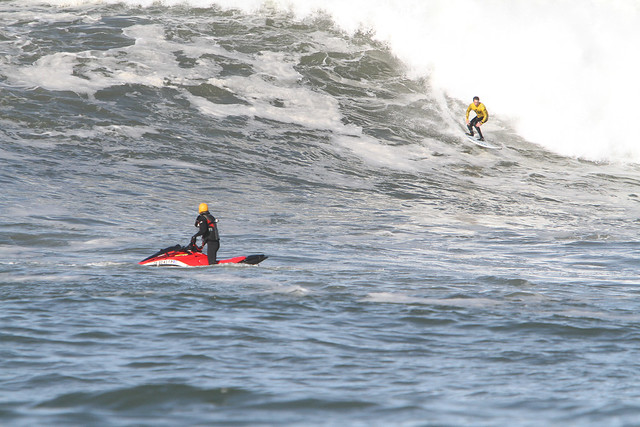
I think being caught in a wave in one’s life is one of the most humbling things around. All your ideas of yourself as a competent, together adult just fall to pieces, and you are just in the raw reality of your response, which may be very unimpressive. Being humbled is not such a bad thing, actually. From a place of humility there is room for learning, and for receiving. You have fallen, and those who love you carry you in their arms. Those people who ride giant waves are supported by other surfers on jet skis, who risk their own life in the waves by going in and rescuing a fallen friend. Sometimes you can be the rescuer, sometimes you are rescued. Both roles are important, both need the other.


As part of exploring this question, I wanted to talk to someone who really knew about waves, first-hand. I had a long chat with a friend who is also a Zen priest, and a life-long fanatical surfer.

 What I realized, talking with him, is that, to a surfer, every wave you ride makes you stronger, makes the body wiser and more able to ride the next wave. A surfer rides the waves with the body’s wisdom, not the mind’s. Surfers fall over and over again, and get up and meet the next wave. Learning to ride the waves of life is like that too. I want to tell the older people here that this is a place where age and experience are a tremendous advantage.

You might be surprised at the story of the genesis of Outward Bound, the famous wilderness survival school. Outward Bound is a nautical term for a ship leaving behind the safety of the harbor for the open sea. The school was developed in the 1930s because it had been noticed that when there was a shipwreck at sea, paradoxically the older, more experienced sailors were more likely to survive than the younger, stronger sailors. Apparently, with shipwrecks, as with many other things, practice matters. We learn something each time we fall, each time we’re shipwrecked.

Falling is not a mistake; it’s what we need to meet the next wave, to build our capacity for uncertainty, for joy in the face of hardship, for compassion, for resilience. We aren’t born with these qualities; they are forged in the waves.

And this is where I think compassion is the most important thing: compassion for yourself if you have fallen, if the wave is too much for you, and compassion for others, for the whole world, all of us caught in the waves in one way or another.

Take a moment to think about your own resources, your own hard-earned life wisdom about how best to ride – or fall- in the waves....

I asked my friend the surfer/Zen guy about what it was like when he got caught in a wave, and I thought he’d give me some deep wise Zen answer. You know what he said? He said, when I’m caught in a wave, all there is is fear. There’s no room for anything else, no time for big thoughts or nice ideas (on second thought, maybe this really is a deep wise Zen answer). There is just “Help!” and hardly even that. And this reminds me of the story about ways to pray, that there are really only two kinds of prayer: Help, and Thank You.  And I would add perhaps, a third, wordless prayer, from the story of my friend and the grizzly: awe.

Finally, all waves have their end, subside into foam, re-enter the sea. That terrible grief, that tremendous confusion, that desperate love, eases, eventually, miraculously. Waves are impermanent, just as we are. As solid and overwhelming as they can seem, they have their time and then they change. We do too, whether we have ridden the wave or struggled in the foam, our life carries us past and into new waters.


I want to close with an inspiring quote from our old friend Henry David Thoreau:

You must live in the present, launch yourself on every wave, find your eternity in each moment. Fools stand on their island opportunities and look toward another land. There is no other land, there is no other life but this.

Friday, April 6, 2012

Big Waves


Sometimes you are going along, living your daily life with all its small joys and small sorrows, and in a moment, in a split-second, everything changes. The earthquake, the tsunami, the moment of violence, one of the infinite forms of the shockingly unexpected breaks over you; your world pivots on its axis, and when you look up, your life is no longer what it was.
Last Friday I was at Tennessee Valley Beach, north of the Golden Gate Bridge in Marin County, California. As you approach the beach through the gentle rolling hills that flank the valley, it looks placid, even a little dull. But at the last moment, where the path shifts to sand, the view opens up to magnificent, cormorant-strewn, awe-inspiring cliffs, as stark and uncompromising as the rugged cliffs of the Scottish Isles. I walked with a friend through the gray, foggy valley, and when we arrived at the beach, the waves were big, thundering up against the cliffs, the wind catching the crests and blowing the foam back like the manes of giant white horses.

Each wave had its own signature, as it encountered the coastline, each one shaped by wind and current into a unique form. I could have watched all afternoon, taking photographs of the beautiful meetings of rock and ocean. My friend wandered off toward the hills, and I stayed on the sloping beach twenty feet or so from the waves, camera in hand.

Then, in a moment, everything changed. A wave, one that seemed just like the others as it approached me, came on to the beach - and kept coming. I looked down and saw the line of foam coming my way, and then I turned and ran toward higher ground, laughing a little to myself. But the wave was faster than I was, and reached me just as I stepped into a patch of saturated sand that caught and held me as I sank into it. I fell to my knees, no longer laughing, and the wave came over the berm and surrounded me, filling up the lower area of the beach where I was.
I scrambled up, holding my camera above the water, soaked to the waist and frightened, realizing that no one could see me on this part of the beach, and that I must find a way to get out of the water before the wave turned and headed back oceanward, carrying me with it. I made it to a higher area and then watched the water continue to fill where I had been, turning the moments-before bare sand beach into a swirling, deep pool. Then, as the wave retreated, its force was strong enough to erode the area where I stood, and I had to move still further away as the wave ate away at my refuge.
Photo by Paphio, Flickr
Afterward I stood and watched the waves again, and they were as they had been before, breaking many feet away, acting just as one would expect waves to act. My friend returned and I explained what had happened, though it must have seemed unreal, a story from dream or nightmare. I had heard of "rogue waves," but had never really believed that people could be swept off beaches into the ocean by a wave they never saw before it engulfed them.
We watched for a long time, and no wave came up the beach and over the berm again. I was wet but fine. Nothing much had happened, but my body knew that it had felt a moment where everything could have changed, when a great force meets an individual life and wrenches it, irrevocably, into a new story, or the end of the story.
*     *    *    *
I have another friend who spent years as a climbing guide in Nepal and South America, but later returned to his hometown (and mine) in Indiana. We try to have adventures together, every once in a while. Our best one was a few years ago, when we spent a joyous few days climbing together in Joshua Tree, sleeping out on big slabs of granite, walking the sandy washes, laughing and joking and eating camp food. My memories of that trip are still vivid and sweet. 

Over the years I have tried to talk him into finding a way back to the mountains and wilderness, but until recently he could never figure out a way to make it happen. But, finally, over the last year, he had fallen in love with southern Colorado, and he was getting ready to move. I was so happy for him.
Although I didn't know it when I encountered the wave on the beach, that same morning my friend was attacked, caught in another kind of rogue wave. He was back in my hometown, working on his house, and he had been arguing with some teenage boys about littering in the alley. They had sworn at him and threatened to "get him." Later he saw them a block away, and several boys surrounded him. He fended off blows, and then one of the boys hit my friend in the face. He fell, knocked unconscious by an enormous, unexpected blow, the tsunami, the earthquake, the pivot. When he came to consciousness, blood everywhere, unable to see clearly, he saw the blurred form of the boys, running away, and laughing.
They had focused only on his face, using some kind of weapon - brass knuckles or something else. They had done enormous damage. It had been deliberate and violent, sadistic, intentional. He was rushed to the local hospital, and then to the trauma hospital an hour and a half away. A few days later he underwent face reconstruction surgery, more than eight hours on the table while three surgeons painstakingly rebuilt bone and cartilege. And my friend does not have insurance.
And the frightening "boys" who did such damage, and who laughed as they ran away, have not been arrested yet.
I found out about the attack on Saturday, as I was preparing for a potluck birthday party - my own birthday party, as a matter of fact, a couple of days early. And I felt my life pivot too, with grief and sorrow. Suddenly a celebration no longer mattered, was no longer possible. I cried  - for him, for everything that had changed with the attack, for a world where this is possible, for the strange fate that had brought him under those fists, in conjunction with those murderous boys, just as he was preparing for a new life. Every day these things happen to strangers in unfamiliar places, and we read about them in the newspaper, but I knew the exact place my friend had been attacked: I had grown up just a stone-throw away, played in the alley where he was surrounded, intimately know the houses and streets around him.  I knew his face, his smile, his laugh.
Always, when these things happen, there's a desperate longing to go back and make it happen differently: don't go down that alley, don't argue with those boys, don't stand on that beach. But time seems more irrevocable and implacable at these moments than it does in ordinary life. There is no going back.
I remember realizing, in my early twenties, that I tended to think of life as basically stable, and accidents or disasters as some kind of mistake, some wrongness intruding into the peace of "just living." But of course, disasters are as much part of life as any other moment, and just as inevitable.
A few years ago I saw the documentary Riding Giants, about the guys who ride the largest waves in the world. When everyone else retreats from the beach, these guys go and meet thirty-foot waves and launch themselves into them. There's no second-guessing and no turning back once they're committed. To turn back or hesitate is to be pulverized by the wave.
Photo by Rick Bucich (Flickr) of Zach Wormhoudt, Maverick's Surf Competition 2010
I was mesmerized by the film. At the time I saw it, I was grieving the violent death of a beloved cat, and struggling with a chronic illness, and I felt caught in the waves of my life, tumbled around, lost and gasping for air. But what I saw on the screen was a radically different approach: a willingness to play in the big waves that come our way, to ride them, to let their power carry us, to not turn away.
Several days after the attack I had a chance to talk with my friend (amazed that he could talk at all, given his injuries) and I saw the same quality of willingness in him that I had seen in Riding Giants: he was riding the giant wave of what had happened to him, not fighting it, not being pulverized by it. Maybe it's due to all his years as a climber on the high peaks of the Himalayas, facing disaster with every rockfall and avalanche, but I heard not one whine from him in our conversation, and I was talking to a guy who had every reason to whine, every reason to be completely freaked out. But instead, he was clear and calm. He calmed me, which was a little bit embarrassing.
At the end of our conversation I realized that I had my own story backwards. I had been feeling sorry for myself - all these disasters ruining my birthday - when actually I had been given the finest birthday present of all: my friend was alive.
I think perhaps this is a big part of the reason that I practice Zen, sitting on a black cushion every morning in front of my altar, spending big chunks of my life in silent retreats. I want to learn to ride giants, to cultivate a mind steady enough to turn toward the wave, for myself and for others. When a surfer rides a really big wave, and gets caught, his only hope is to be rescued by his friends, who go in on a jet-ski, risking their own lives, to pull him out. They know the next time may be their turn.
Photo by Rick Bucich (Flickr), Maverick's Surf Competition 2010 
I'm not naturally very tough or very brave - not like my friend - but I figure that every moment that I can bear what's going on in my mind and body as I sit in silence, even if it's only a little bit uncomfortable, a little bit unbearable, I am cultivating a tiny bit more capacity for the waves. Maybe one day I too can ride giants, play in the rogue waves when they come rolling in, and learn to surf the big mysteries of life and loss and death. That's my wish, for myself and every one of us. 
And if it gets to be too much, I hope all of us have friends who can go in there with us, reach out a steady hand, and bring us to shore.